- Plants
- ›Vascular Plants
- ›flowering plants
- ›Dicots
- ›carrots, ivies, and allies
- ›carrot family
- ›Apioideae
- ›Oenantheae
- ›Oenanthe
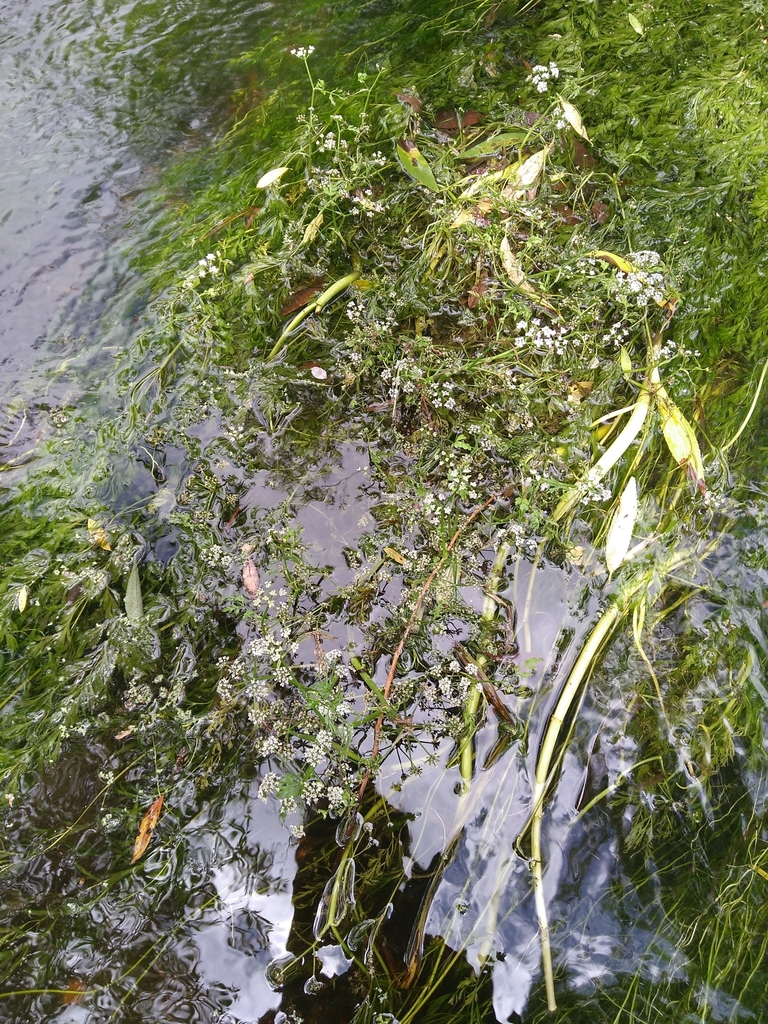
River Water-dropwort
Oenanthe fluviatilis
Oenanthe fluviatilis, the river water-dropwort, is a flowering plant in the carrot family, Apiaceae, which is endemic to north-west Europe. It grows only in clear, unpolluted rivers and is declining throughout its range.
From the article Oenanthe fluviatilis on Wikipedia (CC BY-SA), quoted section by section
Description
River water-dropwort is a hairless perennial with hollow, ridged stems up to 1 m long, submerged or floating in rivers, or emergent in marginal swamps and during periods of low flow in summer. The stems creep along the surface of mud, or on the bottom of a river, rooting at the nodes. These extend upwards through the water column, becoming thicker as they ascend, to a diameter of about an inch (2.5 cm), with a central hollow about half that size. Young plants have tubers, which disappear as they mature, leaving just fibrous roots.
The lower, underwater leaves are once to twice pinnate, with distinctive cuneate (diamond shaped) segments which are deeply divided into almost linear lobes (especially so in faster-flowing water), with petioles as long as the leaf. These submerged leaves remain green throughout the winter but the plants are much reduced, hugging the bottom of the channel. In the summer, the upper, aerial, leaves sometimes form: they are 1-3 times pinnate with ovate, lobed segments about 1 cm long, and have petioles about one third the length of the blade. The petioles on both forms are solid and produce a sheath around the stem at their base. The inflorescence is a compound umbel of 5-10 small, hemispherical umbellules, arising from the leaf nodes or from the tip of the stem. The rays do not thicken after flowering, as they do in some other species of dropwort. …
Range & habitat
River water-dropwort is entirely confined to North-west Europe, being recorded only in Ireland, England, Germany, Austria, France, Denmark and the Low Countries. In a global context it is considered to be Near Threatened (NT), with a population trend that is decreasing. It is possibly extinct in Germany. In Britain, it was first recorded by Coleman in about 1841 on the River Lea in Hertfordshire, where it still grows. Earlier findings have been traced, such as a partial specimen collected by Robert Plot in the 1670s from Oxfordshire. It is currently known in at least 28 English counties and it appears to have been lost from a further 14. It does not occur in Wales or Scotland, but in Ireland it is found in some 26 counties (and lost from maybe half a dozen), mostly in the centre of the island. The conservation importance of river water-dropwort is very high: it is entirely confined to clear, unpolluted river systems; it has a very restricted global distribution; and it is rare and decreasing across its range. In these regards, it is similar to highly protected species such as floating water-plantain. In Britain, it is classed as Least Concern, although it of international importance. …
Wikipedia: “Distribution and status”
What it does
River water-dropwort grows in clean, hard-water lowland rivers, i.e. rivers that drain geological strata with high levels of soluble calcium (chalk, limestone and various soft rocks). In the Alsace region of France, it has been found to be associated with river water-crowfoot, hornwort, fennel pondweed and perfoliate pondweed in the more eutrophic, slow-flowing reaches of that part of the Rhine, where dissolved ammonia (N/NH4) is about 45 μg/L, phosphate (P/PO4) is about 33 μg/L and calcium levels are very high (100 ppm Ca++). The River Itchen in Hampshire is typical of its habitat in Britain. In this chalk stream it grows in a community of Ranunculus penicillatus, Sparganium emersum, Schoenoplectus lacustris and Groenlandia densa, and it is associated with a wide variety of rare and protected species. Its Ellenberg values in Britain are L = 8, F = 11, R = 8, N = 6, and S = 0.
Wikipedia: “Habitat and ecology”
At the table
There are very few references to this species in literature, presumably because it is so little-known. However, D.E. Allen reports that an infusion of "water-fennel" was once used in County Wicklow as a treatment for rheumatism, although he questions whether O. fluviatilis was really the plant in question.
== References ==
Wikipedia: “Uses”
Where it lives
Recorded sightings
—
geo-referenced records in GBIF, from museums, herbaria and field observers.
Drag the globe to turn it. Dots are where records exist, not a range map; darker means more records.
In the stacks
Searching the stacks…
Every page naming Oenanthe fluviatilis in the Biodiversity Heritage Library →
This page is assembled live from iNaturalist, GBIF, Wikipedia, the Source Library and the Internet Archive. It is not yet part of the hand-edited codex. iNaturalist taxon 359464.