- Plants
- ›Vascular Plants
- ›flowering plants
- ›Dicots
- ›carrots, ivies, and allies
- ›carrot family
- ›Apioideae
- ›Oenantheae
- ›Oenanthe
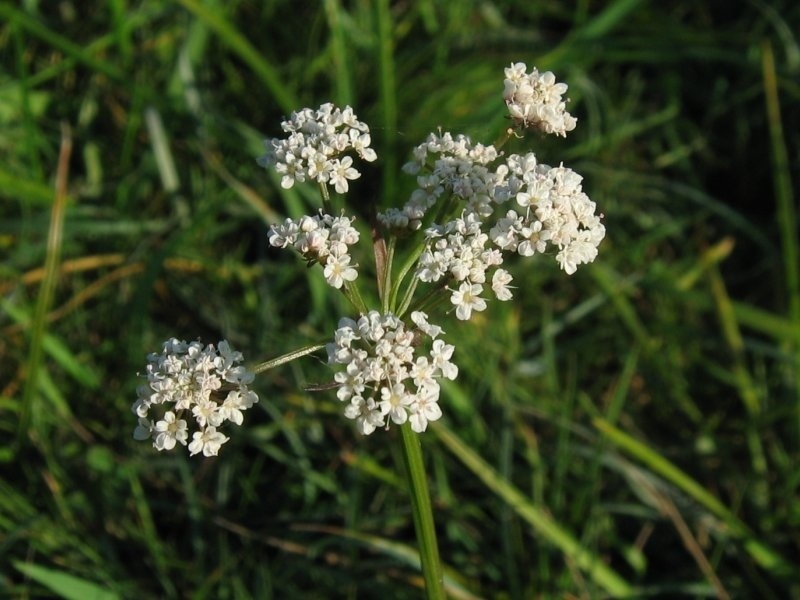
Parsley Water-dropwort
Oenanthe lachenalii
Oenanthe lachenalii, parsley water-dropwort, is a flowering plant in the carrot family, which is native to Europe and parts of North Africa. It is a declining plant of coastal wetlands.
From the article Oenanthe lachenalii on Wikipedia (CC BY-SA), quoted section by section
Description
Parsley water-dropwort is a hairless perennial growing up to 100 cm tall with solid (sometimes becoming hollow with age), striated, cylindrical stems 0.4 cm in diameter. The roots are somewhat swollen, cylindrical in shape, but lacking the distinct tubers that occur in some other members of the genus. The upper leaves are once to twice pinnate with simple linear leaflets up to 5 cm long; the lower ones are twice pinnate, with wider, flat leaflets, more like those of other umbellifers. The leaf stalks are shorter than the leaf blade, sheathing the stem at the base, and with a celery scent. It flowers between June and September in northern Europe, with umbels of 5-9 smaller umbels about 1-2 cm in diameter, each of which has numerous white flowers. There are about 5 awl-shaped bracts on the main umbel and 5-7 small bracteoles at the base of each of the individual umbellules. Plants are monoecious, with hermaphroditic and male flowers in all umbels, but the proportion of hermaphroditic flowers decreases as the season progresses. Each flower has 5 unequal petals with the larger, outer ones slightly larger, 5 stamens and 2 prominent styles arising from a swollen base (stylopodium) at the top of the ovary. After flowering, the flower stalks do not expand (as they do in some other species of water-dropwort) and the umbels do not become flat-topped.
Range & habitat
The global range of parsley water-dropwort is in Western Europe as far as Poland and Greece, extending northwards to southern Scandinavia and southwards as far as the coast of Africa. It is not recorded as an introduction beyond its natural range.
In Britain, it is classified as Least Concern, meaning that it is not rare nor declining at a particularly high rate. It is, however, under threat, especially inland. In England, it has been assessed as decreasing by 24% between 1969 and 1999, and in one English county, Kent, by as much as 41%, although it is still not scarce. Causes of decline include drainage of wetlands and agricultural intensification. It is considered an axiophyte in any British county. In France, it is widespread and classified as Least Concern, indicating that populations are generally stable, overall. However, it is rare and threatened in some inland régions such as Alsace, where it is Critically Endangered (CR) and Île-de-France (Endangered, EN). In the Auvergne it is thought to be extinct, or 'locally extirpated'.
Wikipedia: “Distribution and status”
What it does
This is a wetland plant, occurring primarily in slightly brackish grassland close to the coast. It is also found in freshwater inland marshes, particularly in France and Spain. In Britain, its ecological preferences are described as varying from the upper part of salt marshes, through brackish dykes to base-rich fen-meadows inland. It is fairly common around the coast of both Britain and Ireland, with the exception of northern and eastern Scotland. Its Ellenberg values in Britain are L = 8, F = 8, R = 8, N = 5, and S = 3. In the Aiguamolls de l'Empordà, in Spain, studies show that it occurs in a variety of habitats, from tall fescue/meadow barley meadows with wild celery, saltmarsh rush and narrow-leaved bird's-foot trefoil, to wetter water finger-grass/divided sedge grassland and through to brackish marsh with annual beard-grass, sea aster and Somerset rush.
Wikipedia: “Habitat and ecology”
At the table
Although it can be a component of hay meadows, parsley water-dropwort is considered to be poisonous to livestock, albeit not as toxic as hemlock water-dropwort. No part of the plant is edible by humans, and it appears to have no commercial uses.
== References ==
Wikipedia: “Uses”
Where it lives
Recorded sightings
—
geo-referenced records in GBIF, from museums, herbaria and field observers.
Drag the globe to turn it. Dots are where records exist, not a range map; darker means more records.
In the stacks
Searching the stacks…
Every page naming Oenanthe lachenalii in the Biodiversity Heritage Library →
This page is assembled live from iNaturalist, GBIF, Wikipedia, the Source Library and the Internet Archive. It is not yet part of the hand-edited codex. iNaturalist taxon 359463.