- Plants
- ›Vascular Plants
- ›flowering plants
- ›Dicots
- ›Heathers, Balsams, Primroses, and Allies
- ›Lecythis Family
- ›Lecythis
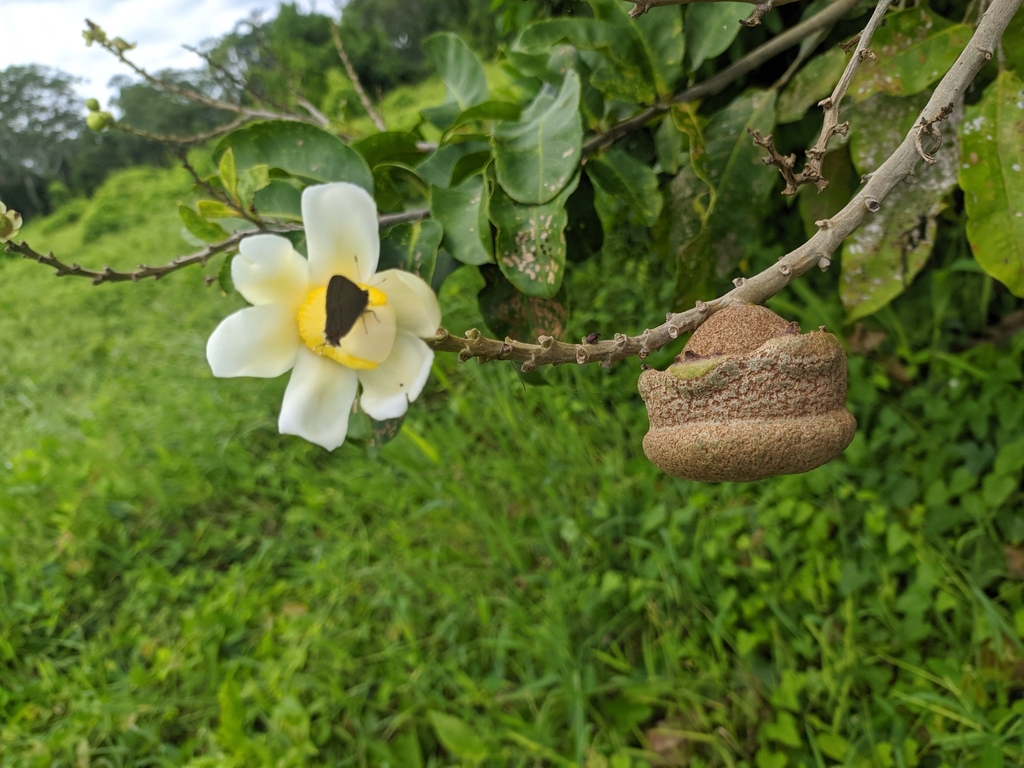
Lecythis minor
Lecythis minor, the monkey-pot tree, is a small tree with toxic seeds that occurs in South America.
From the article Lecythis minor on Wikipedia (CC BY-SA), quoted section by section
Description
Lecythis minor is a small to medium-sized tree that ranges from 5–25 m (16–82 ft) in height and has a 70 cm (28 in) diameter at breast height. Its bark is grey, and is smooth when the tree is young but develops deep vertical fissures as the tree ages. It has ovoid leaves that are about 8.5–24.5 cm (3.3–9.6 in) long and 4.5–10 m (15–33 ft) wide. The leaves are glabrous and coriaceous, with serrated margins. The leaves have 12 to 19 pairs of lateral veins, and the leaf stalks are 5–20 mm (0.20–0.79 in) and puberulous. The flowers of Lecythis minor are arranged on a rachis, being 10–35 cm (3.9–13.8 in) long, and the inflorescences are white to yellow, green while budding. Each rachis has 10 to 75 flowers, and the rachides are pubescent. The fruit of the tree have a distinct cup shape representative of the genus Lecythis, and are spherical with a 7.5–11 mm (0.30–0.43 in) thick pericarp. The seeds are reddish-brown and fusiform, and contain toxic amounts of selenium. The seeds tolerate a very low pH.
Range & habitat
Lecythis minor is common in South America. It ranges from the Maracaibo lowlands of Venezuela to the northern coast of Colombia where it ascends the Magdalena and Cauca valleys. It was introduced in many other places in South America as well, from La Lima in Honduras to Soledad in Cuba. It occurs in dry, open, and disturbed habitats, where it grows as a small and many-branched tree. It can also be found in moister forests where it forms a taller, single-trunked tree. It grows especially well along rivers in tropical forests. The tree tolerates an annual precipitation of 9.1–22.8 dm (36–90 in), an annual temperature of 24.4–26.5 °C (75.9–79.7 °F), and a soil pH of 5.0 to 8.0. The tree is pollinated by bees and seeds are dispersed by fruit bats.
Wikipedia: “Habitat and ecology”
At the table
It is cultivated as an ornamental tree in many places, such as the Summit Gardens in Panama. The nuts of the tree are collected when ripe, and the tree can produce fruit as young as 2 m (6 ft 7 in) tall. In indigenous medicine, the fruit is supposedly antiasthmatic and depilatory.
Wikipedia: “Uses”
Where it lives
Recorded sightings
—
geo-referenced records in GBIF, from museums, herbaria and field observers.
Drag the globe to turn it. Dots are where records exist, not a range map; darker means more records.
In the stacks
Searching the stacks…
Every page naming Lecythis minor in the Biodiversity Heritage Library →
This page is assembled live from iNaturalist, GBIF, Wikipedia, the Source Library and the Internet Archive. It is not yet part of the hand-edited codex. iNaturalist taxon 357310.