- Plants
- ›Vascular Plants
- ›flowering plants
- ›monocots
- ›Aroids, Water Plantains, Seagrass, and allies
- ›Arum Family
- ›Aroideae
- ›Arum tribe
- ›Arum
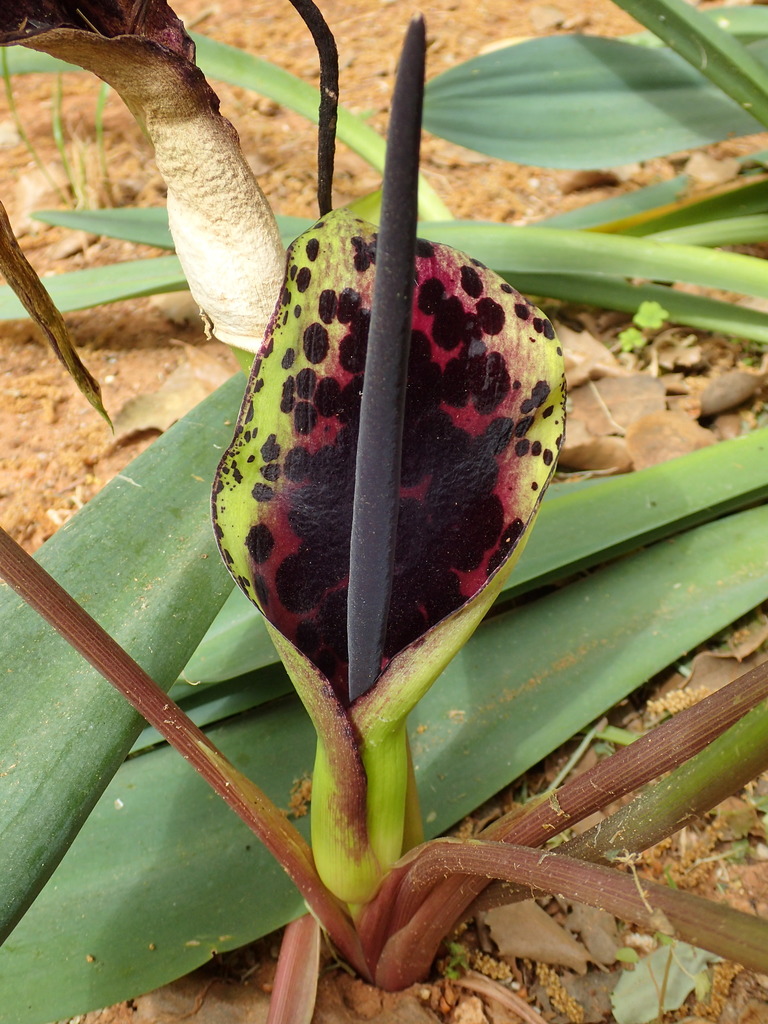
Dioscorides Arum
Arum dioscoridis
Arum dioscoridis, commonly known as the Spotted arum, is a plant of the arum family (Araceae).
The plant was described by James Edward Smith in Flora Graeca (1816). The species is named after the ancient Greek physician and botanist Pedanius Dioscorides.
From the article Arum dioscoridis on Wikipedia (CC BY-SA), quoted section by section
Description
In winter appear green, arrow-shaped leaves. In spring, the short-stalked inflorescence appears consisting of a black, rod-shaped spadix surrounded by a yellow-green, purple-mottled brown or even purple bract (spathe). The color pattern of the spathe is variable, and multiple varieties have been described based on different patterns. The female flowers are located at the bottom of the spadix; above are the male flowers; and the top is a sterile area (appendix). The spadix emits a pungent smell that attracts flies as pollinators. By relative inflorescence height, Arum species are divided into "cryptic" species, whose inflorescences are borne on a short peduncle amid or below the leaves, and "flag" species, whose inflorescences are above leaf level at the end of long peduncles. A. dioscoridis is a cryptic species.
How it is grown
The plant can be grown as an ornamental plant in rock gardens Mediterranean regions. In the Benelux, the plant can be grown indoors as a pot plant. The plant can be propagated by seeding.
Wikipedia: “Cultivation”
Where it lives
Recorded sightings
—
geo-referenced records in GBIF, from museums, herbaria and field observers.
Drag the globe to turn it. Dots are where records exist, not a range map; darker means more records.
In the stacks
Searching the stacks…
Every page naming Arum dioscoridis in the Biodiversity Heritage Library →
This page is assembled live from iNaturalist, GBIF, Wikipedia, the Source Library and the Internet Archive. It is not yet part of the hand-edited codex. iNaturalist taxon 356279.