- Plants
- ›Vascular Plants
- ›flowering plants
- ›Dicots
- ›Mints, Plantains, Olives, and Allies
- ›bignonia family
- ›Jacarandeae
- ›Jacaranda
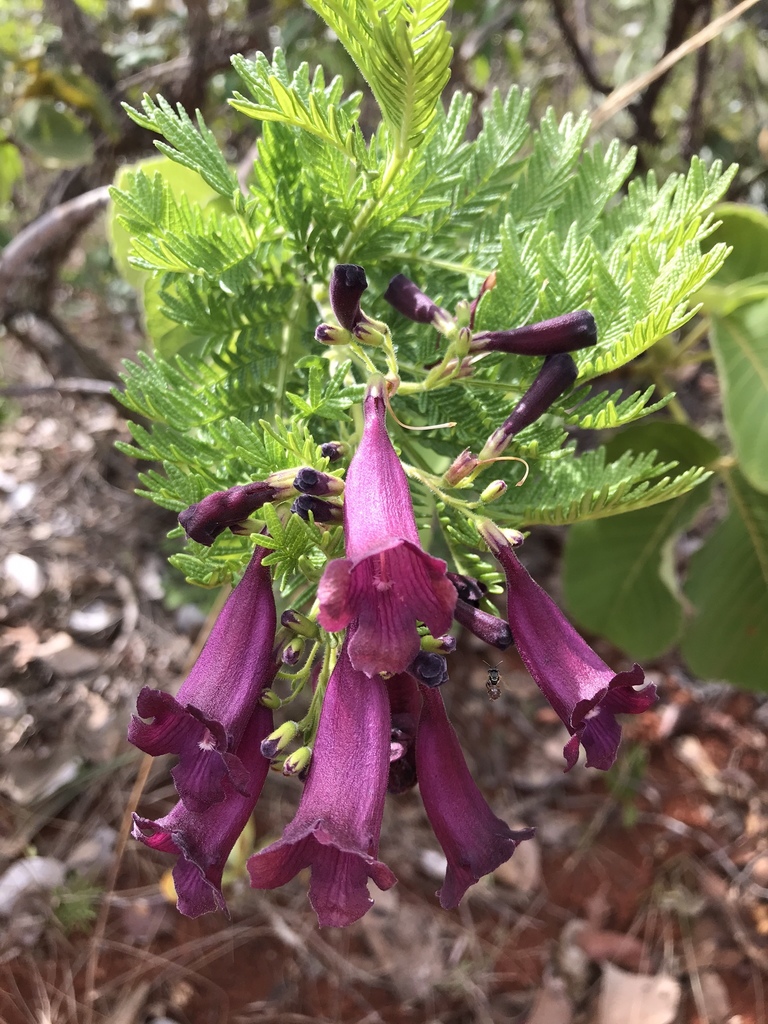
Jacaranda ulei
Jacaranda ulei is a flowering tree native to the Cerrado region of Brazil. It was first described by Édouard Bureau and Karl Moritz Schumann in 1897.
From the article Jacaranda ulei on Wikipedia (CC BY-SA), quoted section by section
Description
Jacaranda ulei is a small tree, growing to between 0.6 metres (2 ft 0 in) and 1.5 metres (4 ft 11 in) tall. The leaves are 6 to 10 cm (2.4 to 3.9 in) in length and bipinnate, having between 8 and 12 pinnae and 6 to 16 leaflets. Leaflets are 15 to 20 cm (5.9 to 7.9 in) long, 3 to 5 cm (1.2 to 2.0 in) wide and "narrowly oblong" in shape. The flowers are deep purple in colour and arranged in a branched, Panicle form. They are 5 to 10mm long and 4 to 7 mm wide with 5 shallow dentate. The fruit is woody and "round to elliptic" in shape, growing 3.5 to 5.5 cm (1.4 to 2.2 in) long and 3 to 4 cm (1.2 to 1.6 in) wide. The species is a resprouter, with its root system allowing it to survive wild fires and droughts seen in the savanna ecosystem of the Cerrado region of Brazil.
At the table
The roots of the plant have been used as a traditional folk remedy to treat urinary tract infections, amoebiasis, backache, rheumatism and skin disorders.
== References ==
Wikipedia: “Uses”
Where it lives
Recorded sightings
—
geo-referenced records in GBIF, from museums, herbaria and field observers.
Drag the globe to turn it. Dots are where records exist, not a range map; darker means more records.
In the stacks
Searching the stacks…
Every page naming Jacaranda ulei in the Biodiversity Heritage Library →
This page is assembled live from iNaturalist, GBIF, Wikipedia, the Source Library and the Internet Archive. It is not yet part of the hand-edited codex. iNaturalist taxon 355670.