- Plants
- ›Vascular Plants
- ›flowering plants
- ›Dicots
- ›Buttercups, Poppies, and Allies
- ›buttercup family
- ›Columbines and Meadow-Rues
- ›Thalictrum
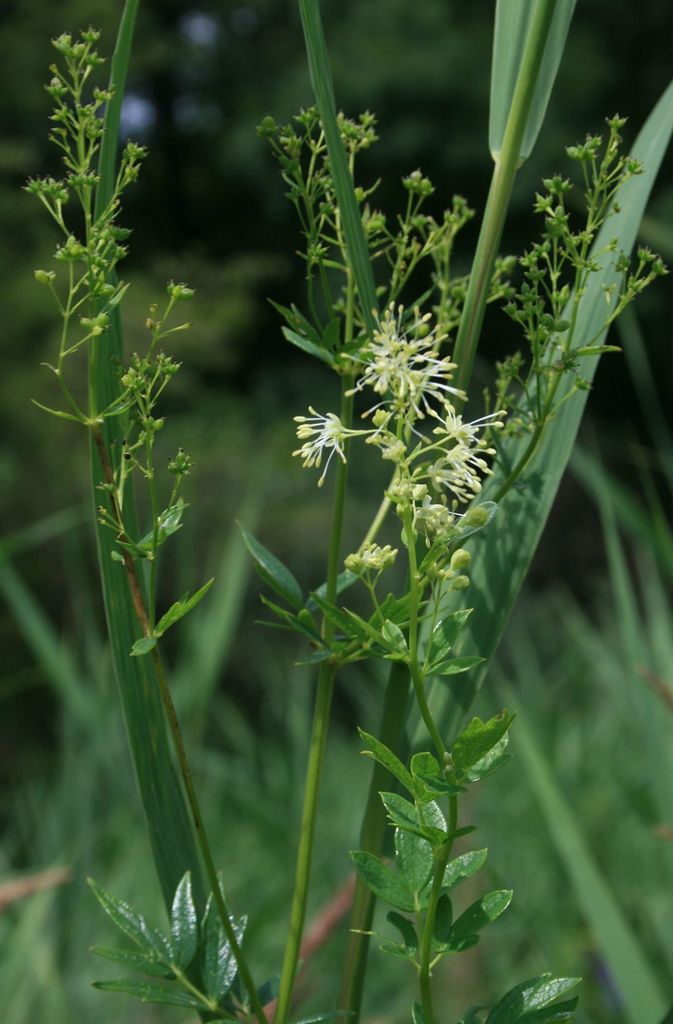
Common Meadow-rue
Thalictrum flavum
Thalictrum flavum, known by the common names common meadow-rue, poor man's rhubarb, and yellow meadow-rue, is a flowering plant species in the family Ranunculaceae. Its native range covers temperate regions of Eurasia and North Africa. Growing to 100 cm (39 in) tall by 45 cm (18 in) broad, it is an herbaceous perennial producing clusters of fluffy yellow fragrant flowers in summer.
From the article Thalictrum flavum on Wikipedia (CC BY-SA), quoted section by section
Description
Thalictrum flavum has fibrous roots, and wedge-shaped, dark green leaves, with a paler green underneath; they are divided into multiple sections. It blooms between June and August. The flowers are composed of short sepals and longer, erect stamens. The sepals are actually white, but the multiple erect, yellow stamens, give the flower a yellow appearance. Later, three fruits are formed from each flower head.
Phytochemistry. The plant contains an enzyme called pavine N-methyltransferase, which modifies a variety of benzylisoquinoline alkaloids including the eponymous alkaloid pavine. Benzylisoquinoline alkaloids like pavine often have a variety of pharmacological actions, and as a result some have medical uses such as analgesic or anticancer effects while others have significant toxicity. T. flavum also contains another benzylisoquinoline alkaloid, thalidezine, which is also present in other Thalictrum species.
Range & habitat
It is very widespread, and is native to temperate regions of Asia, Northern Africa and Europe.
Range. It is found in Northern Africa within Algeria. In Europe, it is found in (Eastern Europe) Belarus, Estonia, Latvia, Lithuania, Ukraine, (Middle Europe), Austria; Czech Republic, Germany, Hungary, Poland, Slovakia, Switzerland, (northern Europe) Denmark, Finland, Ireland, Norway, Sweden, United Kingdom, (southeastern Europe) Albania, Bosnia and Herzegovina, Bulgaria, Croatia, Italy, Montenegro, North Macedonia, Romania, Serbia, (southwestern Europe) France and Spain. In Asia, it is found in the Caucasus, (within Azerbaijan and Georgia) Russian Federation, (within Amur and Primorye), China, (Xinjiang,) Kazakhstan, Siberia and Turkey.
It has naturalised in the UK, and found in southern and western England, as well as in Scotland and Ireland.
Habitat. It is found generally in grasslands, marshy fields, fens and riverbanks.
Wikipedia: “Distribution and habitat”
What it does
It is pollinated mainly by flies and bees, with wind dispersal of the seeds. The larva of the Perizoma sagittata (Marsh Carpet moth) are found on the plant, eating the seeds and the flowers.
Wikipedia: “Ecology”
In medicine
It has been used in folk medicine in the UK, the foliage has been used a purgative.
Wikipedia: “Medicinal”
Where it lives
Recorded sightings
—
geo-referenced records in GBIF, from museums, herbaria and field observers.
Drag the globe to turn it. Dots are where records exist, not a range map; darker means more records.
In the stacks
Searching the stacks…
Every page naming Thalictrum flavum in the Biodiversity Heritage Library →
This page is assembled live from iNaturalist, GBIF, Wikipedia, the Source Library and the Internet Archive. It is not yet part of the hand-edited codex. iNaturalist taxon 354776.