- Plants
- ›Vascular Plants
- ›flowering plants
- ›monocots
- ›palms, bullanocks, and allies
- ›palms
- ›Coryphoideae
- ›Caryoteae
- ›Arenga
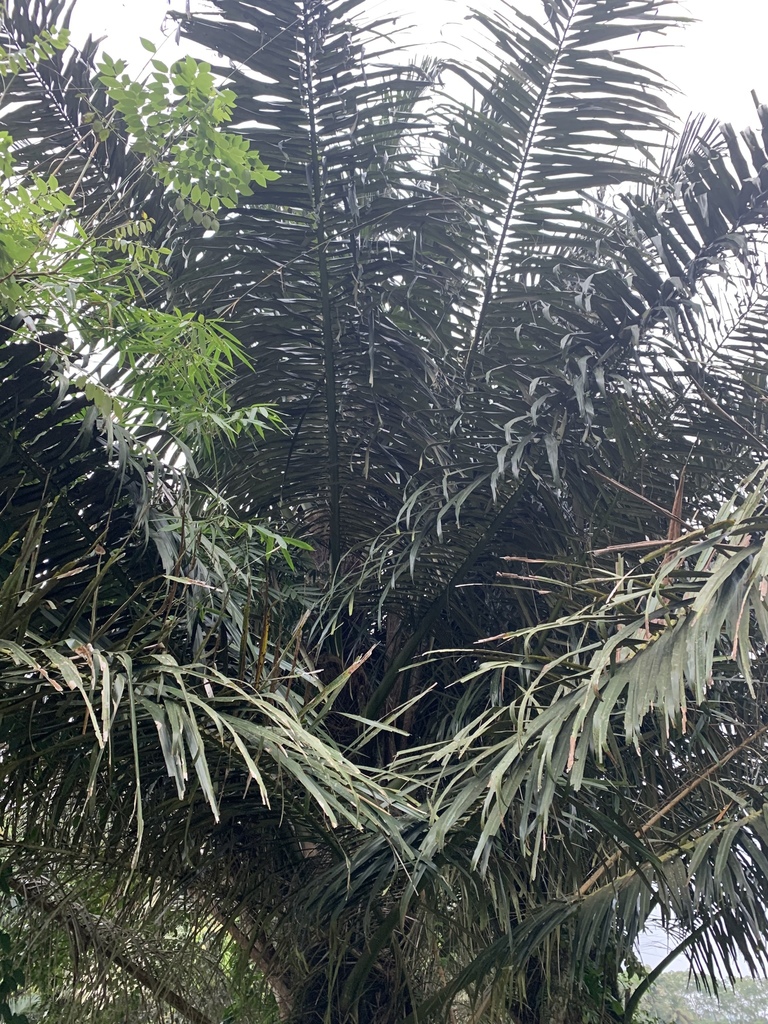
Sugar Palm
Arenga pinnata
Arenga pinnata (syn. Arenga saccharifera) is an economically important feather palm native to tropical Asia, from eastern India east to Malaysia, Indonesia, and the Philippines in the east. Common names include sugar palm, areng palm (also aren palm or arengga palm), black sugar palm, and kaong palm, among other names.
From the article Arenga pinnata on Wikipedia (CC BY-SA), quoted section by section
Description
It is a medium-sized palm, growing to 20 metres (66 feet) tall, with the trunk remaining covered by the rough old leaf bases. The leaves are 6–12 m (20–39 ft) long and 1.5 m (5 ft) broad, pinnate, with the pinnae in 1–6 rows, 40–70 centimetres (16–28 inches) long and 5 cm (2 in) broad. The fruit is subglobose, 7 cm (3 in) diameter, green maturing black. The palm is remarkable in two ways; first it is fast growing. One at the conservatory of the New York Botanic Garden grew to a height of 27 m (89 ft) in 25 years. Secondly it has very long pseudo-spines which look dangerous, but are not; possibly an example of Batesian mimicry.
What it does
A. pinnata suffers from the red palm weevil, Rhynchophorus ferrugineus, and is one of its major hosts in China. It is not a threatened species, though it is locally rare in some parts of its range. It serves as an important part of the diet of several endangered species, including cloud rats of the genus Phloeomys.
Wikipedia: “Ecology”
At the table
Many products of the palm are used, as food, as construction materials, and for other purposes.
Sap. The sap is harvested for commercial use in southeast Asia, yielding a sugar known as gur in India, gula aren in Indonesia, and pakaskas in the Philippines. The sap is collected and made as lahang, a traditional cold sweet drink, and is also fermented into vinegar (Filipino sukang kaong), palm wine (Filipino tubâ, Malaysian and Indonesian tuak, in eastern Indonesia sageru), which in turn is distilled into a spirit (sopi in Maluku, cap tikus in North Sulawesi). Edmund Roberts talks about drinking an alcoholic beverage made in the Cavite area. He described it as a "fermented" and "intoxicating liquor". He said that it was "the pith furnished with sugar – when the liquor was properly boiled down, a farina...and of the inside of its triangular-shaped fruit a sweet bread was made." Sugar (jaggery) is also commonly derived from the fresh sap in Indonesia and the Philippines. These are traditionally prevented from fermenting by placing crushed chili or ginger in the collecting container. The sap is boiled until it reduces to a thick syrup which is then dried into a brown sugar. Similar sugar extraction methods are also traditionally used for other sugar palms, such as the buri palm (Corypha elata). The raw juice and pulp are caustic. …
Wikipedia: “Uses”
In human culture
In the Philippines, an annual Irok Festival is celebrated in the municipality of Indang in Cavite which is a major producer of kaong fruits, sukang kaong, and tubâ in the country. Irok is a local name for Arenga pinnata in the northwestern Philippines. The world's first ever crossword puzzle, labelled "Word-Cross" in the 21 December 1913 edition of New York World newspaper's Sunday Fun supplement and created by Arthur Wynne, a Liverpool, UK-born journalist, included a clue: The fibre of the gomuti plant. The answer was doh. In some areas of southern Thailand, such as Ban Khlong Bor Saen and Bang Toei, Phang Nga, cultural beliefs associated with Arenga pinnata are prevalent. The trees are intertwined with the locals' lives and serve as a source of income for the villagers over generations. The locals typically call this plant Chok (Thai: ชก) or Nao (Thai: เหนา) . However, it has a nickname "Ton Luk Kha Mae" (Thai: ต้นลูกฆ่าแม่) which means a child kills its mother, as the Arenga pinnata in those areas can produce fruits only once in its lifetime and it will perish within 4 -5 years. A belief revolves around the practice of singing and dancing during the sap tapping process. Locals believe that when the tree is surrounded by music, it yields abundantly and the sap quality is enhanced. …
Wikipedia: “Culture”
Where it lives
Recorded sightings
—
geo-referenced records in GBIF, from museums, herbaria and field observers.
Drag the globe to turn it. Dots are where records exist, not a range map; darker means more records.
In the old herbals & bestiaries

In the stacks
Searching the stacks…
Every page naming Arenga pinnata in the Biodiversity Heritage Library →
This page is assembled live from iNaturalist, GBIF, Wikipedia, the Source Library and the Internet Archive. It is not yet part of the hand-edited codex. iNaturalist taxon 348791.