- Plants
- ›Vascular Plants
- ›flowering plants
- ›Dicots
- ›pinks, cactuses, and allies
- ›cacti
- ›globular cacti, moonlight cacti, torch cacti, and allies
- ›Cereeae
- ›Cereus
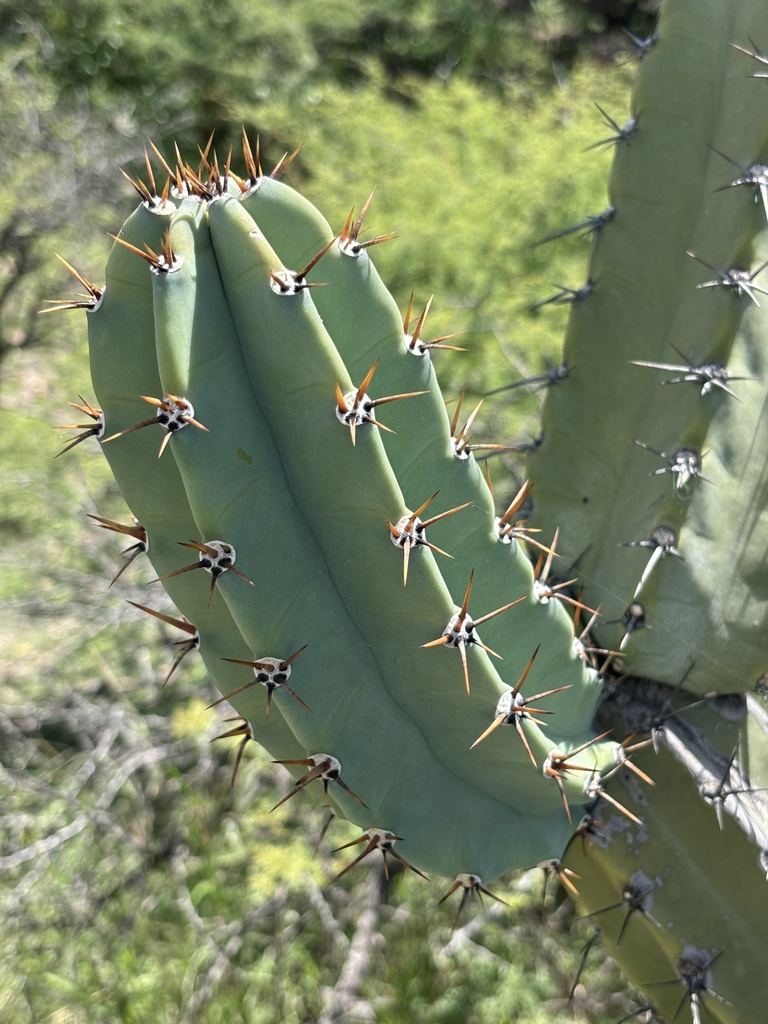
Cereus forbesii
Cereus forbesii is a species of columnar cactus whose native range is Bolivia to N. Central Argentina.
Common hybrids include C. forbesii 'Ming Thing' (a monstrose form) and 'Spiralis', with its vertically spiraling growth habit.
From the article Cereus forbesii on Wikipedia (CC BY-SA), quoted section by section
Description
C. forbesii is a columnar, branching, colony-forming cactus which can grow up to 3 m (9 ft 10 in) in height, with a mature circumference of around 15 cm (5.9 in); however, due to weather, natural breakage, self-propagation and other growth-limiting factors, it is more frequently observed at a height of about 2 m (6 ft 7 in). Larger specimens have been noted as exceeding 7 m (23 ft) tall. The cylindrical, glaucoma shoots are initially blue-green and later turn light green, with a diameter of 5 to 8 centimeters. The columns are composed of 4-8 blunt, compressed ribs. The gray areoles are small. The (mostly singular) central spine, which occasionally forms two or three, is strong, yellowish-brown and up to 16 centimetres (6.3 inches) long. The five surrounding radial spines reach a length of up to 2 centimetres (0.79 inches). The flowers are white to reddish, often with a backing of pink petals and a yellow center. The blooms, when pollinated, ripen into red, pulpy fruits, not unlike the fruits of some Opuntia species.
Range & habitat
It is endemic to the Argentine provinces of Catamarca, Chaco, Córdoba, Formosa, Jujuy, La Rioja, Salta, Santa Fe, Santiago del Estero and Tucumán, and north of the city of San Luís. In Bolivia, it is found in the departments of Chuquisaca, Santa Cruz and Tarija. It grows atop arid, windswept hills, within sparse forests, wooded plains, and also on the edges of salt flats, often an elevation of 500–2,000 m (1,600–6,600 ft). Like similarly related cacti, C. forbesii has adapted to extreme temperature fluctuations, including full-sun conditions during the daytime with seasonal near-freezing temperatures at night (especially in winter). Plants growing over 2,000 m above sea level may even contend with wintertime snowfall.
Wikipedia: “Distribution”
Where it lives
Recorded sightings
—
geo-referenced records in GBIF, from museums, herbaria and field observers.
Drag the globe to turn it. Dots are where records exist, not a range map; darker means more records.
In the stacks
Searching the stacks…
Every page naming Cereus forbesii in the Biodiversity Heritage Library →
This page is assembled live from iNaturalist, GBIF, Wikipedia, the Source Library and the Internet Archive. It is not yet part of the hand-edited codex. iNaturalist taxon 347994.