- Plants
- ›Vascular Plants
- ›flowering plants
- ›Dicots
- ›pinks, cactuses, and allies
- ›Old World pitcher plants
- ›Nepenthes
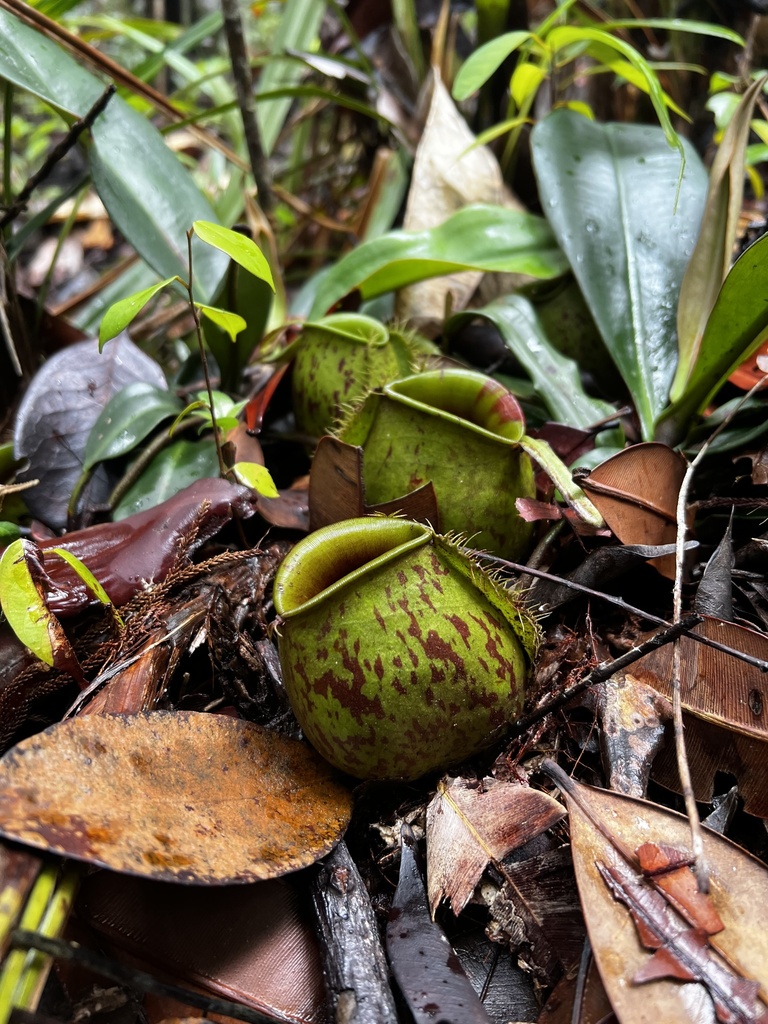
flask-shaped pitcher plant
Nepenthes ampullaria
Nepenthes ampullaria (; Latin ampulla meaning "flask") is a very distinctive and widespread species of tropical pitcher plant, present in Borneo, the Maluku Islands, New Guinea, Peninsular Malaysia, Singapore, Sumatra, and Thailand.
Nepenthes ampullaria is unique among its genus by having evolved away from carnivory; the plants are partly detritivores, collecting and digesting falling leaf litter in their pitchers.
From the article Nepenthes ampullaria on Wikipedia (CC BY-SA), quoted section by section
Description
Due to its unique pitcher morphology and unusual growth habit, it is difficult to confuse N. ampullaria with any other species in the genus. Francis Ernest Lloyd translated Troll's 1932 account of this species as follows:
"I came across N. ampullaria among the massive vegetations of a swamp-forest on the island of Siberut off the west coast of Sumatra. It was a fabulous, unforgettable sight. Everywhere, through the network of lianas the peculiarly-formed pitchers of this species gleamed forth, often in tight clusters and, most remarkably, the muddy moss-overgrown soil was spotted with the pitchers of this plant, so that one got the impression of a carpet." This carpetlike appearance is due to the presence of many pink or white foliage leaves which emerge directly from the rhizome. The stem of N. ampullaria is light brown in colour and may climb to 15 metres (49 ft) in height. Leaves are light green, up to 25 centimetres (9.8 in) long, and 6 centimetres (2.4 in) wide. Pitchers are produced at the ends of short tendrils no more than 15 centimetres (5.9 in) long.
The urceolate pitchers are generally quite small, rarely exceeding 10 centimetres (3.9 in) in height and 7 centimetres (2.8 in) in width. The peristome is greatly incurved, with the inner section accounting for around 85% of its total cross-sectional surface length. …
Range & habitat
One of the most widespread Nepenthes species, N. ampullaria is native to Borneo, the Maluku Islands, New Guinea, Peninsular Malaysia, Singapore, Sumatra, and Thailand. It has also been recorded from many smaller islands, including Bangka, Bengkalis, Ko Lanta, Ko Tarutao, Langkawi, Mendol, the Mentawai Islands (Siberut), the Meranti Islands (Padang, Rangsang, Tebing Tinggi), Nias, Penang, the Riau Islands (Lingga Islands, Natuna Islands, Riau Archipelago), and Rupat. Nepenthes ampullaria generally grows in damp, shady forest from sea level to 2,100 metres (6,900 ft) altitude. In Borneo, it occurs usually on relatively flat terrain in kerangas forest, peat swamp forest, and degraded swamp forest, at elevations of 0 to 1,000 metres (3,300 ft). In Sumatra and Peninsular Malaysia, it grows from sea-level to 1,100 metres (3,600 ft) altitude on flat terrain in heath forest, padang, belukar, peat swamp forest, degraded swamp forest, and in paddy fields. In New Guinea, it is predominantly present in Araucaria forests. The species has also been recorded from secondary forests, open microphyllous vegetation, and swamp grassland.
Wikipedia: “Distribution and habitat”
What it does
Nepenthes ampullaria has largely moved away from carnivory and acquires a substantial portion of its nutrients from digesting leaf matter that falls to the forest floor. It is thus partially detritivorous.
The species has developed several unique traits as a consequence of its adaptation to trapping leaf litter:
It is one of the few species in the genus to lack "lunate" cells in its pitchers. These are modified stomatal guard cells which, it is thought, deny prey a foothold in the pitcher. The pitcher lid is atypical, being very small and reflexed (tilted outwards instead of covering the pitcher's mouth), such that leaf litter is allowed to fall directly into the pitcher. Nectar glands, which play an important role in prey capture, are very rare and in some cases completely absent from the pitcher lid. The marginal glands of the peristome are greatly reduced compared to those of other species. In terrestrial pitchers, the glandular region extends almost to the peristome, such that there is little or no conductive waxy zone. The waxy zone functions by causing prey to slip and fall into the digestive fluid. The plant's architecture, consisting of subsurface runners and offshoots, is unusual for the genus. The species often forms a "carpet" of pitchers covering the soil. This serves to maximise the area over which falling debris may be intercepted. The pitchers of N. …
Wikipedia: “Ecology”
Where it lives
Recorded sightings
—
geo-referenced records in GBIF, from museums, herbaria and field observers.
Drag the globe to turn it. Dots are where records exist, not a range map; darker means more records.
In the stacks
Searching the stacks…
Every page naming Nepenthes ampullaria in the Biodiversity Heritage Library →
This page is assembled live from iNaturalist, GBIF, Wikipedia, the Source Library and the Internet Archive. It is not yet part of the hand-edited codex. iNaturalist taxon 346348.