- Plants
- ›Vascular Plants
- ›flowering plants
- ›Dicots
- ›Soapberries, Cashews, Mahoganies, and Allies
- ›citrus family
- ›Aurantioideae
- ›Citrus
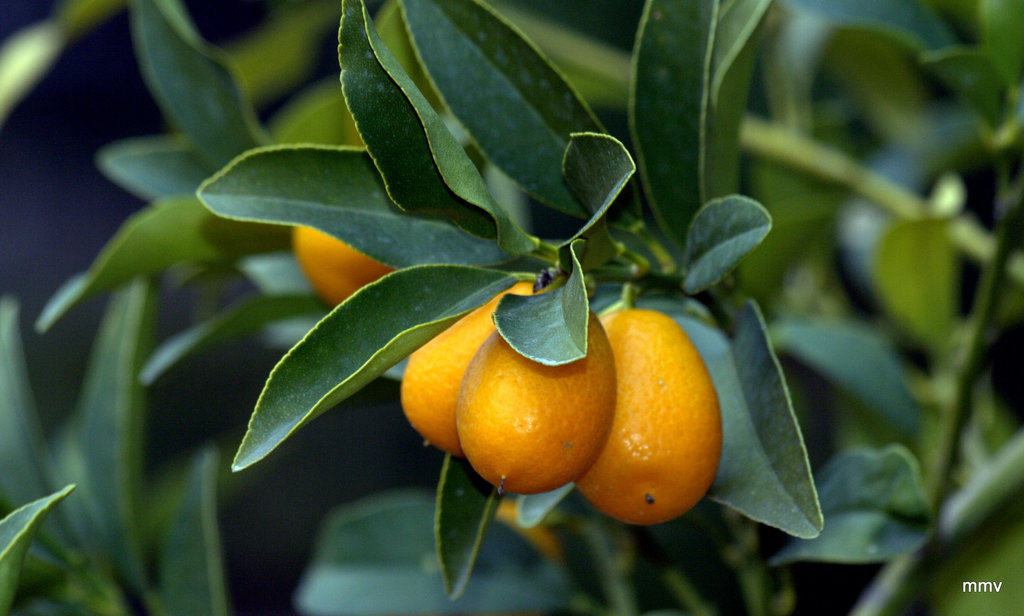
Kumquat
Citrus japonica
Kumquats ( KUM-kwot), sometimes spelled cumquat, are a group of small, angiosperm, fruit-bearing trees in the family Rutaceae. The edible fruit closely resembles the orange (Citrus x sinensis) in color, texture, and anatomy, but is much smaller, being approximately the size of a large olive. They are native to southern China but have been cultivated for centuries in Japan and Southeast Asia. The kumquat is a fairly cold-hardy citrus.
The taxonomy of kumquats is disputed. They were once classified as forming the historical genus Fortunella or placed within Citrus, sensu lato. Different classifications have assigned them ranging from a single species, Citrus japonica, to numerous species representing each cultivar. Recent genomic analysis defines three pure species, Citrus hindsii, C. margarita and C. crassifolia, with C. × japonica being a hybrid of the last two.
From the article Kumquat on Wikipedia (CC BY-SA), quoted section by section
Description
Kumquat plants have thornless branches and extremely glossy leaves. They bear dainty white flowers that occur in clusters or individually inside the leaf axils. The plants can reach a height from 2.5 to 4.5 meters (8 to 15 feet), with dense branches, sometimes bearing small thorns. They bear yellowish-orange fruits that are oval or round in shape. The fruits can be 2.5–5 centimeters (1–2 inches) in diameter and have a sweet, pulpy skin and slightly acidic inner pulp. The fruit is often eaten whole by humans and has a taste that is sweet and somewhat sour. Kumquat trees are self-pollinating.
Range & habitat
The kumquat plant is native to Southern China. The first historical reference to kumquats appears in literature of China from at least the 12th century. They have been cultivated for centuries in other parts of East Asia, South Asia, and Southeast Asia. They were introduced into Europe in 1846 by Robert Fortune, collector for the London Horticultural Society, and have spread across the world.
Wikipedia: “Origin and distribution”
At the table
A raw kumquat is 81% water, 16% carbohydrates, 2% protein, and 1% fat (table). In a reference amount of 100 grams (3+1⁄2 ounces), raw kumquat supplies 296 kilojoules (71 kilocalories) of food energy and is a rich source of vitamin C (49% of the Daily Value), with no other micronutrients in significant content (table).
Wikipedia: “Nutrition”
How it is grown
Kumquats are much hardier than citrus plants such as oranges. Sowing seeds in the spring is ideal because the temperature is pleasant, with more chances of rain and sunshine. This also gives the tree enough time to become well established before winter. Early spring is the best time to transplant a sapling. They do best in direct sunlight (needing 6–7 hours a day) and are planted directly in the ground. Kumquats do well in USDA hardy zones 9 and 10 and can survive in temperatures as low as 18 degrees Fahrenheit (−8 degrees Celsius). On trees mature enough, kumquats will form in about 90 days. In cultivation in the UK, Citrus japonica has gained the Royal Horticultural Society's Award of Garden Merit (confirmed 2017).
Propagation. Kumquats do not grow well from seeds and so are vegetatively propagated by using rootstock of another citrus fruit, air layering, or cuttings.
Varieties. The Nordmann seedless is a seedless cultivar of the Nagami kumquat (Citrus margarita). It is similar to Nagami but with a slightly different shape and lighter skin. The Centennial Variegated is another cultivar of the Nagami kumquat. It originated from the open pollination of a Nagami kumquat tree. The fruits are striped light green and yellow when underripe, and turn orange and lose their stripes when they ripen. They are oval-shaped, necked, 2.5 inches long, and have a smooth rind. …
Wikipedia: “Cultivation”
In human culture
The English word kumquat is a borrowing of the Cantonese gām gwāt (IPA: [kɐ́m kʷɐ́t̚]; Chinese: 金橘), from gām 'golden' + gwāt 'mandarin orange'.
Wikipedia: “Etymology”
Where it lives
Recorded sightings
—
geo-referenced records in GBIF, from museums, herbaria and field observers.
Drag the globe to turn it. Dots are where records exist, not a range map; darker means more records.
In the old herbals & bestiaries


In the stacks
Searching the stacks…
Every page naming Citrus japonica in the Biodiversity Heritage Library →
This page is assembled live from iNaturalist, GBIF, Wikipedia, the Source Library and the Internet Archive. It is not yet part of the hand-edited codex. iNaturalist taxon 343817.