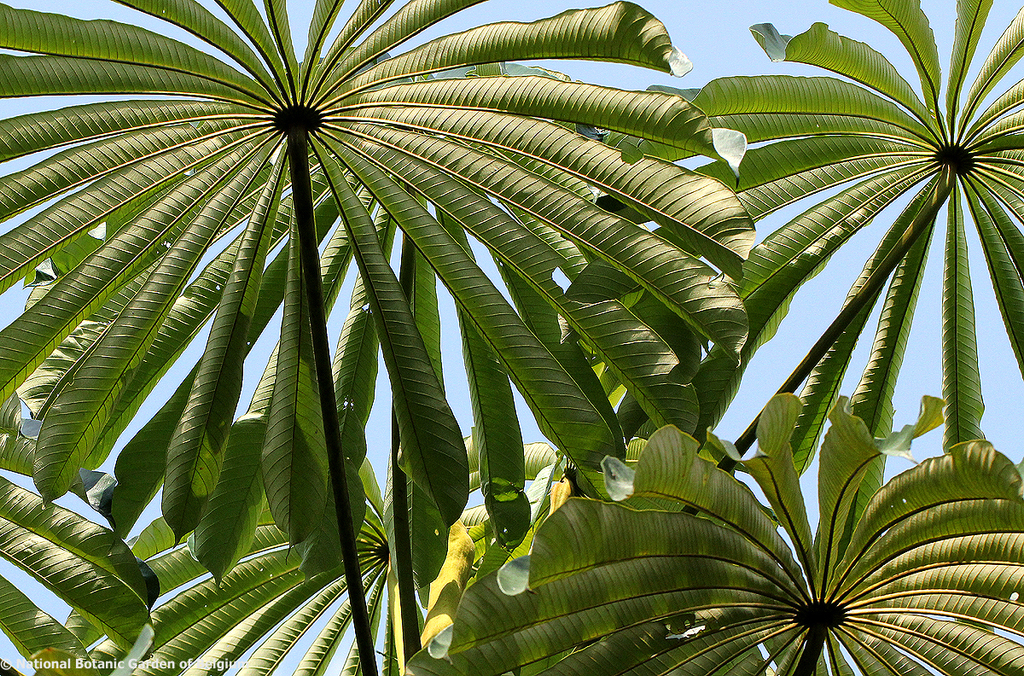
African corkwood tree
Musanga cecropioides
Musanga cecropioides, the African corkwood tree or umbrella tree, is found in tropical Africa from Sierra Leone south to Angola and east to Uganda. It is typical in secondary forests.
This tree is also known as parasolier, n'govoge, govwi, doe, kombo-kombo, musanga, and musanda.
From the article Musanga cecropioides on Wikipedia (CC BY-SA), quoted section by section
Description
Musanga cecropioides can reach a height of 45 metres (148 ft) with a diameter of up to 50 centimetres (20 in). Its trunk has a pale whitish/yellow tone with a rough, granular texture. Its leaves have palmately arranged leaflets, up to twenty-six together, forming an eccentric circle up to 110 cm (43 in) diameter. The lowest and largest leaflet is up to 75 cm (30 in) long by 15 cm (5.9 in) wide.
What it does
Musanga cecropioides is a pioneer species and readily springs up in newly cleared patches of forest. In Nigeria it is joined in these locations by the poison devil's-pepper (Rauvolfia vomitoria), the Ivory Coast almond (Terminalia ivorensis) and the dragon's blood tree (Harungana madagascariensis). Five years later, M. cecropioides had become dominant, with a closed canopy at 10 m (33 ft)
Wikipedia: “Ecology”
At the table
Uses of the wood from the African corkwood tree range from flotation devices, such as rafts, to toys. The wood of the African corkwood tree has a frail concreteness and has a tendency to mold and tarnish easily. The tree has traditional medical uses among the Bantu peoples of the Central African Republic, Gabon and Equatorial Guinea.
Wikipedia: “Uses”
Where it lives
Recorded sightings
—
geo-referenced records in GBIF, from museums, herbaria and field observers.
Drag the globe to turn it. Dots are where records exist, not a range map; darker means more records.
In the stacks
Searching the stacks…
Every page naming Musanga cecropioides in the Biodiversity Heritage Library →
This page is assembled live from iNaturalist, GBIF, Wikipedia, the Source Library and the Internet Archive. It is not yet part of the hand-edited codex. iNaturalist taxon 341036.