- Plants
- ›Vascular Plants
- ›flowering plants
- ›Dicots
- ›Roses, Elms, Figs, and Allies
- ›mulberry and fig family
- ›Moreae
- ›Morus
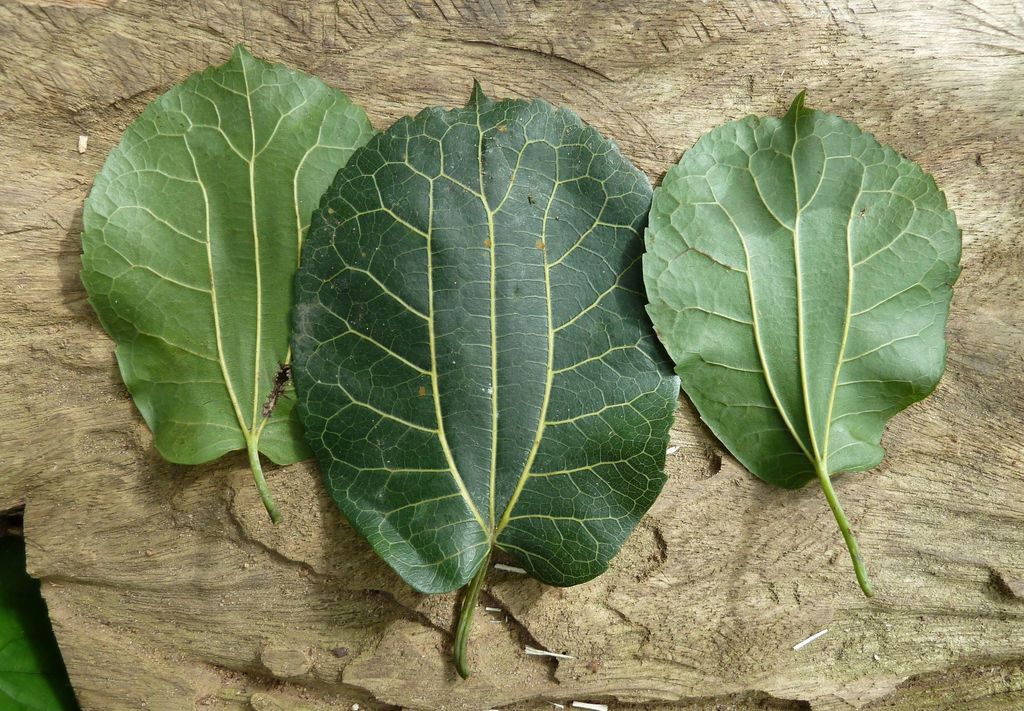
African mulberry
Morus mesozygia
Morus mesozygia, known as black mulberry or African mulberry, is a small to medium sized forest tree of Tropical Africa. Its leaves and fruit provide food for the mantled guereza, a colobus monkey native to much of Tropical Africa, and for the common chimpanzee of West and Central Africa. It is also a commercial hardwood.
From the article Afromorus on Wikipedia (CC BY-SA), quoted section by section
Description
Afromorus mesozygia is a dioecuous tree that can grow up to 35 m tall, the bark is smooth, greyish in color with irregular white patches. The slash is yellow exuding a white latex. Leaves are distichous, the stipules are caducous and up to 10 mm long. Surface of leaflets has a leathery or papery look, the leaflets are elliptical to broadly ovate in shape and tend to be between 3-13 cm long and 2-8 cm wide with a margin that is serrate to crenate. The apex is acuminate to acute and base is cordate. The inflorescence is an axillary spike and the fruit is drupe like.
Range & habitat
It occurs in Tropical Africa, from Senegal to Ethiopia in the north, and southwards to KwaZulu-Natal in South Africa. Its habitat are rainforests and deciduous forests.
Wikipedia: “Distribution and habitat”
What it does
These trees are a food source for the common chimpanzee of West and Central Africa, e.g. in Ngogo in Kibale National Park in Uganda Leaves and fruit also provide food for the mantled guereza, a colobus monkey native to much of Tropical Africa. African mulberry is sometimes cultivated as a shade tree or for ornamental purposes. Leaves and stem bark extracts are used in decoctions for pain management. The fruit is eaten by various human communities in its range, many of which also use the foliage as fodder for livestock. Wood obtained from the species is used for carpentry work and also gathered for use as firewood.
Wikipedia: “Ecology and uses”
Where it lives
Recorded sightings
—
geo-referenced records in GBIF, from museums, herbaria and field observers.
Drag the globe to turn it. Dots are where records exist, not a range map; darker means more records.
In the stacks
Searching the stacks…
Every page naming Morus mesozygia in the Biodiversity Heritage Library →
This page is assembled live from iNaturalist, GBIF, Wikipedia, the Source Library and the Internet Archive. It is not yet part of the hand-edited codex. iNaturalist taxon 340219.