- Plants
- ›Vascular Plants
- ›flowering plants
- ›Dicots
- ›nightshades, bindweeds, gooseweeds, and allies
- ›nightshade family
- ›nightshades and allies
- ›nightshades and jaltomatas
- ›Solanum
- ›Leptostemonum
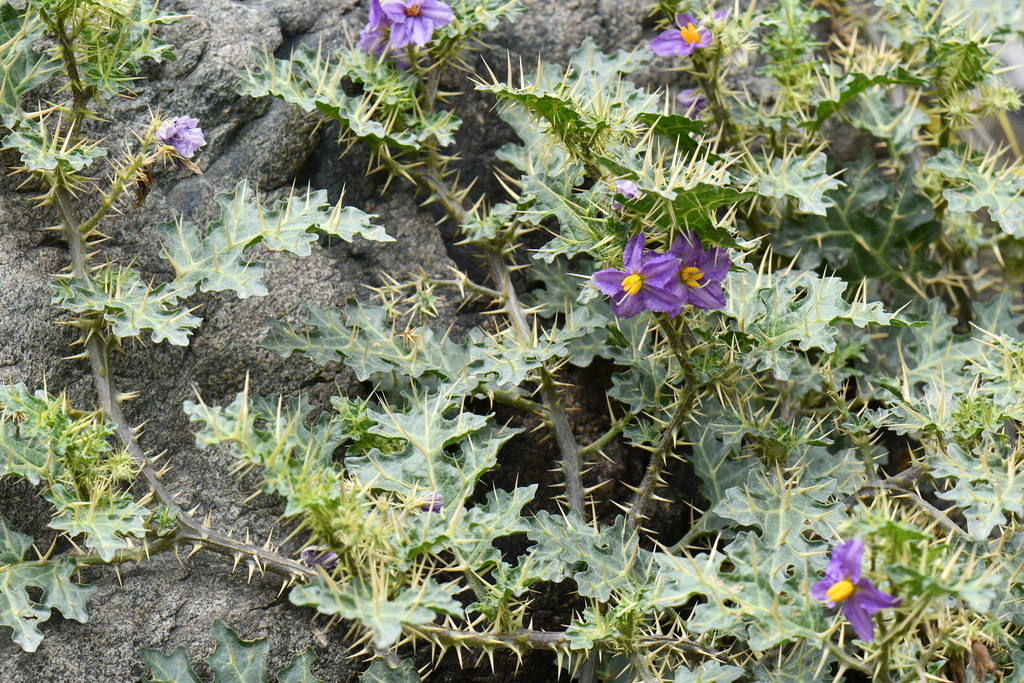
Surattense Nightshade
Solanum virginianum
Solanum virginianum, also called Surattense nightshade, yellow-fruit nightshade, yellow-berried nightshade, Thai green eggplant, Thai striped eggplant (from the unripe fruit), is a species of nightshade native to Asia (Saudi Arabia, Yemen, Afghanistan, Iran, China, Bangladesh, India, Nepal, Pakistan, Sri Lanka, Myanmar, Thailand, Vietnam, Indonesia, Malaysia), and is adventive in Egypt. It is a medicinal plant used in India, but the fruit is poisonous.
From the article Solanum virginianum on Wikipedia (CC BY-SA), quoted section by section
Description
Solanum virginianum is an erect herb, that is sometimes woody at the base, and measures 50–70 cm (20–28 in) tall. It is copiously armed with sturdy, needlelike, and broad-based prickles measuring 5-20 mm x 0.5-1.5 mm. The plant has ovate-oblong, sinuated leaves that are unequally paired, with blades measuring 4-9 cm × 2-4.5 cm. They have an acute apex, unequal lobes and are either pinnate or possessive of usually 5-9 lobes. The veins and stalks of the leaves are prickly, and the stalks have a length of 2-3.5 cm. The racemose inflorescence of the plant is 4-7 cm tall, and the bell-shaped sepal tube has a diameter of 1 cm. The blue-purple flowers measure 1.4–1.6 cm × 2.5 cm. The petals are ovate-deltate, measure 6–8 mm, and are densely pubescent with stellate hairs. The filaments have a measurement of 1 mm, the anthers 8 mm, and the style 1 cm. The fruiting pedicels of Solanum virginianum are 2–3.6 cm tall. They have prickles and sparse stellate hairs, while the fruiting sepals are prickly and sparsely pubescent. Pale yellow berries of 1.3–2.2 cm in diameter are produced, when ripe the yellow fruits are around 3 cm in diameter. Flowering normally appears around November to May.
In medicine
In-vitro antioxidant and in-vivo antimutagenic properties of Solanum xanthocarpum seed extracts have been examined by qualitative phytochemical screening, which reveals the presence of polyphenols, flavonoids, glycoside, alkaloids, carbohydrates, and reducing sugar in the plant. Based on preliminary qualitative phytochemical screening, quantitative estimation of polyphenols in the plant has also been performed. The quantitative estimation of alcoholic extracts found significant amounts of polyphenols, as compared to aqueous extracts. In-vitro antioxidant studies have been performed by two methods: DDPH, and a superoxide radical scavenging method. The alcoholic extracts showed significant antioxidant properties, as compared to aqueous extracts. Based on polyphenols and antioxidant properties, alcoholic extracts were used for the antimutagenic (clastogenic) test. The alcoholic extracts produced significant results regarding the antimutagenic activity.
Wikipedia: “Medicine”
Where it lives
Recorded sightings
—
geo-referenced records in GBIF, from museums, herbaria and field observers.
Drag the globe to turn it. Dots are where records exist, not a range map; darker means more records.
In the stacks
Searching the stacks…
Every page naming Solanum virginianum in the Biodiversity Heritage Library →
This page is assembled live from iNaturalist, GBIF, Wikipedia, the Source Library and the Internet Archive. It is not yet part of the hand-edited codex. iNaturalist taxon 339965.