- Plants
- ›Vascular Plants
- ›flowering plants
- ›Dicots
- ›Gentians, Dogbanes, Madders, and Allies
- ›madder family
- ›Rubioideae
- ›Palicoureeae
- ›Carapichea
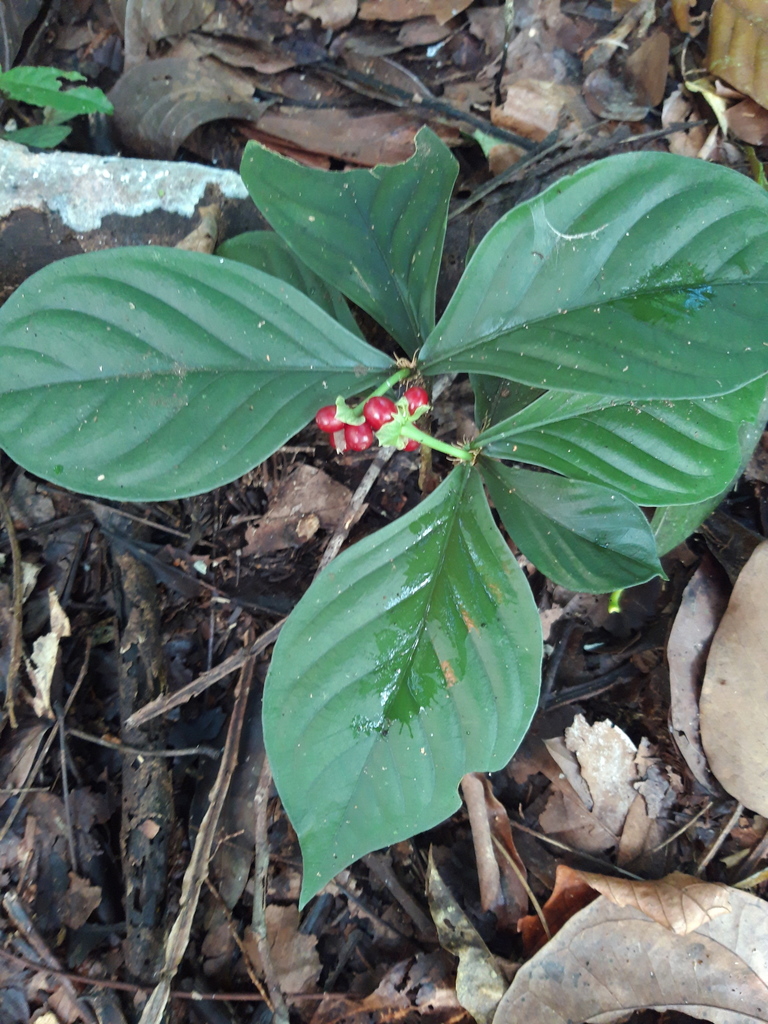
Carapichea ipecacuanha
Carapichea ipecacuanha is a species of flowering plant in the family Rubiaceae. It is native to Costa Rica, Nicaragua, Panama, Colombia, and Brazil. Its common name, ipecacuanha (Portuguese pronunciation: [ipekɐkuˈɐ̃ɲɐ]), is derived from the Tupi ypekakûãîa (lit. 'duck penis'). The plant has been discussed under a variety of synonyms over the years by various botanists. The roots were used to make syrup of ipecac, a powerful emetic, a longtime over-the-counter medicine no longer approved for medical use in the West for lack of evidence of safety and efficacy. An example of emetic compound from the roots is emetine.
From the article Carapichea ipecacuanha on Wikipedia (CC BY-SA), quoted section by section
Description
Ipecacuanha is a slow-growing plant, which reduces its commercial appeal as a crop plant. It is seldom cultivated in South America but it has been cultivated in India and elsewhere. The root of ipecacuanha has been used in preparation of the medicament, the syrup, is simple or divided into a few branches, flexuous, and composed of rings of various size. It is somewhat fleshy when fresh, and appearing as if closely strung on a central woody cord. The different kinds known in commerce (gray, red, brown) are all produced by the same plant, the differences arising from the age of the plant, the mode of drying, etc. Various other plants can be used as substitutes for it.
In human culture
Ipecacuanha was known to Europe by the mid 17th century. Nicholas Culpeper, an English botanist, herbalist, and physician, compared Ipecacuanha to the herb Orach in his book, Complete Herbal & English Physician, published in 1653. One of the first recorded shipments of Ipecacuanha to Europe was in 1672, by a traveler named Legros, who imported a quantity of the root to Paris from South America. In 1680, a Parisian merchant named Garnier possessed some 68 kilograms (150 pounds) of the substance and informed the physician Jean Claude Adrien Helvetius (1685–1755, father of Claude-Adrien Helvétius) of its power in the treatment of dysentery. Helvetius was granted sole right to vend the remedy by Louis XIV, but sold the secret to the French government, who made the formula public in 1688. Ipecacuanha has a long history of use as an emetic, for emptying the stomach in cases of poisoning, a use that has been discontinued in medical settings (see syrup of ipecac). It has also been used as a nauseant, expectorant, and diaphoretic, and was prescribed for conditions such as bronchitis. The most common and familiar preparation is syrup of ipecac, which was commonly recommended as an emergency treatment for accidental poisoning until the final years of the 20th century. Ipecacuanha was also traditionally used to induce sweating. …
Wikipedia: “History”
Where it lives
Recorded sightings
—
geo-referenced records in GBIF, from museums, herbaria and field observers.
Drag the globe to turn it. Dots are where records exist, not a range map; darker means more records.
In the stacks
Searching the stacks…
Every page naming Carapichea ipecacuanha in the Biodiversity Heritage Library →
This page is assembled live from iNaturalist, GBIF, Wikipedia, the Source Library and the Internet Archive. It is not yet part of the hand-edited codex. iNaturalist taxon 339963.