- Plants
- ›Vascular Plants
- ›Ferns
- ›Leptosporangiate Ferns
- ›Polypod Ferns
- ›eupolypods I
- ›Hare's-foot Fern family
- ›Davallia
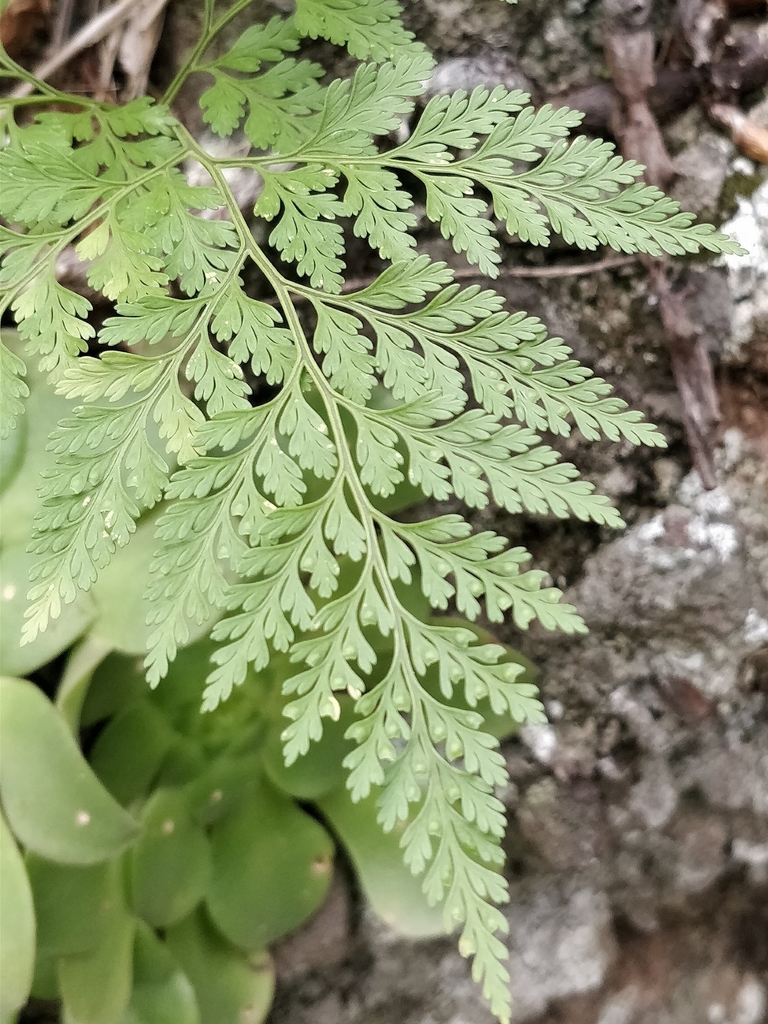
Davallia canariensis
Davallia canariensis, the hare's-foot fern, is a species of fern in the family Davalliaceae. It is endemic to Macaronesia and the Iberian Peninsula. It grows well in a sunny atmosphere and amongst rocks.
From the article Davallia canariensis on Wikipedia (CC BY-SA), quoted section by section
Description
Davallia canariensis is a spreading, deciduous fern with thick, scaly rhizomes and broad, finely-divided fronds, it grows up to 50 cm (20 in) tall and 100 cm (39 in) broad.
Range & habitat
Davallia canariensis is found on the western Mediterranean Basin, from Cape Verde, the Canary Islands and Madeira to Morocco and the western Iberian Peninsula (western Portugal and northwest and southwest Spain). It grows on tree trunks and branches, mossy siliceous rocks in cool and humid places with oceanic influences, from sea-level to 600 m (2,000 ft) in altitude. The Latin specific epithet canariensis means "from the Canary Islands". As it is only hardy down to 5 °C (41 °F), in temperate climates it must be grown under glass as a houseplant. However, it may be placed outside in a sheltered spot during the summer months. It has an Award of Garden Merit from the Royal Horticultural Society.
Wikipedia: “Distribution and habitat”
Where it lives
Recorded sightings
—
geo-referenced records in GBIF, from museums, herbaria and field observers.
Drag the globe to turn it. Dots are where records exist, not a range map; darker means more records.
In the stacks
Searching the stacks…
Every page naming Davallia canariensis in the Biodiversity Heritage Library →
This page is assembled live from iNaturalist, GBIF, Wikipedia, the Source Library and the Internet Archive. It is not yet part of the hand-edited codex. iNaturalist taxon 338384.