- Plants
- ›Vascular Plants
- ›flowering plants
- ›Dicots
- ›sandalwoods, mistletoes, and allies
- ›balanophora family
- ›Balanophora
fungus root
Balanophora fungosa
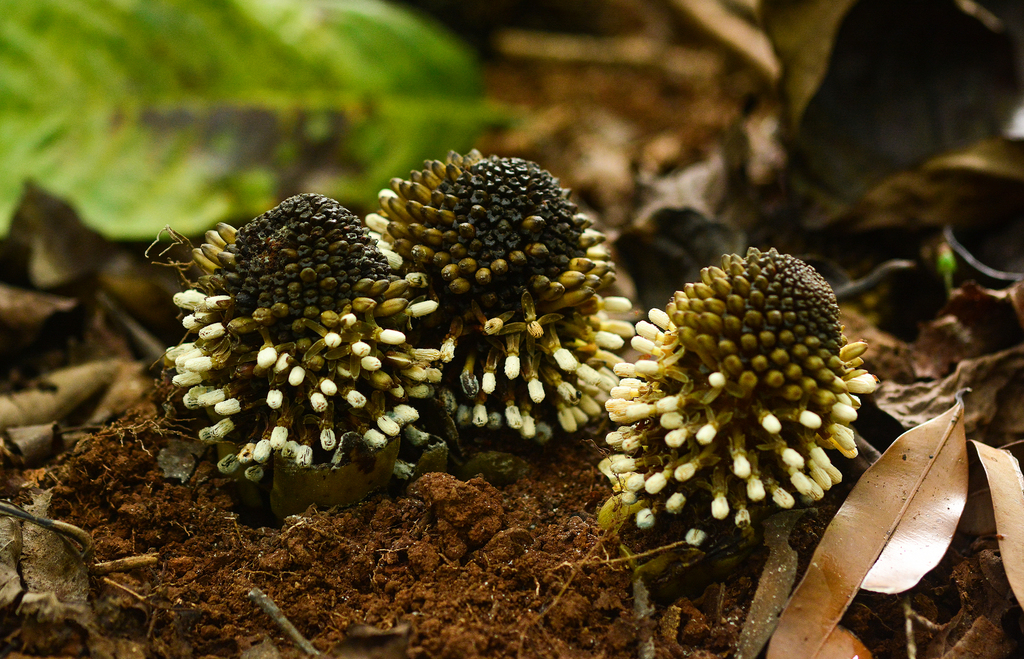
Balanophora fungosa, sometimes known as fungus root, is a flowering plant in the family Balanophoraceae and occurs in South Asia, Southeast Asia, Australia and some Pacific islands. It is a parasite growing on the roots of rainforest trees. The flowering structure is shaped like a puffball but in fact consists of a globe covered with thousands of tiny female flowers. The globe is surrounded at its base by a much smaller number of male flowers. In flower, the plant emits an odour resembling that of mice.
From the article Balanophora fungosa on Wikipedia (CC BY-SA), quoted section by section
Description
Like other members of its genus, B. fungosa is holoparasitic and contains no chlorophyll. The aerial parts of the plant consist of a hard, irregularly shaped tuber from which the flower-bearing structures extend. The leaves are scale-like, pale cream in colour, 8–30 millimetres (0.3–1 in) long, 7–20 millimetres (0.3–0.8 in) wide and more or less stem clasping. The plant is monoecious or dioecious. When monoecious, it bears both pistillate (female) and staminate (male) flowers. Thousands of minute female flowers cover a globe-shaped structure 15–20 millimetres (0.6–0.8 in) in diameter. The styles are less than 1 millimetre (0.04 in) long. About 20 male flowers are arranged around the base of the globe, each about 3–5 millimetres (0.1–0.2 in) in diameter with a pedicel about 5–6 millimetres (0.20–0.24 in) long and are covered with powdery white pollen.
Range & habitat
Balanophora fungosa is found in coastal forests from near sea level to 900 metres (3,000 ft) in Australia, Taiwan, Indonesia, Ryukyu Islands, New Guinea, the Philippines, some Pacific Islands including New Caledonia, India and Cambodia. In Australia it occurs in Queensland, from about Noosa to the tip of Cape York Peninsula.
Wikipedia: “Distribution and habitat”
What it does
Twelve species of plant in eight families are known to be hosts to Balanophora fungosa var. indica including some of those in the genera Syzygium, Olea and Rapanea. The plant is sometimes a weed in coffee and tea plantations. Numerous small animals visit the flowers, including ants, springtails, flies, a moth of the family noctuidae, and even rats, which appear to be attracted by the smell. Workers of the Asiatic honeybee, Apis cerana have been observed collecting pollen. Two beetle species of the genus Lasiodactylus, a moth of the family Pyralidae and a moth of the family Tipulidae use the bracts at the base of the flowers as a breeding site.
Wikipedia: “Ecology”
In medicine
Some cultures, such as the Paliar people of Tamil Nadu, use B. fungosa to treat medical conditions.
== References ==
Wikipedia: “Use as medicine”
Where it lives
Recorded sightings
—
geo-referenced records in GBIF, from museums, herbaria and field observers.
Drag the globe to turn it. Dots are where records exist, not a range map; darker means more records.
In the stacks
Searching the stacks…
Every page naming Balanophora fungosa in the Biodiversity Heritage Library →
This page is assembled live from iNaturalist, GBIF, Wikipedia, the Source Library and the Internet Archive. It is not yet part of the hand-edited codex. iNaturalist taxon 337638.