- Plants
- ›Vascular Plants
- ›flowering plants
- ›Dicots
- ›Gentians, Dogbanes, Madders, and Allies
- ›Dogbane Family
- ›Rauvolfioideae
- ›Carisseae
- ›Carissa
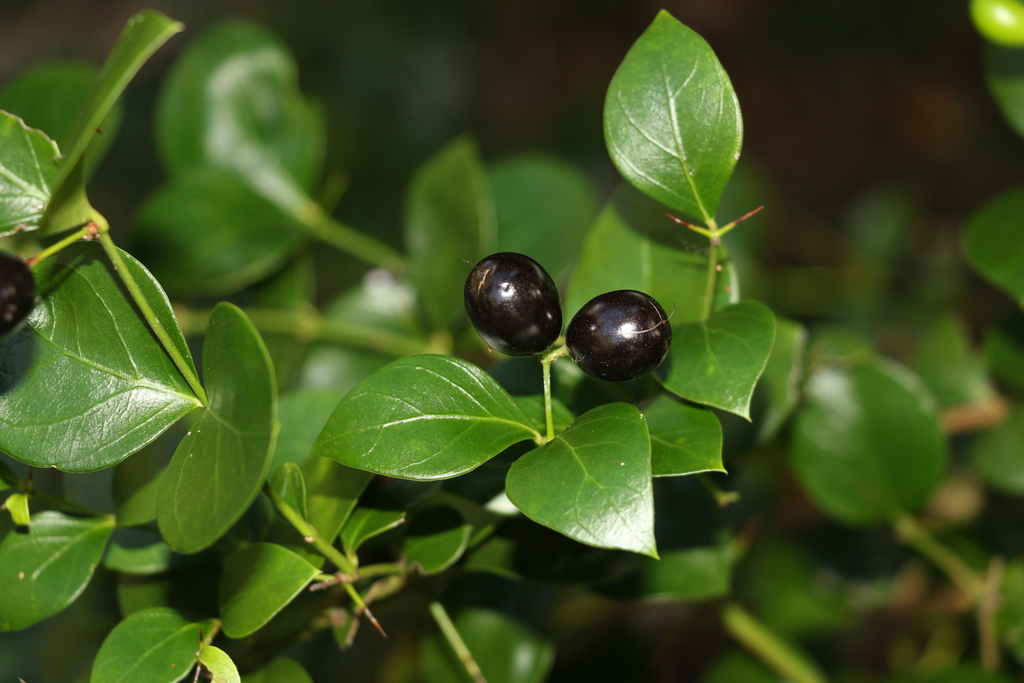
conkerberry
Carissa ovata
Carissa spinarum, the conkerberry or bush plum, is a large shrub of the dogbane family (Apocynaceae), widely distributed in tropical regions of Africa, Southern Asia, Australia, and various islands of the Indian Ocean. It is most well known in Australia, where it is also called currant bush or, more ambiguously, native currant or even black currant. It is, however, neither closely related to plums (Prunus) nor to true currants (Ribes), which belong to entirely different lineages of eudicots. In India, it is also called wild karanda/wild karavanda, referring to the related karanda (C. carandas). Carissa spinarum is often discussed under its many obsolete synonyms (see below).
It grows as a multi-stemmed shrub, 0.5 to 3 m (1.6 to 9.8 ft) in height. The leaves are glossy green, opposite, narrow ovate to lanceolate and 1–5 cm (0.4–2.0 in) in length. The branches bear thorns of 1–3 cm (0.4–1.2 in) length. White, star-shaped flowers about 1 cm (0.4 in) across are followed by ovate green berries, 1–2 cm (0.4–0.8 in) in length, which turn black or dark purple when ripe.
From the article Carissa spinarum on Wikipedia (CC BY-SA), quoted section by section
What it does
Carissa spinarum is most often found in semiarid coastal regions on fine-textured soils such as clays and clay-loams; in more arid regions the plant tends to be confined to areas of higher moisture such as at the base of hills or floodout areas. But it has a high ecological tolerance and can live in a wide range of habitats. In Australia for example, it is often found in association with Eucalyptus brownii, poplar box (E. populnea), gidgee (Acacia cambagei) or brigalow (A. harpophylla), in coastal rainforest, gallery forest and vine thickets in regions receiving in excess of 900 mm (35 in) annual rainfall, as well as softwood scrubs and open eucalypt savannas receiving less than 700 mm (28 in) annual rainfall. Conkerberries are edible, but only when fully ripe; they have a sweet flavour, but the milky sap of this plant – and its unripe fruit – is poisonous, as typical for the Apocynaceae. They are a popular bush tucker food for Australian Aborigines in Central Australia. The fruit is known as merne arrankweye in the Arrernte language, anwekety in Anmatyerr and nganango in Pintupi. The fruits are also a popular food for the Australian bustard, emu and many other birds in its range. Its leaves provide food for butterflies (e.g. Australian crow, Euploea core) and moths (e.g. …
Wikipedia: “Ecology”
Where it lives
Recorded sightings
—
geo-referenced records in GBIF, from museums, herbaria and field observers.
Drag the globe to turn it. Dots are where records exist, not a range map; darker means more records.
In the stacks
Searching the stacks…
Every page naming Carissa ovata in the Biodiversity Heritage Library →
This page is assembled live from iNaturalist, GBIF, Wikipedia, the Source Library and the Internet Archive. It is not yet part of the hand-edited codex. iNaturalist taxon 334776.