- Plants
- ›Vascular Plants
- ›flowering plants
- ›monocots
- ›grasses, sedges, cattails, and allies
- ›Sedges
- ›Cyperoideae
- ›Cypereae
- ›Cyperus
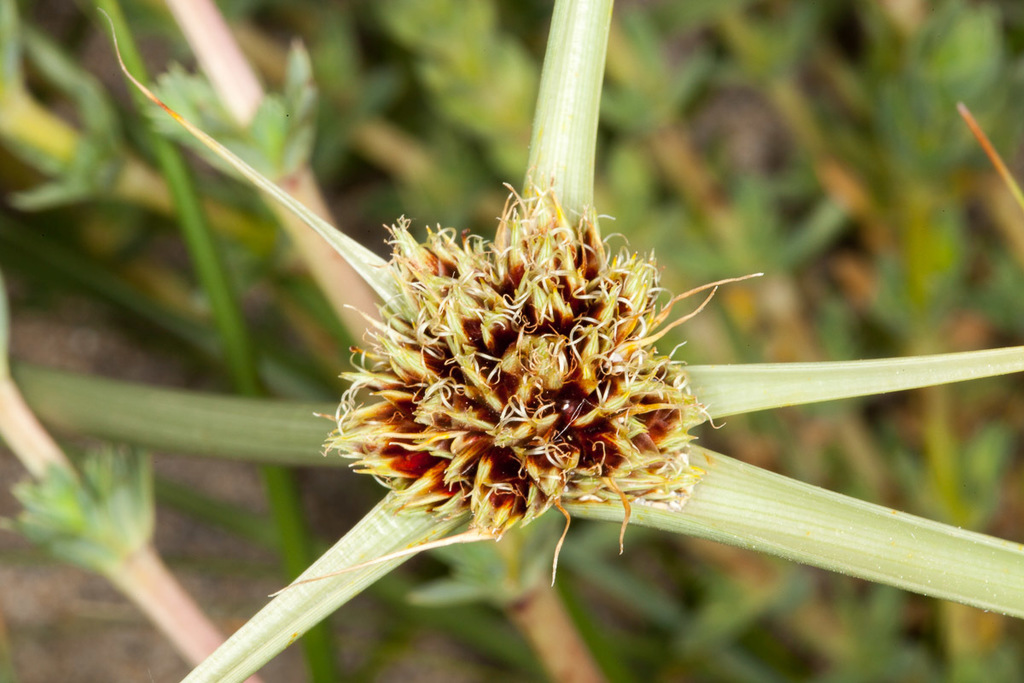
Capitate Galingale
Cyperus capitatus
Cyperus capitatus, known as capitate galingale or sand galingale is a species of sedge that is native to coasts of the Mediterranean and close by; it has no subspecies.
It was first formally described by Domenico Vandelli in 1771.
From the article Cyperus capitatus on Wikipedia (CC BY-SA), quoted section by section
Description
An unmistakable Cyperus growing in coastal sands, spreading by scaly undersand roots, with leaves mostly at the stem base, that are large, thick, blue-grey and U-shaped (often both broad and narrow-curled ones), and with bracts under the flowers resembling the leaves but with widened bases. The flowers form a single agglomerated head of spikelets, with the floret glumes large, broad (5-8 x 2.5-4 mm), membraneous-edged, with conspicuous tip points (mucro 1-3 mm).
Range & habitat
Mediterranean coastal sands, dunes and slacks and some coasts close by - Albania, Algeria, Baleares, Bulgaria, Canary Is., Cape Verde, Corse, Cyprus, East Aegean Is., Egypt, France, Greece, Italy, Kriti, Lebanon-Syria, Libya, Mauritania, Morocco, North Caucasus, Palestine, Portugal, Sardegna, Sicilia, Sinai, Spain, Tunisia, Turkey, Turkey-in-Europe, Western Sahara, Yugoslavia.
Wikipedia: “Range and habitat”
Where it lives
Recorded sightings
—
geo-referenced records in GBIF, from museums, herbaria and field observers.
Drag the globe to turn it. Dots are where records exist, not a range map; darker means more records.
In the stacks
Searching the stacks…
Every page naming Cyperus capitatus in the Biodiversity Heritage Library →
This page is assembled live from iNaturalist, GBIF, Wikipedia, the Source Library and the Internet Archive. It is not yet part of the hand-edited codex. iNaturalist taxon 334577.