- Plants
- ›Vascular Plants
- ›flowering plants
- ›Dicots
- ›Soapberries, Cashews, Mahoganies, and Allies
- ›citrus family
- ›Zanthoxyloideae
- ›Zanthoxylum
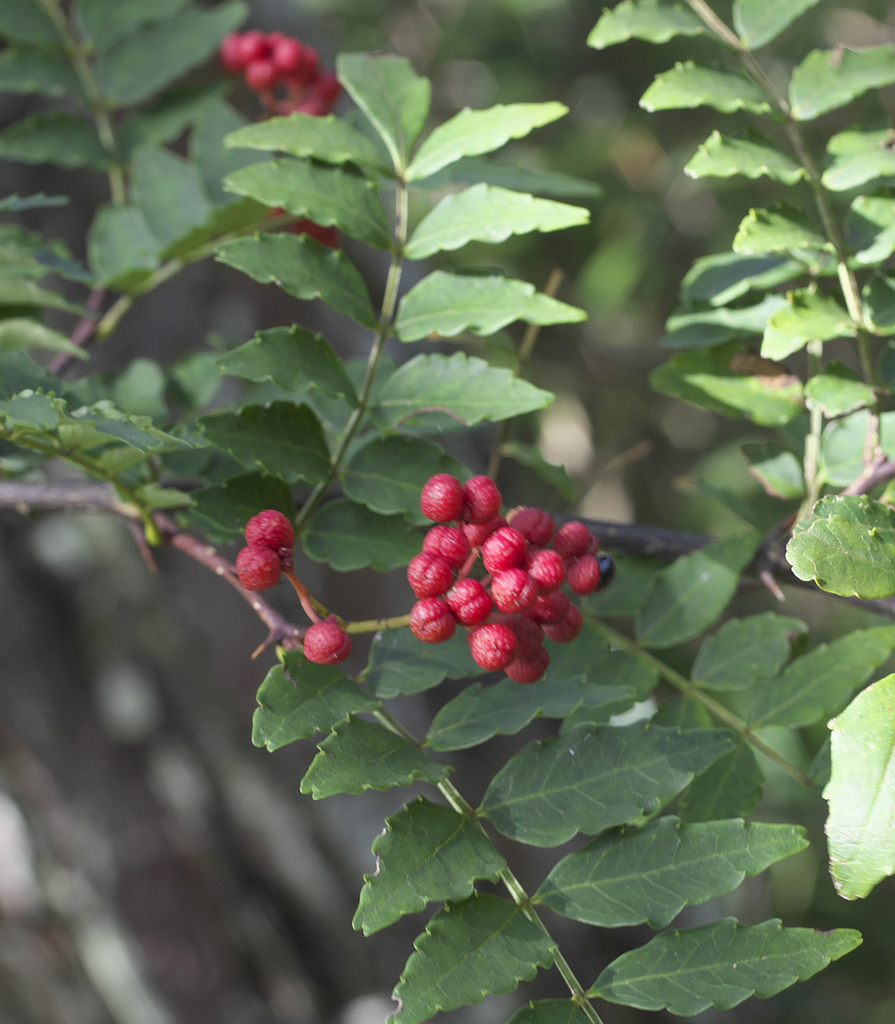
Japanese Pepper
Zanthoxylum piperitum
Zanthoxylum piperitum, called Japanese pepper, chopi, or Korean pepper in English and sanshō (Japanese: 山椒) in Japanese, is a deciduous aromatic spiny shrub or small tree, belonging to the Rutaceae (citrus and rue) family. Natural range spans from Hokkaido to Kyushu in Japan, southern parts of the Korean peninsula, and Chinese mainland. The related Z. schinifolium (Japanese: イヌザンショウ pron. inuzanshō, lit., "dog sansho") occurs as far south as Yakushima, attaining a height of 3 meters.
From the article Zanthoxylum piperitum on Wikipedia (CC BY-SA), quoted section by section
Range & habitat
Its natural range spans from Hokkaido to Kyushu in Japan, southern parts of the Korean Peninsula, and Chinese mainland.
Wikipedia: “Distribution and habitat”
What it does
It is a host plant for the Japanese indigenous swallowtail butterfly species, the citrus butterfly Papilio xuthus, which has also spread to Hawaii.
Wikipedia: “Ecology”
At the table
The pulverized mature fruits ("peppercorns" or "berries") known as "Japanese pepper" or kona-zanshō (粉ざんしょう) are the standard spice for sprinkling on kabayaki-unagi (broiled eel). It is also one of the seven main ingredients of the blended spice called shichimi, which also contains red chili peppers. Finely ground Japanese pepper, kona-zanshō, is nowadays usually sold in sealed packets, and individual serving sizes are included inside heat-and-serve broiled eel packages.
Young leaves and shoots, pronounced ki-no-mé or ko-no-mé (木の芽, lit. 'tree bud') herald the spring season, and often garnish grilled fish and soups. They have a distinctive flavor which is not to the liking of everyone. It is a customary ritual to put a leaf between cupped hands, and clap the hands with a popping sound, this supposedly serving to bring out the aroma. The young leaves are crushed and blended with miso using suribachi (mortar) to make a paste, a pesto sauce of sorts, and then used to make various aemono (tossed salad). …
Wikipedia: “Japanese cuisine”
In medicine
Chemical analysis has revealed that the seeds contain remarkably high concentrations of sugar-modified derivatives (glucosides) of N-methylserotonin and N,N-dimethylserotonin, also known as bufotenin.
Wikipedia: “Phytochemistry”
How it is grown
In Japan, Wakayama Prefecture boasts 80% of domestic production. Aridagawa, Wakayama produces a specialty variety called budō sanshō ('grape sansho'), which bears large fruits and clusters, rather like a bunch of grapes. The thornless variety, Asakura sansho, derives its name from its place of origin, the Asakura district in the now defunct Yokacho, integrated into Yabu, Hyōgo.
Wikipedia: “Cultivation”
Where it lives
Recorded sightings
—
geo-referenced records in GBIF, from museums, herbaria and field observers.
Drag the globe to turn it. Dots are where records exist, not a range map; darker means more records.
In the stacks
Searching the stacks…
Every page naming Zanthoxylum piperitum in the Biodiversity Heritage Library →
This page is assembled live from iNaturalist, GBIF, Wikipedia, the Source Library and the Internet Archive. It is not yet part of the hand-edited codex. iNaturalist taxon 332459.