- Plants
- ›Vascular Plants
- ›flowering plants
- ›Dicots
- ›Nances, Willows, and Allies
- ›Passionfruit Family
- ›Turneroideae
- ›Turnera
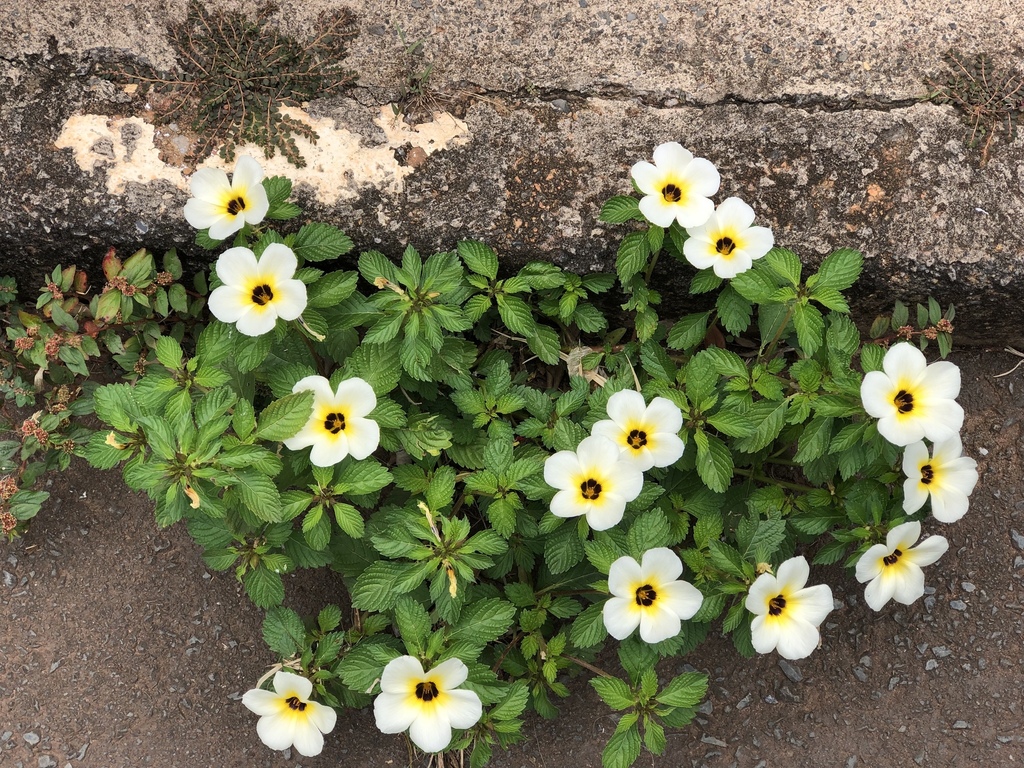
Cuban Buttercup
Turnera subulata
Turnera subulata is a species of flowering subshrub in the passionflower family known by the common names white buttercup, sulphur alder, politician's flower, dark-eyed turnera, and white alder. Despite its names, it is not related to the buttercups or the alders. It is native to Central and South America, from Panama south to Brazil. It is well known in many other places as an introduced species, such as Malaysia, Indonesia, several other Pacific Islands, the Caribbean, and Florida in the United States.
It is commonly cultivated as a garden flower, but because of its high adaptability, it is also known as a garden weed.
From the article Turnera subulata on Wikipedia (CC BY-SA), quoted section by section
Description
Like most other Turnera, this species is heterostylous, with two morphs. The "pin" morph has long styles in its flowers, while the "thrum" morph has short styles. Both morphs produce the same amount of pollen. One study reported that during pollination, pin flowers receive more pollen from thrum flowers than from other pin flowers. The genes that cause this dimorphism in style size are the subject of current research. So far, it has been established that short styles contain proteins, polygalacturonases, that are absent in long styles.
Wikipedia: “Appearance”
In medicine
This plant, like other plants of the Turnera genus, is wildly used in traditional medicine for centuries, mainly in tropical and subtropical regions. In South America, its leaf extract is used to treat many conditions, such as diabetes, hypertension, tumors, influenza, chronic pain and inflammation. It is mainly used in the northeastern region of Brazil, where it is also used to treat amenorrhea and dysmenorrhea, being consumed as tea or infusions. While little is known about its medicinal proprieties, the species has shown antioxidant, antibacterial and anti-inflammatory effects in tests, as well as modulating the effects of some drugs.
Wikipedia: “Traditional medicine”
Where it lives
Recorded sightings
—
geo-referenced records in GBIF, from museums, herbaria and field observers.
Drag the globe to turn it. Dots are where records exist, not a range map; darker means more records.
In the stacks
Searching the stacks…
Every page naming Turnera subulata in the Biodiversity Heritage Library →
This page is assembled live from iNaturalist, GBIF, Wikipedia, the Source Library and the Internet Archive. It is not yet part of the hand-edited codex. iNaturalist taxon 327909.