- Plants
- ›Vascular Plants
- ›flowering plants
- ›Dicots
- ›Mints, Plantains, Olives, and Allies
- ›Verbena Family
- ›Duranteae
- ›Duranta
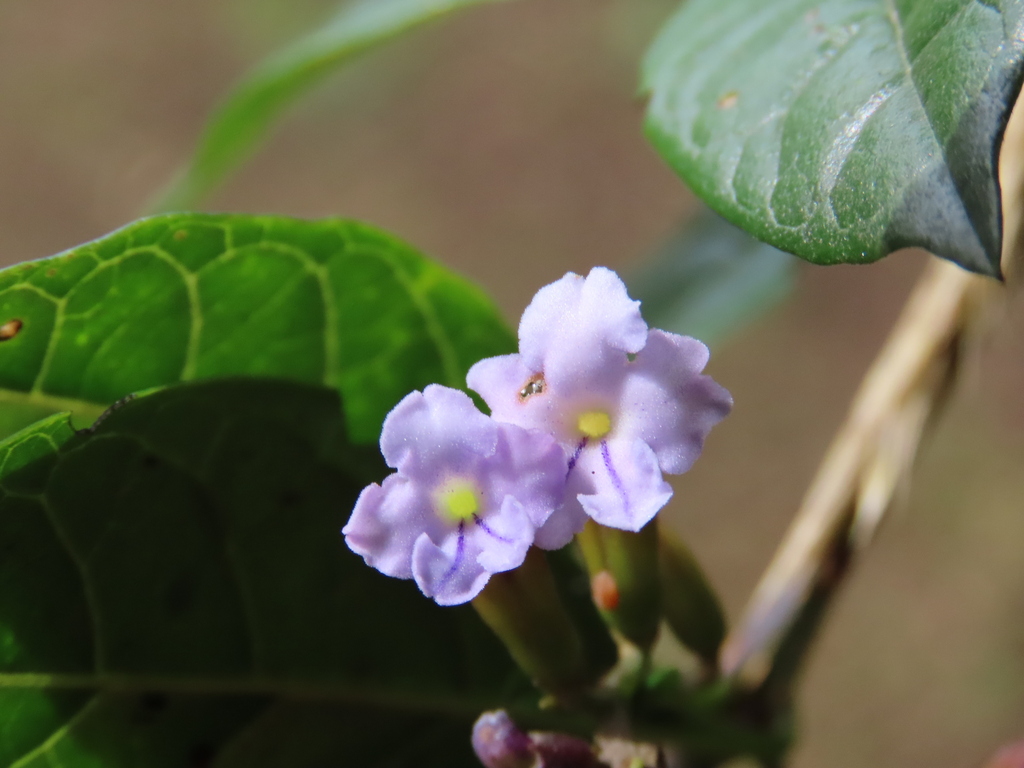
Duranta mutisii
Duranta mutisii, commonly known as espino in Spanish, is a shrub of the family Verbenaceae that is found in South America.
From the article Duranta mutisii on Wikipedia (CC BY-SA), quoted section by section
Description
It is a shrub that can reach 8 meters high, with more or less dense foliage, has an irregular crown, with abundant branching and subquadrangular branches. Its leaves are simple opposite, with an entire border, smooth, leathery, with an acute apex and cuneate base, without stipules and without exudate. The spines are opposite and curved. The flowers are light blue, tubular, grouped in axillary inflorescences in the form of a cluster. The fruits are yellow, round, apiculated, with yellow pulp and each contains one seed.
Range & habitat
It is distributed in South America at an altitude of 1800 to 3000 meters above sea level, in the following countries: Colombia, Ecuador, Peru and Venezuela.
Wikipedia: “Distribution”
At the table
It serves as food for a great diversity of native fauna; its flowers and fruits serve as food for insects and birds, its leaves are food of diverse amount of larvae, for example the larvae of Rothschildia aricia that produce silk. The plant is also used to counteract deforestation, use in fences and also as ornamental in parks.
== References ==
Wikipedia: “Uses”
Where it lives
Recorded sightings
—
geo-referenced records in GBIF, from museums, herbaria and field observers.
Drag the globe to turn it. Dots are where records exist, not a range map; darker means more records.
In the stacks
Searching the stacks…
Every page naming Duranta mutisii in the Biodiversity Heritage Library →
This page is assembled live from iNaturalist, GBIF, Wikipedia, the Source Library and the Internet Archive. It is not yet part of the hand-edited codex. iNaturalist taxon 327786.