- Animals
- ›Molluscs
- ›Bivalves
- ›Autobranchia
- ›Pteriomorphia
- ›Scallops and Allies
- ›Pectinoidea
- ›Scallops
- ›Pedinae
- ›Fortipectinini
- ›Mizuhopecten
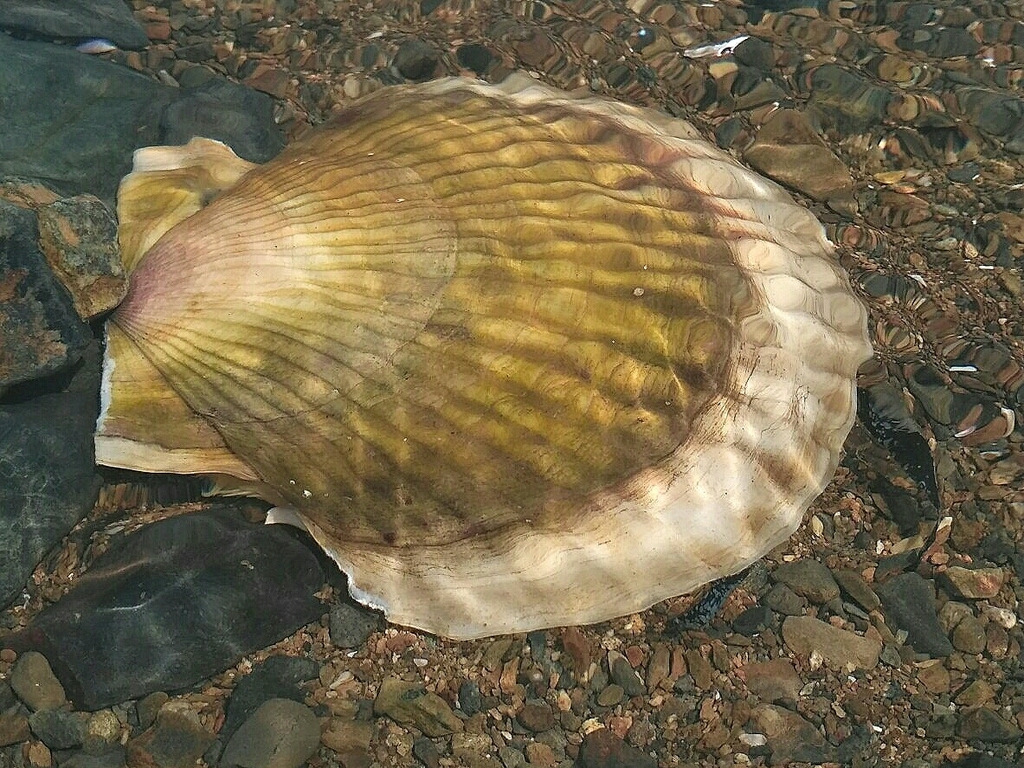
Ezo Giant Scallop
Mizuhopecten yessoensis
Mizuhopecten yessoensis (Yesso scallop, giant Ezo scallop) is a species of marine bivalve mollusks in the family Pectinidae, the scallops. Its name Yesso/Ezo refers to its being found north of Japan.
Its tissues bioaccumulate algal yessotoxins and are studied extensively.
From the article Mizuhopecten yessoensis on Wikipedia (CC BY-SA), quoted section by section
Description
The Yesso scallop (Mizuhopecten yessoensis) is a cold water marine bivalve species. The valves have a convex center with a smooth exterior shell. On one side it is white and on the other dark brown.
Range & habitat
The Yesso scallop is widely distributed along the cold coast of Northern Japan. Scallop cultivation is located in the northern islands of Honshu and Hokkaido, with the Sea of Okhotsk, Saroma Lake and Funka Bay in Hokkaido accounting for more than 80% of the scallop production during the period of 1991 to 2002.
Wikipedia: “Habitat”
What it does
Temperature plays a key role in the timing of spawning and larvae settlement of the Yesso scallop. Generally, the scallops spawn between May 1 to June 9 over the span of 10 days. It was found that the timing for the commencement of spawning is shifted to a later date when the surface temperature of the water remains below 0°C for a prolonged period. In addition, lower temperatures throughout April could potentially influence the onset timing of scallop spawning. Furthermore, the shortening of pre-spawning period (dates between the surface water temperature rise above zero to May 1) may be another contributing factor to the later dates of spawning. On the other hand, the timing of scallop spat settlement is closely related to water temperature too; the colder the pre-spawning period, the later the larvae settlement. The commencement of the Yesso Scallop larvae settlement is typically between June 4 to July 5 over the period of 15 days. The upper limit for scallop development was found to be 18°C.
Wikipedia: “Ecology and behavior”
At the table
In Japan, it is known as hotate-gai, and the adductor muscle is eaten raw as sashimi and sushi. In China, it is sometimes dried to make conpoy, usually described as "Japanese conpoy".
== References ==
Wikipedia: “As food”
Where it lives
Recorded sightings
—
geo-referenced records in GBIF, from museums, herbaria and field observers.
Drag the globe to turn it. Dots are where records exist, not a range map; darker means more records.
In the stacks
Searching the stacks…
Every page naming Mizuhopecten yessoensis in the Biodiversity Heritage Library →
This page is assembled live from iNaturalist, GBIF, Wikipedia, the Source Library and the Internet Archive. It is not yet part of the hand-edited codex. iNaturalist taxon 324568.