- Plants
- ›Vascular Plants
- ›flowering plants
- ›Dicots
- ›Heathers, Balsams, Primroses, and Allies
- ›heath family
- ›Epacrids, Styphelias and Allies
- ›Styphelieae
- ›Leucopogon
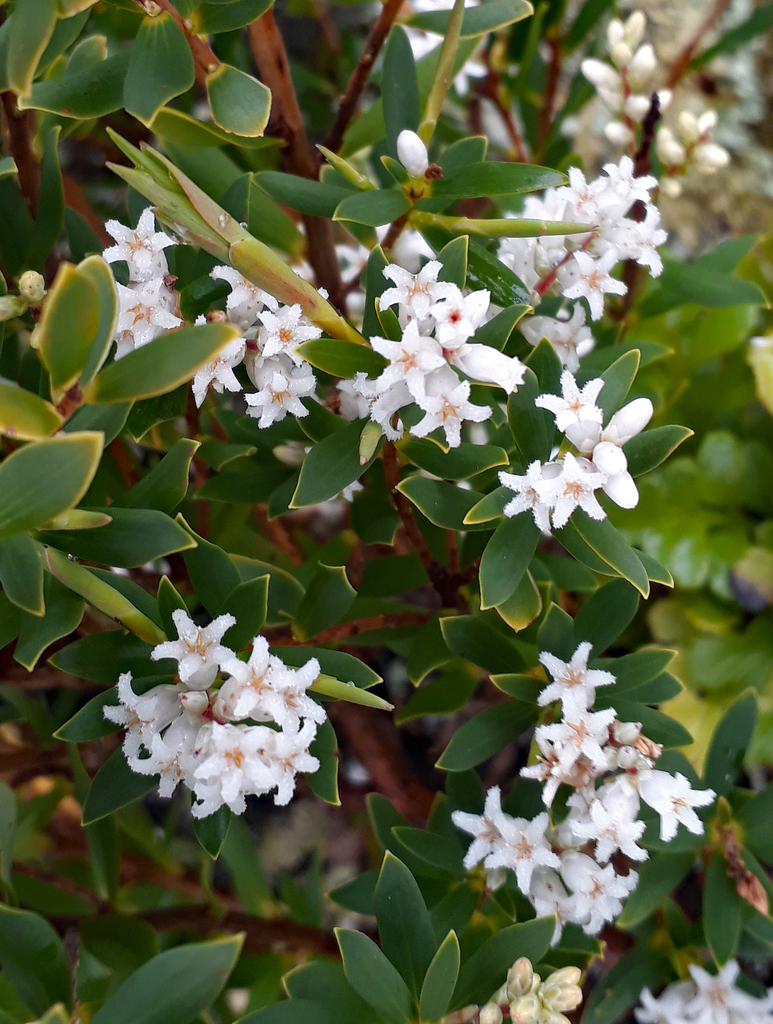
coastal beard-heath
Leucopogon parviflorus
Leucopogon parviflorus, commonly known as coast beard-heath or native currant, is a shrub or small tree in the family Ericaceae. It is native to all Australian states and territories excluding the Northern Territory and the ACT and also grows in New Zealand. The species can grow to between 1 and 5 metres in height and has leaves that are 11 to 29 mm long and 2.4 to 7.5 mm in width, often with curved tips. The white flowers are around 15 mm long and are produced in spikes of 7 to 13. These occur throughout the year.
Leucopogon parviflorus can grow in many differing conditions, from sandy dunes to rocky cliff faces, in sheltered or exposed weather conditions. However, it does grow most efficiently in sandier areas, with sufficient shelter from the elements. It is a significant food source to many Australian coastal birds and insects and relies on these animals for pollination and seed dispersion. It is also commercially cultivated by landscapers and florists to be used in coastal gardens and floral arrangements.
From the article Leucopogon parviflorus on Wikipedia (CC BY-SA), quoted section by section
Description
The size and appearance of the Leucopogon parviflorus ranges depending on the size and age of the plant. Its size can range from a medium sized shrub to a small tree, anywhere between 1 and 5 meters tall as a result of the age of the shrub and its exposure to the harsh weather conditions that occur on Australia's and New Zealand's coast lines. Smaller, finer branches found on the shrub are "soft and hairy". These small hairs allow the plant to be more drought tolerant as they prevent water loss. The appearance of the bark and trunk of the plant changes with age, with the trunk becoming much thicker and the bark developing into a deep dark brown with fine grooves and cracks throughout the body of the trunk as the shrub ages. The leaves of Leucopogon parviflorus are stiff and smooth with leaves usually reaching lengths of 10-35mm. They are flat or slightly curved and oblanceolate (longer than it is wider, with the widest part being near the tip) to elliptic (oval, broadest at the middle) in shape. The leaves have smooth edges with faint veins that are more obviously visible when the leaf is dried. Leaf colour ranges from a pale yellow-green to a dark green on top with the bottom of the leaf always paler than the top. Younger plant growth is often a bright green. It produces small, star-shaped white flowers that are furry on the inside. They produce a powerful, but sweet fragrance. …
Range & habitat
Leucopogon parviflorus is native to Australia and grows widely across the entire coasts of the states of New South Wales, Victoria, South Australia, Tasmania. It also grows in the southernmost parts of Queensland and Western Australia. The shrub also grows on the coastal areas of the Chatham Islands in New Zealand. It is wide growing in Australia. The shrub thrives in sandy dunes and flats, rocky cliff faces and headlands, and among coastal scrub and does best in soils that are a neutral pH. Since the 1970s studies have shown the shrub growing less in cliff and plateau environments, with an increase of growth in coastal habitats. The ideal altitude for Leucopogon parviflorus is within 50 meters of sea level. The ideal rainfall for the shrub is 1200-1400mm per annum. It thrives best in dune scrub or low-open forests behind beaches, surrounded by other shrubs such as Acacia Sophorae. The shrub can grow in varying levels of exposure. It can grow in full sun exposure as well as in mid-shaded areas and is tolerant to strong coastal winds.
Wikipedia: “Distribution and habitat”
What it does
Leucopogon parviflorus is a perennial shrub that has multiple prolonged flowering sessions during the winter, spiring, and autumn months followed by a fruit bearing period in the summer. It is a slow germinating plant, on average taking 6-18 months from dispersal to begin germination. It is also a slow growing plant, taking at least 10 years to reach a notable size. The life span of L. parviflorus ranges from 20 to 100 years depending on growing conditions and environmental factors such as fire and drought. L. parviflorus relies on biotic pollination – pollination mediated by other animals. The main pollination vectors for the species are flying insects, notably honey bees and hover-flies. The corolla tube has a wide opening that allows pollinators open access to the stigma and stamen of the flower for efficient pollination. The fuzzy hairs on the flower petals also serve to aid in pollination as they are better able to catch pollen granules dispersed by the wind or pollinators.
Many parts of L. parviflorus are utilised by birds for either food or other uses. Smaller branches of the plant have been seen to be picked up by birds for nest construction. Rarely, birds are seen to feed off of parts of the plant other than the fruit. The only bird noted to feed off of the leaves, Australian native the crimson rosella, does so in the winter. …
Wikipedia: “Ecology”
At the table
Leucopogon parviflorus' fruit is safe for humans to eat as a sweet food source once fully ripened. Indigenous Australian communities such as the Djab Wurrung people have been harvesting the shrub's berries for hundreds of years and have extensive knowledge surrounding the shrub and other native Australian flora. The fruit is mainly eaten as a snack as the majority of the fruit is the pip of the berry, with limited flesh. Because of L. parviflorus' slow growing nature it is often used for bonsai. Leaving the shrub exposed to the elements is an effective way to stunt the growth of the plant.
Cultivation. It is common to see Leucopogon parviflorus used by Australian landscapers when putting together gardens along the coastline as a result of the plant's attractive year-round flowering and its ability to thrive in what many other native plants find to be difficult soil conditions. Propagation methods, and the ease of propagation of L. parviflorus has been disputed between sources. The New Zealand Plant Conservation Network states that L. parviflorus is easy to grow from a fresh seed collected from one of the tree's berries, and that it is also possible to propagate from wood cuttings, though this method is slower, and makes it much harder to successfully propagate. Another source disputes this, stating that cuttings from a new growth is a quicker, and easier way to propagate L. …
Wikipedia: “Uses”
In human culture
The name of the genus Leucopogon is derived from the Greek language referring to the white "beard" of flowers that a mature shrub has.
Wikipedia: “Etymology”
Where it lives
Recorded sightings
—
geo-referenced records in GBIF, from museums, herbaria and field observers.
Drag the globe to turn it. Dots are where records exist, not a range map; darker means more records.
In the stacks
Searching the stacks…
Every page naming Leucopogon parviflorus in the Biodiversity Heritage Library →
This page is assembled live from iNaturalist, GBIF, Wikipedia, the Source Library and the Internet Archive. It is not yet part of the hand-edited codex. iNaturalist taxon 323832.