- Plants
- ›Vascular Plants
- ›flowering plants
- ›Dicots
- ›myrtles, evening primroses, and allies
- ›myrtle family
- ›Myrtoideae
- ›gum trees
- ›Eucalyptus
- ›Symphyomyrtus
- ›Adnataria
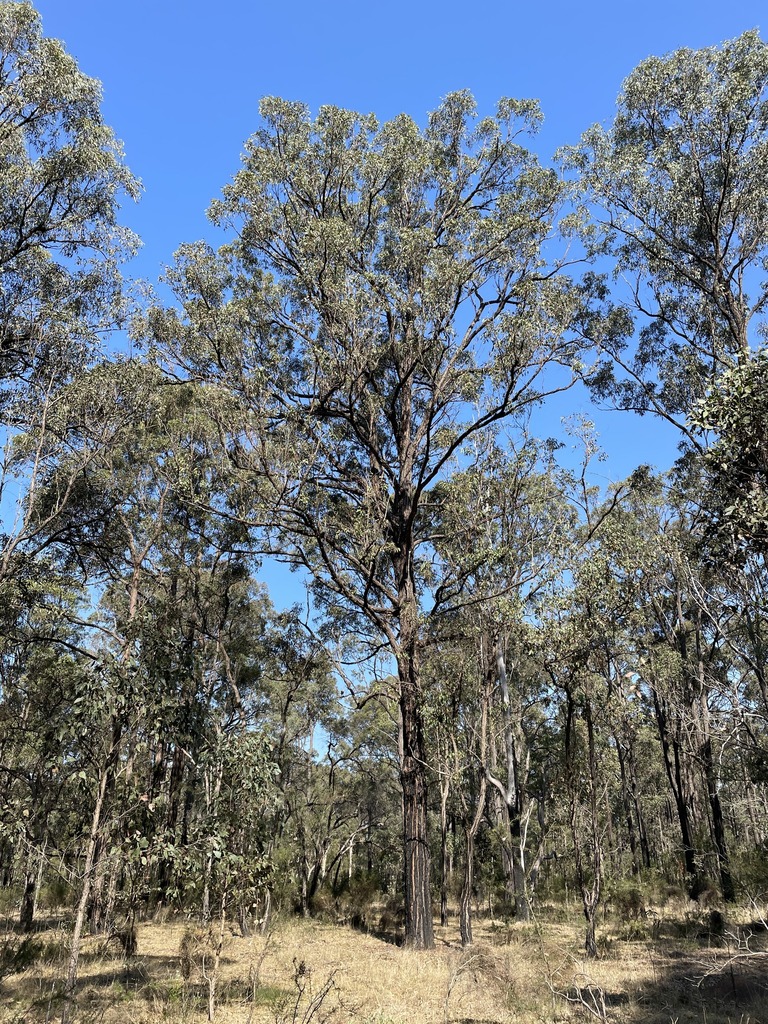
Red Ironbark
Eucalyptus fibrosa
Eucalyptus fibrosa, commonly known as the red ironbark, broad-leaved red ironbark or broad-leaved red ironbark, is a species of medium-sized to tall tree endemic to eastern Australia. It has grey to black ironbark, lance-shaped to egg-shaped adult leaves, flower buds in groups of between seven and eleven, white flowers and conical fruit.
From the article Eucalyptus fibrosa on Wikipedia (CC BY-SA), quoted section by section
Description
Eucalyptus fibrosa is a tree that typically grows to a height of 35 m (115 ft) and forms a lignotuber. It has rough, grey to black, sometimes flaky ironbark from the base of the trunk to the thinner branches. Young plants and coppice regrowth have petiolate, egg-shaped to more or less triangular or round leaves that are 80–200 mm (3.1–7.9 in) long, 45–140 mm (1.8–5.5 in) wide and a slightly lighter shade of green on one side. Adult leaves are lance-shaped to egg-shaped, the same shade of green on both sides, 85–180 mm (3.3–7.1 in) long and 15–45 mm (0.59–1.77 in) wide on a petiole 13–30 mm (0.51–1.18 in) long. The flower buds are arranged on the ends of branchlets in groups of seven, nine or eleven on a branching peduncle 9–20 mm (0.35–0.79 in) long, the individual buds on pedicels 2–8 mm (0.079–0.315 in) long. Mature buds are spindle-shaped, 8–17 mm (0.31–0.67 in) long and 3–5 mm (0.12–0.20 in) wide with a conical to horn-shaped operculum. Flowering has been recorded in most months and the flowers are white. The fruit is a woody, conical capsule 5–10 mm (0.20–0.39 in) long and wide with the valves close to rim level. Some other ironbarks occurring in the same area including E. siderophloia, E. rhombica and E. decorticans are similar but all have smaller buds and fruit, and a much shorter operculum than that of E. fibrosa.
Range & habitat
Red ironbark grows in forest on shallow, relatively infertile soil. It is widespread on the coast, tablelands and nearby inland areas from near Rockhampton in Queensland to Moruya in New South Wales.
Wikipedia: “Distribution and habitat”
Where it lives
Recorded sightings
—
geo-referenced records in GBIF, from museums, herbaria and field observers.
Drag the globe to turn it. Dots are where records exist, not a range map; darker means more records.
In the stacks
Searching the stacks…
Every page naming Eucalyptus fibrosa in the Biodiversity Heritage Library →
This page is assembled live from iNaturalist, GBIF, Wikipedia, the Source Library and the Internet Archive. It is not yet part of the hand-edited codex. iNaturalist taxon 323762.