Pouched Coral Fern
Gleichenia dicarpa
Gleichenia dicarpa, commonly known as pouched coral fern or tangle fern, is a small fern of the family Gleicheniaceae found in eastern Australia, New Caledonia and New Zealand. It can also be found in parts of Southeast Asia. It forms tangled thickets in wet places such as swamps and riverbanks.
From the article Gleichenia dicarpa on Wikipedia (CC BY-SA), quoted section by section
Description
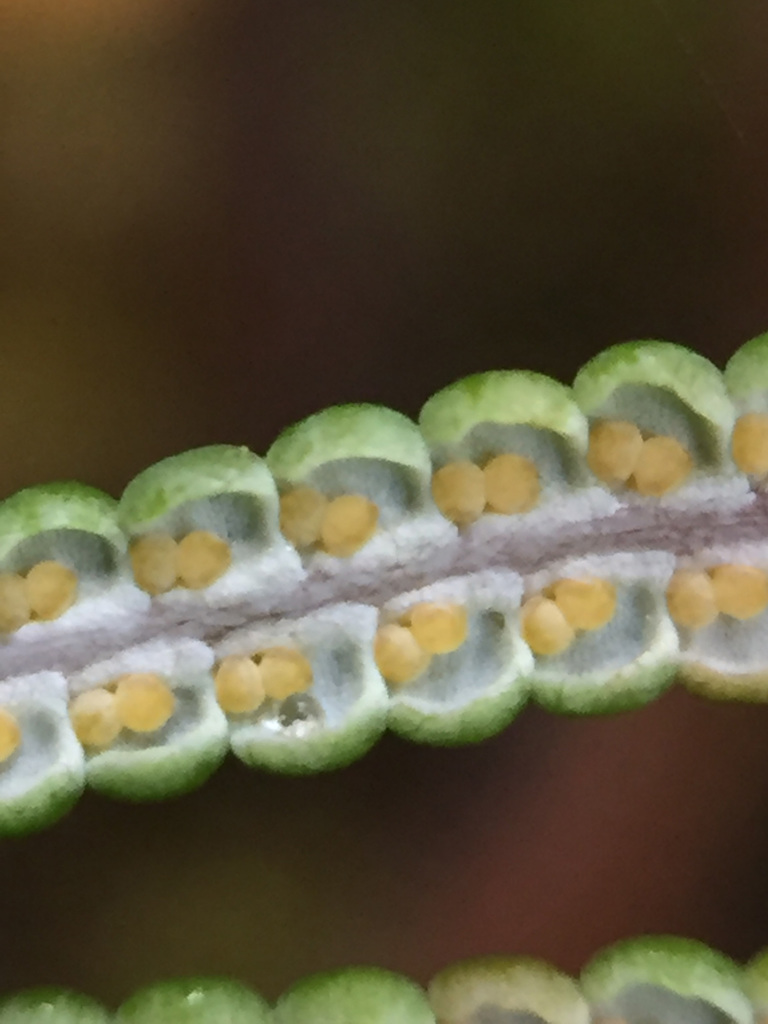
G. dicarpa consists of numerous fronds arising more or less vertically from a thin many branched rhizome. Each frond can reach 2 m (7 ft) in length with pinnae up to 4 cm (1.6 in) long. The smallest end-branches, known as pinnules, are a mere 1 to 1.5 mm long and recurved margins that give them a cup- or pouch shape. In fertile fronds, two spores lie within the pouch. It is these pouches which give the fern its common name. The spores are yellowish and darken to black when ripe. Fronds growing in sunnier areas often have a bleached yellow coloration.
Range & habitat
G. dicarpa is found throughout eastern Australia, from Queensland through New South Wales and Victoria and in Tasmania. It is widespread in Tasmania, where it is found up to altitudes of 900 m (3000 ft). It is widely distributed in New Zealand, where it is found on North, South and Stewart Islands, as well as the Chatham Islands. It is also found in New Caledonia. A common plant, often seen growing under waterfalls, in peatlands, under cliffs and in tall open forest. It can grow in nutrient poor conditions, preferring high humidity and good levels of sunshine and moisture. Its tangled roots collect detritus and prevent erosion. It can also be a pioneer species of disturbed ground.
Wikipedia: “Distribution and habitat”
How it is grown
Although not commercially available, G. dicarpa can be readily propagated from spores, and grows as long as it is not allowed to dry out and is not otherwise disturbed. It prefers acidic soil and sunny aspect.
== References ==
Wikipedia: “Cultivation”
Where it lives
Recorded sightings
—
geo-referenced records in GBIF, from museums, herbaria and field observers.
Drag the globe to turn it. Dots are where records exist, not a range map; darker means more records.
In the stacks
Searching the stacks…
Every page naming Gleichenia dicarpa in the Biodiversity Heritage Library →
This page is assembled live from iNaturalist, GBIF, Wikipedia, the Source Library and the Internet Archive. It is not yet part of the hand-edited codex. iNaturalist taxon 323510.