- Plants
- ›Vascular Plants
- ›flowering plants
- ›monocots
- ›grasses, sedges, cattails, and allies
- ›Rushes and Allies
- ›Juncus
- ›Agathryon
- ›Juncotypus
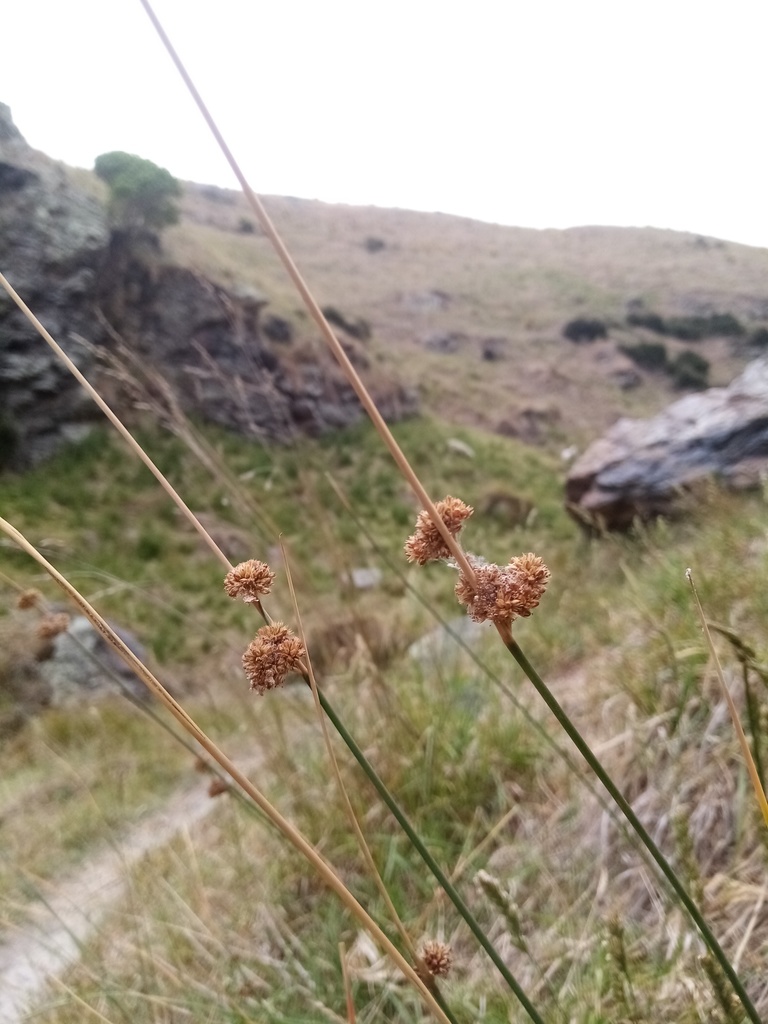
austral rush
Juncus australis
Juncus australis is a species of rush known by the common names austral rush, leafless rush and wīwī. The species is native to south-eastern Australia and New Zealand, where it can be found around bodies of water.
Its habitat is wet or seasonally wet grasslands and woodlands, and it can grow in dense and damp soil along rivers and creeks. It is a rhizomatous perennial rush that grows up to 120 centimetres tall. The plant flowers in clusters, with dense heads at the tip of the stem.
From the article Juncus australis on Wikipedia (CC BY-SA), quoted section by section
Description
Juncus australis grows predominantly in circular clumps, loosely packed and growing in an open habit. The clumps are often formed around one or a few live or dead stems in the centre of the clump, and grow on average 50 centimetres from other clumps. The stems of the plant grow vertically, growing 60–120 cm high. The stems are tough and not easily squashed or broken. The colouration of the culm is relatively dull, with no shine, and ranging from green to blue-green or grey-green. The diameter of the culm ranges from 1.5 millimetres to 4 millimetres, with each stem having 30-60 striations, having a consistent distance between each striation. The pith is not solid throughout the culm, generally having large, non-continuous air pockets throughout the stem. The plant has no leaves, but most culms have several bracts, changing in colour from yellow to brown. The basal sheaths are shiny at the base, and range in colour between dark yellow-brown and chestnut brown. The inflorescence appears in a lateral formation, with “flowers clustered at the ends of stroud branchlet tips; sometimes condensed into a globose head”. The flowers grow to be 2.2 to 3 millimetres long, and with a light green colouration, that turns to light brown later in the plant’s cycle. The flower heads are branched and are formed around one or more dense clusters. …
Range & habitat
The distribution of Juncus australis is almost completely natural. The species is not being intentionally planted anywhere, but grows and spreads across its habitats through its effective organic propagation mechanisms. Juncus australis is found across southeast Australia and parts of New Zealand. Within New South Wales, the plant has been noted as far north as Glen Innes, in the North Tablelands. The species is found in much of NSW, extending down from the North Tablelands to the Central Tablelands and Southern Tablelands, and going as far west as Wellington and Albury. There are also recorded sightings of the plant in coastal areas, such as on the Central Coast and the South Coast. It has also been recorded in the alpine regions of the Snowy Mountains and the Victorian Alps. The species has also been recorded in much of Victoria, but is more heavily distributed on the eastern side of the State, continuing the coastal line of distribution from NSW into the southeast corner of Australia. While the species in Australia is predominantly found along the south-east coastline, notably in New South Wales and Victoria, there are also recordings of the plant in Queensland, South Australia, the Australian Capital Territory, and Tasmania. …
Wikipedia: “Distribution”
What it does
Juncus australis has flowering and fruiting seasons that follow typical seasonal patterns of its temperate climate. The plant flowers from September to December, in synthesis with spring in the Southern Hemisphere. The fruiting season of Juncus australis ranges from November to May. The spatial pattern of dispersal is an important factor in the development of biotic communities. The propagation methods of Juncus australis allow for environmentally pervasive dispersal. The seeds are mucilaginous, which disperse through attachment, water and wind. The mucilaginous coating provides a hydrophobic and waxy seal that assists in floatation, allowing the seeds to disperse easily through movements of water. Wind dispersal is aided by propagules with a high surface area to volume ratio, increasing the potential dispersal range through increased air resistance, allowing the propagules to travel further. Due to the various propagation methods, Juncus australis plants are easily grown from fresh seeds. Juncus australis is a perennial rush species, meaning that its lifespan extends beyond a single year. Juncus australis plants, while blooming in the spring, typically survive through the winter to bloom again the following year.
Wikipedia: “Ecology”
At the table
Juncus australis is not often used by humans, with almost all of the species being naturally occurring in its habitats. In many cases it is regarded as a weed, particularly when it invades pasture lands. Juncus australis is not, and is unlikely to become, a popular garden plant. There are, however, uses for Juncus australis, particularly as a feature for landscaping. Due to its growth patterns in wetlands and damp soils, Juncus australis is a useful species to plant along bodies of water, such as edging for dams and waterways, as it can help with bank stabilisation. It has also been noted as an effective ornamental plant, providing a habitat for waterbirds around ponds. As a tough reed, it functions well as an ornamental planting around creeks and ponds, as both a feature plant and as a mass planting. The species is occasionally sold, and can be found in specialist native plant nurseries. There is also some evidence to suggest that there may have been some traditional uses of the plant by Aboriginal people. The seeds have been identified as a potential food source. The stems of Juncus species have also been used as fibre for string and basket making. This is reflected in the etymology of the name, as juncus comes from the Latin word ‘jungere’, meaning to tie or bind, identifying the usage of the stems to make cord.
== References ==
Wikipedia: “Uses”
Where it lives
Recorded sightings
—
geo-referenced records in GBIF, from museums, herbaria and field observers.
Drag the globe to turn it. Dots are where records exist, not a range map; darker means more records.
In the stacks
Searching the stacks…
Every page naming Juncus australis in the Biodiversity Heritage Library →
This page is assembled live from iNaturalist, GBIF, Wikipedia, the Source Library and the Internet Archive. It is not yet part of the hand-edited codex. iNaturalist taxon 323419.