- Plants
- ›Vascular Plants
- ›flowering plants
- ›Dicots
- ›Mints, Plantains, Olives, and Allies
- ›broomrape family
- ›Rhinantheae
- ›Euphrasia
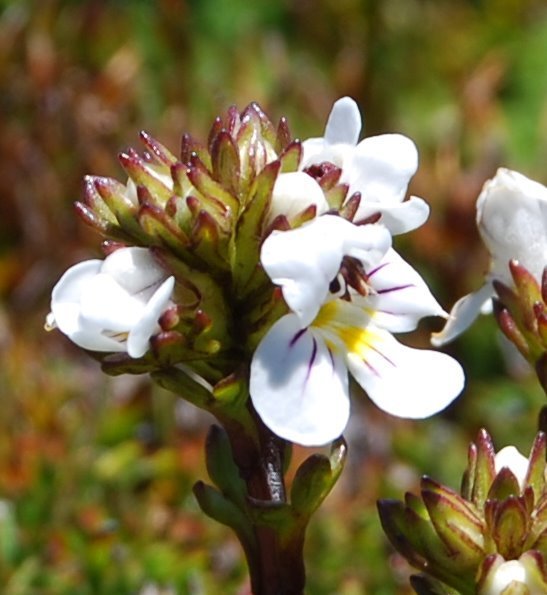
striate eyebright
Euphrasia striata
Euphrasia striata, commonly known as ‘shiny striped eyebright’ is an endemic Tasmanian species, which is a member of the Scrophulariaceae family. The distinctive purple striations on the petals, from which the name was derived, are characteristic of the species.
From the article Euphrasia striata on Wikipedia (CC BY-SA), quoted section by section
Description
Euphrasia striata is a short, perennial herb which is unbranched above ground. It generally ranges from 5 – 20 cm in height and has a width of 20 – 30 cm. Its leaves (measuring up to 9mm in length) are glossy, fleshy, opposite, widest at the top, prominently lobed with a pointed apex green and brownish purple in colour. Flowers have white petals with three distinctive purple striations, a yellow patch within the throat of the corolla., anthers with a short awn, and are arranged in terminal spikes. Flowering occurs from summer to autumn. Fruit takes the form of a pointed capsule between 4 and 6 mm long
Key distinguishing characteristics. Key characteristics distinguishing Euphrasia striata from other Euphrasia species:
Purple striations on petals No hairs on the stamens where anthers attach Plant not branched above ground
Range & habitat
Euphrasia striata is commonly occurring in alpine and sub-alpine areas., especially in the higher altitude grasslands of Tasmania's central and southern highlands
Wikipedia: “Habitat and distribution”
What it does
Euphrasia striata prefers areas of open alpine habitat, which is maintained through exposure to harsh conditions such as strong winds and low temperatures. This habitat preference is explained by the requirement of light for seed germination. Euphrasia striata is semi-parasitic, forming a non-specific relationship with hosts during seedling establishment. This semi-parasitic nature helps the species survive the harsh conditions it often inhabits.
== References ==
Wikipedia: “Ecology”
Where it lives
Recorded sightings
—
geo-referenced records in GBIF, from museums, herbaria and field observers.
Drag the globe to turn it. Dots are where records exist, not a range map; darker means more records.
In the stacks
Searching the stacks…
Every page naming Euphrasia striata in the Biodiversity Heritage Library →
This page is assembled live from iNaturalist, GBIF, Wikipedia, the Source Library and the Internet Archive. It is not yet part of the hand-edited codex. iNaturalist taxon 323370.