- Plants
- ›Vascular Plants
- ›flowering plants
- ›Dicots
- ›proteas, lotuses, planes, and allies
- ›Protea family
- ›Paired Proteas
- ›Embothrieae
- ›Hakeinae
- ›Hakea
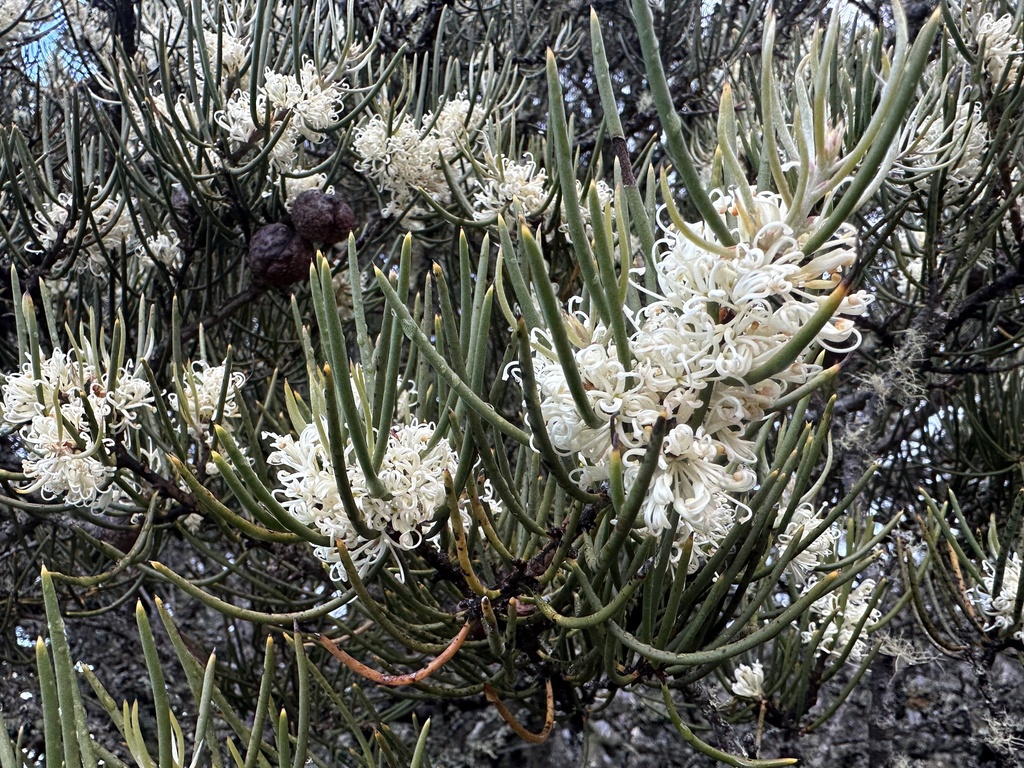
Mountain Needlewood
Hakea lissosperma
Hakea lissosperma is a type of spreading shrub with almost 4 metres height, needle-shaped leaves and white flowers. In 1999 it was recognised that it grows commonly in over 1200 m rocky mountains, in subalpine woodland. And common names include needle bush and mountain needlewood. What is more, this species is a favourite of birds due to the dense clusters of flowers and pungent rigid needle-shaped leaves which can be a shelter against predators. It is...
From the article Hakea lissosperma on Wikipedia (CC BY-SA), quoted section by section
Description
The mountain needlewood is a spreading shrub or small tree commonly with spiny leaves and dense clusters of white flowers, growing approximately from 2 to 6 metres (7 to 20 ft) in height. It is a low woody plant with several main stout branches. The flat evergreen leaves are terete, usually 6 to 10 centimetres (2.4 to 3.9 in) in length and 1.5 to 2 millimetres (0.059 to 0.079 in) wide. The leaf follicles are usually 20 to 30 mm (0.79 to 1.18 in) long and 15 to 20 mm (0.59 to 0.79 in) wide while the mature ones are about 2.3 to 2.7 cm (0.91 to 1.06 in) and 1.7 to 2 cm (0.67 to 0.79 in) wide and coarsely wrinkled or blistered.
Flowers and Regeneration. Flowers commonly form in late spring and early summer between October and December in alpine areas, earlier at lower altitudes. The flowers are white or cream in colour and clustered in leaf axils on stalks usually 4 to 6 mm (0.157 to 0.236 in) long. The perianth is usually glabrous and 5 to 6 mm (0.197 to 0.236 in) in length. The fruit that forms after flowering commonly becomes hard and brown or grey-brown when it is mature usually in the second year after flowering. Immature fruit will not ripen off the plant and fruit is usually held on the plant for several years. Seed is usually not occupying whole valve face. Each seed is usually 17 to 23 mm (0.669 to 0.906 in) long and 6.5 to 10.5 mm (0.256 to 0.413 in) wide. …
Range & habitat
H. lissosperma is found in Tasmania, Victoria, New South Wales and the Australian Capital Territory. In Tasmania the species is commonly found in the following areas: Break O'Day, Central Highlands, Circular Head, Derwent Valley, Dorset, Flinders Island, Glamorgan-Spring Bay, Hobart, Huon Valley, Kentish, Kingborough, Launceston, Meander Valley, Northern Midlands, Southern Midlands, Tasman, Waratah-Wynyard, West Coast. In Victoria it is found in the east parts including; East Gippsland, Fall Highlands, Victorian Alps and Snowy Mountains. In New South Wales it is found only in alpine areas in the south east surrounding the Australian Capital Territory.
Wikipedia: “Distribution”
How it is grown
This tree should only be planted in a sheltered location. Seeds can be collected any time of year but only from older fruit which is usually grey-brown in colour. The seeds must then be leached and the dry fruit will usually open in 2–3 weeks or place in an oven 80 to 100 °C (176 to 212 °F) for 30 minutes with the door partially open. Besides leaching, stratification can also be used. Once planted the germination time is approximately 6 months. The species is a favourite of birds due to the dense clusters of flowers and pungent rigid needle-shaped leaves which can be a shelter against predators. It is also resistant to wildlife browsing due to its unpalatability.
== References ==
Wikipedia: “Cultivation”
Where it lives
Recorded sightings
—
geo-referenced records in GBIF, from museums, herbaria and field observers.
Drag the globe to turn it. Dots are where records exist, not a range map; darker means more records.
In the stacks
Searching the stacks…
Every page naming Hakea lissosperma in the Biodiversity Heritage Library →
This page is assembled live from iNaturalist, GBIF, Wikipedia, the Source Library and the Internet Archive. It is not yet part of the hand-edited codex. iNaturalist taxon 323333.