- Plants
- ›Vascular Plants
- ›flowering plants
- ›Dicots
- ›proteas, lotuses, planes, and allies
- ›Protea family
- ›Paired Proteas
- ›Embothrieae
- ›Hakeinae
- ›Hakea
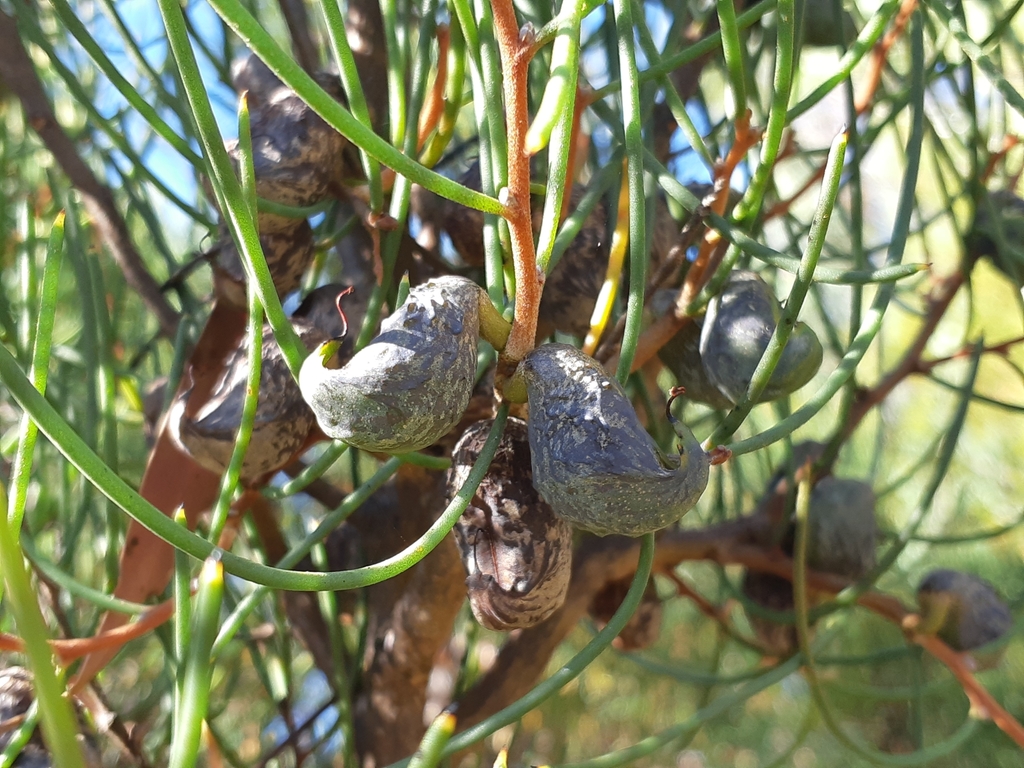
beaked hakea
Hakea epiglottis
Hakea epiglottis is a species of shrub in the family Proteaceae, endemic to Tasmania. It grows to 3 metres tall, with leaves which are 1.5 to 7.5 cm long and 1 to 2 mm wide. The young leaves are covered in rust-coloured hairs, which distinguishes this species from the similar Hakea megadenia.
From the article Hakea epiglottis on Wikipedia (CC BY-SA), quoted section by section
Description
Hakea epiglottis grows to 3 m (10 ft) tall. The inflorescence on male plants have 2-8 flowers whereas female plants have 1–3 flowers. The bracts are 3–4 mm (0.3–0.4 cm) long on a stem about 1 mm (0.04 in) long. The flower stems are 3.5–5 mm (0.4–0.5 cm) long with flat white silky hairs extending on to sepals that are 2.5–4 mm (0.1–0.2 in) long and pale yellow inside. The pistil is recurved 5.5–6.5 mm (0.2–0.3 in) long. The style has a small pollen disc which is concave in male flowers but with a conical protuberance in female flowers. Fruit are shaped like the letter 'S' and are 1.4–2.6 cm (0.6–1 in) long. Needle-like leaves are 1.5–11 cm (0.6–4 in) long and 1–2 mm (0.04–0.08 in) wide. The young leaves are covered in rust-coloured hairs, which distinguishes this species from the similar Hakea megadenia. Unisexual populations have male plants which do not produce fruit but flowers that produce pollen. Female populations have fruit with no pollen. There are recorded populations of bisexual plants where the fruit occur together with flowers producing pollen. A 1989 publication by John Wrigley & Murray Fagg states that specimens at Wakehurst Place, an annexe of Kew Gardens London, are believed to be 60-70 years old measuring 3 m (9.8 ft) high and wide. Clusters of white through to bright yellow flowers appear in leaf axils in spring.
Range & habitat
Hakea epiglottis is a common species found in all but the north-east coast of Tasmania growing in peaty heath.
== References ==
Wikipedia: “Distribution and habitat”
Where it lives
Recorded sightings
—
geo-referenced records in GBIF, from museums, herbaria and field observers.
Drag the globe to turn it. Dots are where records exist, not a range map; darker means more records.
In the stacks
Searching the stacks…
Every page naming Hakea epiglottis in the Biodiversity Heritage Library →
This page is assembled live from iNaturalist, GBIF, Wikipedia, the Source Library and the Internet Archive. It is not yet part of the hand-edited codex. iNaturalist taxon 323332.