- Plants
- ›Vascular Plants
- ›flowering plants
- ›Dicots
- ›sandalwoods, mistletoes, and allies
- ›sandalwood family
- ›Leptomeria
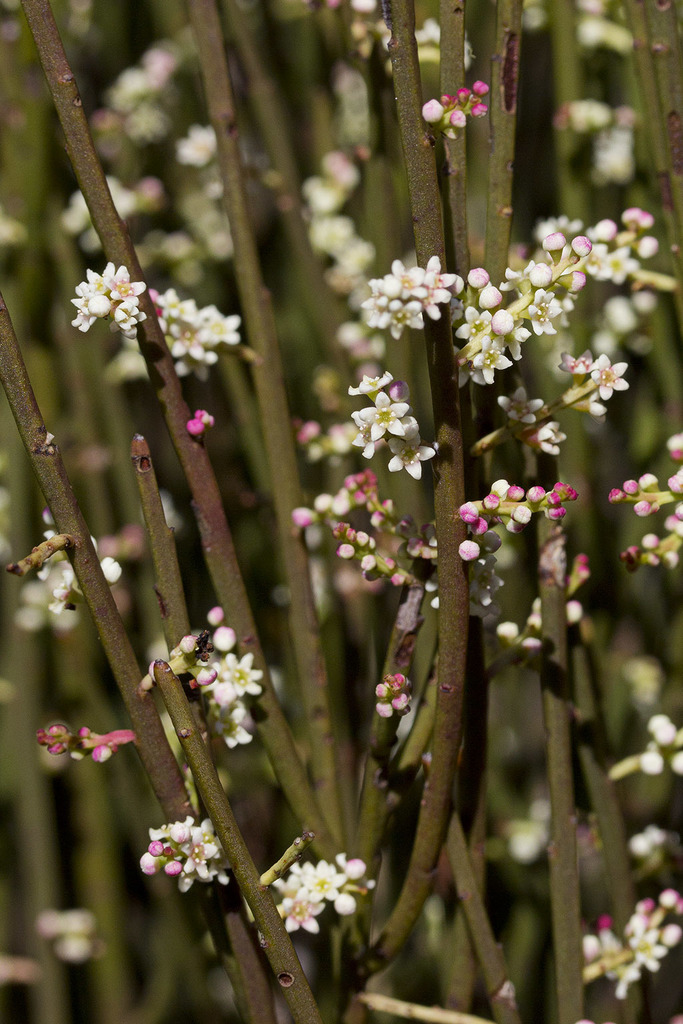
Pale Currant Bush
Leptomeria drupacea
Leptomeria drupacea, also known as the pale currant bush, is an endemic Australian hemi-parasitic erect shrub. It occurs commonly in dry woodlands across Tasmania Australia and in some parts of Victoria and Queensland. It has long yellowish-green slender branchlets that often give a broom-like appearance.
From the article Leptomeria drupacea on Wikipedia (CC BY-SA), quoted section by section
Description
Leptomeria drupacea is an upright green shrub that can grow up to 3m. Its flexible, almost cylindrical branchlets have longitudinal ridges, and its leaves and bracts are sessile and scale-like with a truncate base and a narrowly acute apex; 0.71mm long, 0.30mm wide. Its flowers are bisexual and are arranged into a raceme of around 10-16 flowers, which is typically inserted laterally to the branchlets. The pedicel of the flowers is obscure and hard to differentiate from the floral tube. The white to cream tepals (flushed reddish-pink upon ageing), 0.61mm long, are concave with an incurved and adaxially thickened apex that forms a hood with tiny hairs on the adaxial surface, restricted to small tufts. The floral disk is deeply lobed with a diameter of 0.60mm and the anthers, filaments and style are typically 0.10- 0.15mm long. The smooth drupe, 3-6mm, are oval to almost round with a fleshy thick epicarp. The drupes start green, ripen reddish and are edible. Flowering occurs late spring to summer.
Range & habitat
Leptomeria drupacea is found in open eucalypt forests and woodlands, heath or heath-sedgelands, and sandy communities across eastern mainland Australia and Tasmania alongside eucalypts, wattles and banksias.
Wikipedia: “Distribution and habitat”
Where it lives
Recorded sightings
—
geo-referenced records in GBIF, from museums, herbaria and field observers.
Drag the globe to turn it. Dots are where records exist, not a range map; darker means more records.
In the stacks
Searching the stacks…
Every page naming Leptomeria drupacea in the Biodiversity Heritage Library →
This page is assembled live from iNaturalist, GBIF, Wikipedia, the Source Library and the Internet Archive. It is not yet part of the hand-edited codex. iNaturalist taxon 323321.