- Plants
- ›Vascular Plants
- ›flowering plants
- ›Dicots
- ›proteas, lotuses, planes, and allies
- ›Protea family
- ›Paired Proteas
- ›Embothrieae
- ›Hakeinae
- ›Hakea
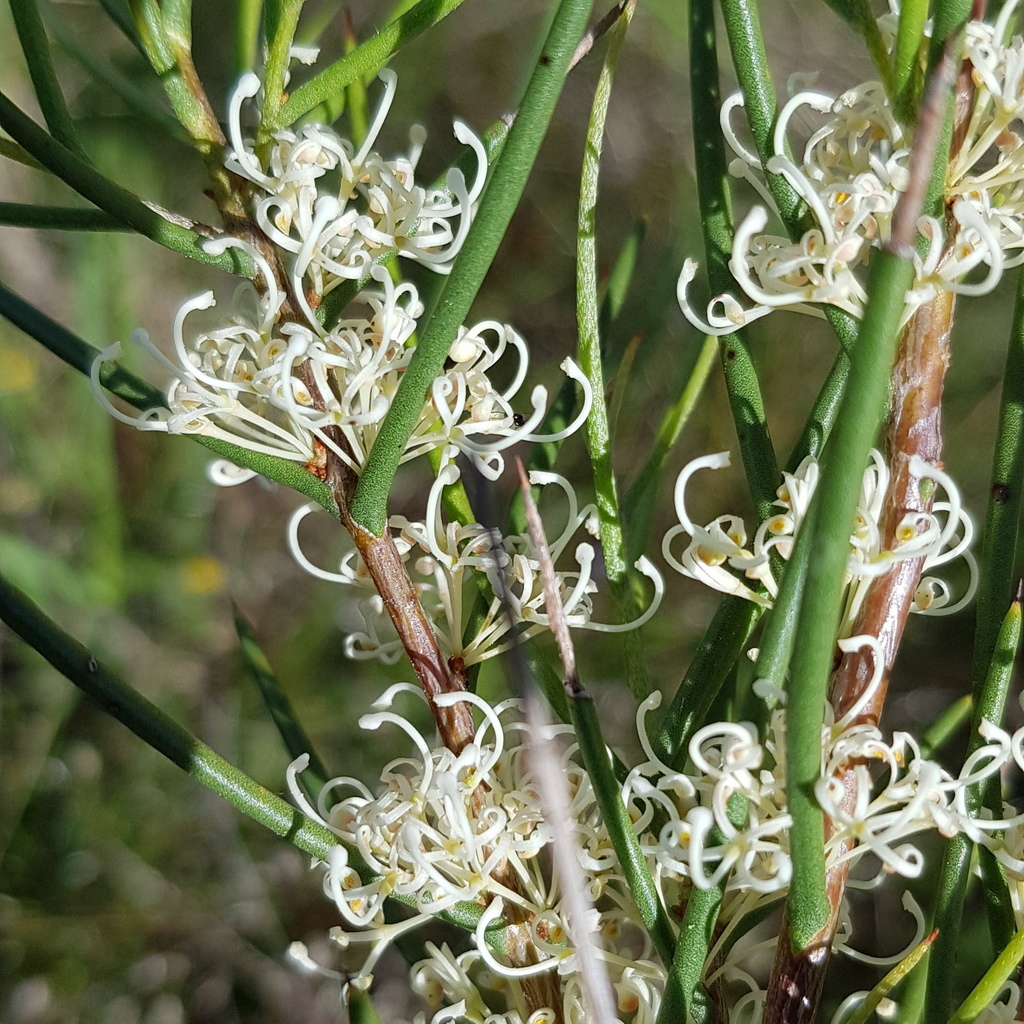
Small-fruit Hakea
Hakea microcarpa
Hakea microcarpa , commonly known as small-fruit hakea is a flowering plant in the family Proteaceae and is endemic to eastern Australia. It is a spreading shrub, often growing in woodlands, heathlands and near swamps in montane areas of eastern Australia.
From the article Hakea microcarpa on Wikipedia (CC BY-SA), quoted section by section
Description
Hakea microcarpa is a shrub growing to 2 m (7 ft) tall but often wider than tall. Its leaves and branches are glabrous except for a few hairs on new growth and which are lost by the time of flowering. The leaves are usually needle-shaped, 3–11 cm (1–4 in) long and about 1.5 mm (0.06 in) wide but sometimes there are a few flat leaves up to 5 mm (0.2 in) wide. The flowers are off-white in colour and are arranged in groups of ten to forty in the leaf axils. The stalk of each flower is 2–5 mm (0.08–0.2 in) long and the perianth is 2.5–3.5 mm (0.098–0.14 in) long. Flowering occurs from September to February and is followed by the fruit which is a woody follicle containing two winged seeds. The follicle is oblong in shape, about 16 mm (0.6 in) long and 7 mm (0.3 in) wide with a small point 2–3 mm (0.08–0.1 in) long on each of the two sides.
Range & habitat
Small-fruited hakea grows on the east coast and ranges of Australia from Stanthorpe to Tasmania where it grows in subalpine bogs, or in forest or woodland in damp sites.
== References ==
Wikipedia: “Distribution and habitat”
Where it lives
Recorded sightings
—
geo-referenced records in GBIF, from museums, herbaria and field observers.
Drag the globe to turn it. Dots are where records exist, not a range map; darker means more records.
In the stacks
Searching the stacks…
Every page naming Hakea microcarpa in the Biodiversity Heritage Library →
This page is assembled live from iNaturalist, GBIF, Wikipedia, the Source Library and the Internet Archive. It is not yet part of the hand-edited codex. iNaturalist taxon 323311.