- Plants
- ›Vascular Plants
- ›flowering plants
- ›Dicots
- ›myrtles, evening primroses, and allies
- ›myrtle family
- ›Myrtoideae
- ›Leptospermeae
- ›Leptospermum
Woolly Teatree
Leptospermum lanigerum
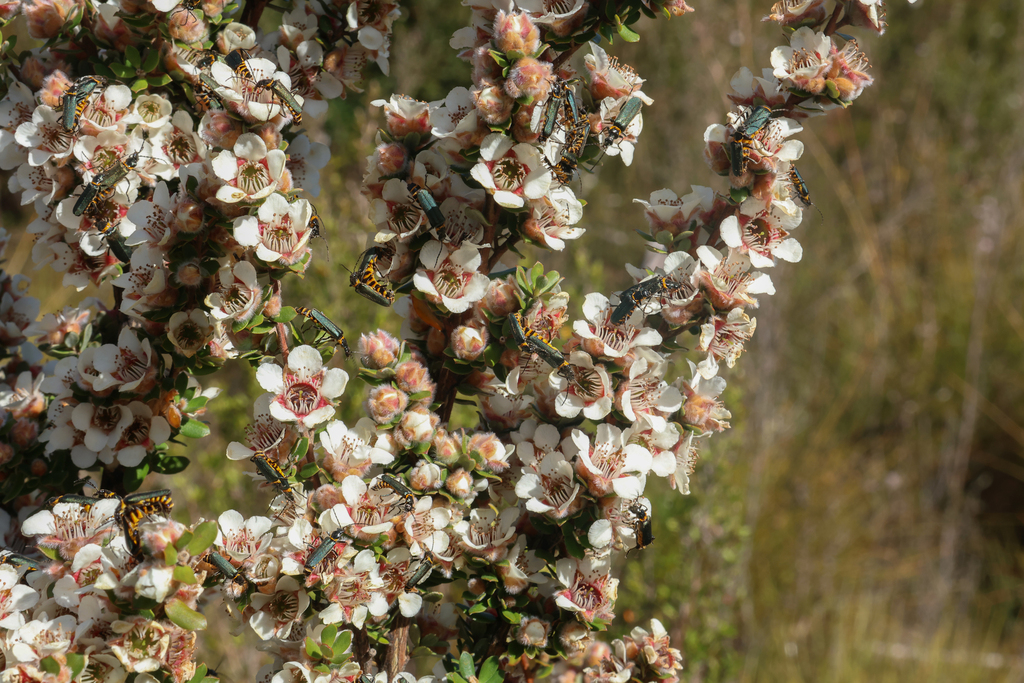
Leptospermum lanigerum, commonly known as the woolly teatree, is a small tree or medium shrub from the plant family Myrtaceae. Its common name derives from the conspicuously hairy capsules produced as fruit, along with the fine, silky hairs present on branches and leaves. L. lanigerum is widespread in many habitats, particularly in waterlogged areas such as moist, sandy coastal heaths, on river banks, riparian scrub, woodlands and on the fringe of montane grasslands. This species is endemic to Australia, with native populations occurring in New South Wales, South Australia, Tasmania and Victoria.
Flowers possess the typical characteristics present within the genus Leptospermum; five free, white petals, many stamens and five small sepals; although the most distinctive feature is the persistent hairy capsules and the silvery appearance of mature foliage.
From the article Leptospermum lanigerum on Wikipedia (CC BY-SA), quoted section by section
Description
This small tree to medium-sized shrub is variable in size and shape and present in a number of different forms. Plants can grow as large, spreading or erect shrubs up to 3 metres (9.8 ft) high by 3 metres (9.8 ft) across, or very compact, columnar shrubs, up to 3 m high and 1 metre (3.3 ft) across. L. lanigerum also grows as a slender tree up to 18 metres (59 ft) tall in montane habitats in Tasmania.
Leaves. Leaves are usually alternately arranged along the stem, oblong in shape and with slightly rolled margins. Leaves vary in size from 4–20 millimetres (0.16–0.79 in), with new growth usually covered in small, soft, silky hairs. These hairs usually cause the foliage to appear silvery grey, however leaves can vary in colour from silvery grey to dark green, or occasionally possess a glossy upper surface. Like all species in the family Myrtaceae, L. lanigerum leaves are dotted with small oil containing glands, and when crushed emit a strong, characteristic aroma. These oil glands allow for easy identification, and detailed analysis of the oils has assisted in the classification and taxonomy of species within the genus Leptospermum.
Flowers. Leptospermum lanigerum bears the characteristic flowers present within the genus Leptospermum: five distinctly separate, white petals, five small sepals, numerous stamens, along with inferior ovaries. …
Range & habitat
Leptospermum lanigerum is endemic to Australia, mainly distributed within the south eastern states. Native populations are found in eastern South Australia, across Victoria and southern New South Wales, as well as the whole of Tasmania. Plants are common and widespread, predominantly found in wet, swampy areas and along river banks, sandy coastal heaths or within woodlands. L. lanigerum is occasionally found growing in cool temperate rainforest in western Tasmania, however is a doubtful true rainforest species due to the need for disturbances such as fire to release seed. The hardy nature and preferred habitat of this plant makes it useful in riparian restoration and stream bank stabilisation, as they thrive in swampy areas where many other species do not. In Tasmania, L. lanigerum is a key swamp forest species. Swamp forests form in flat, poorly drained sites and contain a closed tree canopy made from sclerophyllous species of the genera Leptospermum, Acacia and Melaleuca. In Tasmania, L. lanigerum forms tall, dense stands, up to 18m in height. In other Australian states, individuals mainly exist as short, thick shrubs. Although this species is mainly present at low altitudes, some individuals also grow among sub-alpine vegetation and along the edge of montane grasslands. L. …
Wikipedia: “Distribution and habitat”
What it does
Leptospermum species are pollinated by insects, usually beetles. Each flower contains sweet nectar within the centre which acts as an attractant to beetles. These beetles then carry pollen on all parts of their body, mainly head and legs, to other flowers. The nectar, along with the insects present, also attracts other animals such as birds, making Leptospermum species and other Myrtaceae genera popular garden plants.
Wikipedia: “Pollination”
At the table
Leptospermum lanigerum was the first Leptospermum species to be brought into cultivation in March 1773. Captain Tobias Furneaux, of HMS Adventure, collected seed from Adventure Bay, Tasmania, as part of Captain James Cook's second visit to the South Seas. This seed was recorded as being in cultivation at the Royal Botanic Gardens, Kew, in 1774. Indigenous Australians had many uses for L. lanigerum, including the creation of kangaroo spears and double barbed spears from L. lanigerum wood. Young shoots and stems of many Leptospermum species were also used medicinally to treat urinary disorders. Although not widely drunk today, it is recorded that many Leptospermum species were used as a tea substitute by European settlers. Captain Cook's crew also brewed tea as they believed it would help prevent diseases such as scurvy.
== References ==
Wikipedia: “History and uses”
How it is grown
Leptospermum lanigerum is an adaptable species that can tolerate most soils and aspects. Plants are often propagated from seedlings or cuttings and sold in nurseries for garden use. This species is a popular garden plant, due to its attractive flowers and adaptability. Three main forms are known; a large, spreading or erect shrub to 3 m high and 3 m across, a compact columnar shrub to 3 m high by 1 m wide and a slender tree up to 18 m tall (only in Tasmania).
Wikipedia: “Propagation and cultivation”
Where it lives
Recorded sightings
—
geo-referenced records in GBIF, from museums, herbaria and field observers.
Drag the globe to turn it. Dots are where records exist, not a range map; darker means more records.
In the stacks
Searching the stacks…
Every page naming Leptospermum lanigerum in the Biodiversity Heritage Library →
This page is assembled live from iNaturalist, GBIF, Wikipedia, the Source Library and the Internet Archive. It is not yet part of the hand-edited codex. iNaturalist taxon 323290.