- Plants
- ›Vascular Plants
- ›flowering plants
- ›Dicots
- ›Sunflowers, Bellflowers, Fanflowers, and Allies
- ›fanflower family
- ›Scaevola
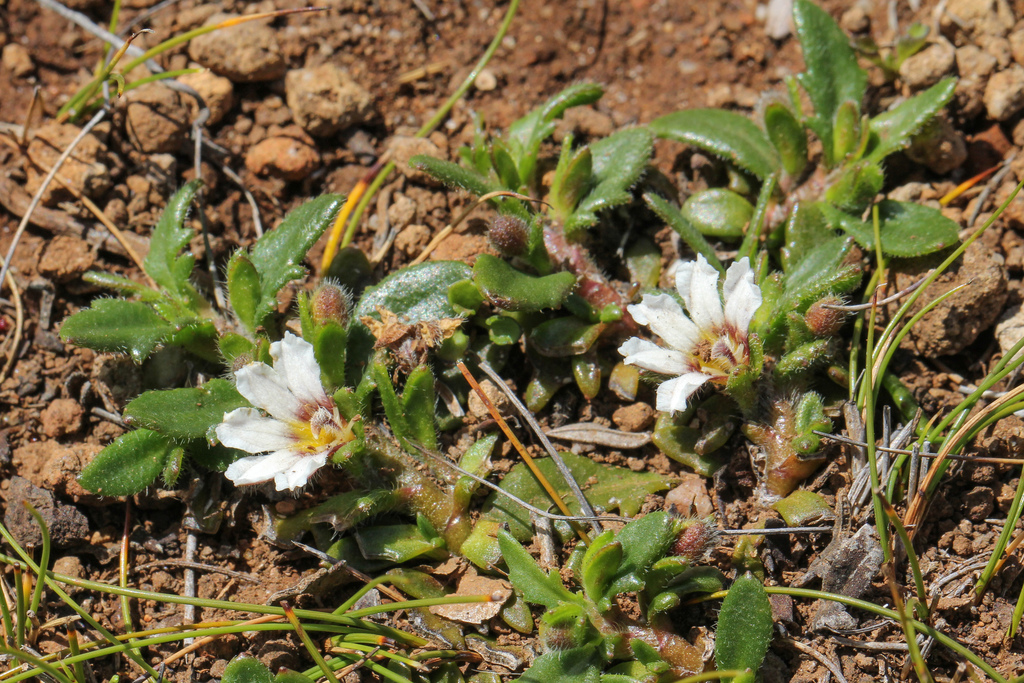
creeping fan-flower
Scaevola hookeri
Scaevola hookeri, the creeping fan-flower or alpine fan-flower, is a prostrate perennial herb in the family Goodeniaceae. It is native to eastern Australia. Leaves are 6 to 50 mm long and 2 to 15 mm wide. Flowers are white or blue with a yellowish throat and appear between December and March in the species native range. The species was first formally described by W.H. de Vriese in 1850 in Nederlandsch Kruidkundig Archief and given the name...
From the article Scaevola hookeri on Wikipedia (CC BY-SA), quoted section by section
Description
Scaevola hookeri is a prostrate, perennial herb with stems up to 30 cm (12 in) long that root at the nodes and long, rough, upright to soft, thin, weak hairs. The leaves are 1–5 cm (0.39–1.97 in) long, and 2 to 15 mm wide, oval to oblong, both surfaces with occasional flattened, soft, short hairs, margins flat, smooth or toothed on a short stalk. The flowers are borne singly in leaf axils, white or blue with a yellowish throat on a peduncle 1–8 mm (0.039–0.315 in) long, bracteoles oblong to elliptic shaped and 4–6 mm (0.16–0.24 in) long. The corolla is rough on the outside, with occasional soft, weak hairs on the inside and petals up to 1 mm (0.039 in) wide. Flowering occurs usually from November to March and the egg-shaped fruit is about 3 mm (0.12 in) long, wrinkled with short, soft, upright hairs.
Range & habitat
Creeping fan-flower grows in grassland and woodland in high altitude areas in Victoria, New South Wales, Tasmania, and also South Australia where it is listed as "endangered".
== References ==
Wikipedia: “Distribution and habitat”
Where it lives
Recorded sightings
—
geo-referenced records in GBIF, from museums, herbaria and field observers.
Drag the globe to turn it. Dots are where records exist, not a range map; darker means more records.
In the stacks
Searching the stacks…
Every page naming Scaevola hookeri in the Biodiversity Heritage Library →
This page is assembled live from iNaturalist, GBIF, Wikipedia, the Source Library and the Internet Archive. It is not yet part of the hand-edited codex. iNaturalist taxon 323238.