- Plants
- ›Vascular Plants
- ›flowering plants
- ›Dicots
- ›Heathers, Balsams, Primroses, and Allies
- ›heath family
- ›Epacrids, Styphelias and Allies
- ›Epacrideae
- ›Epacris
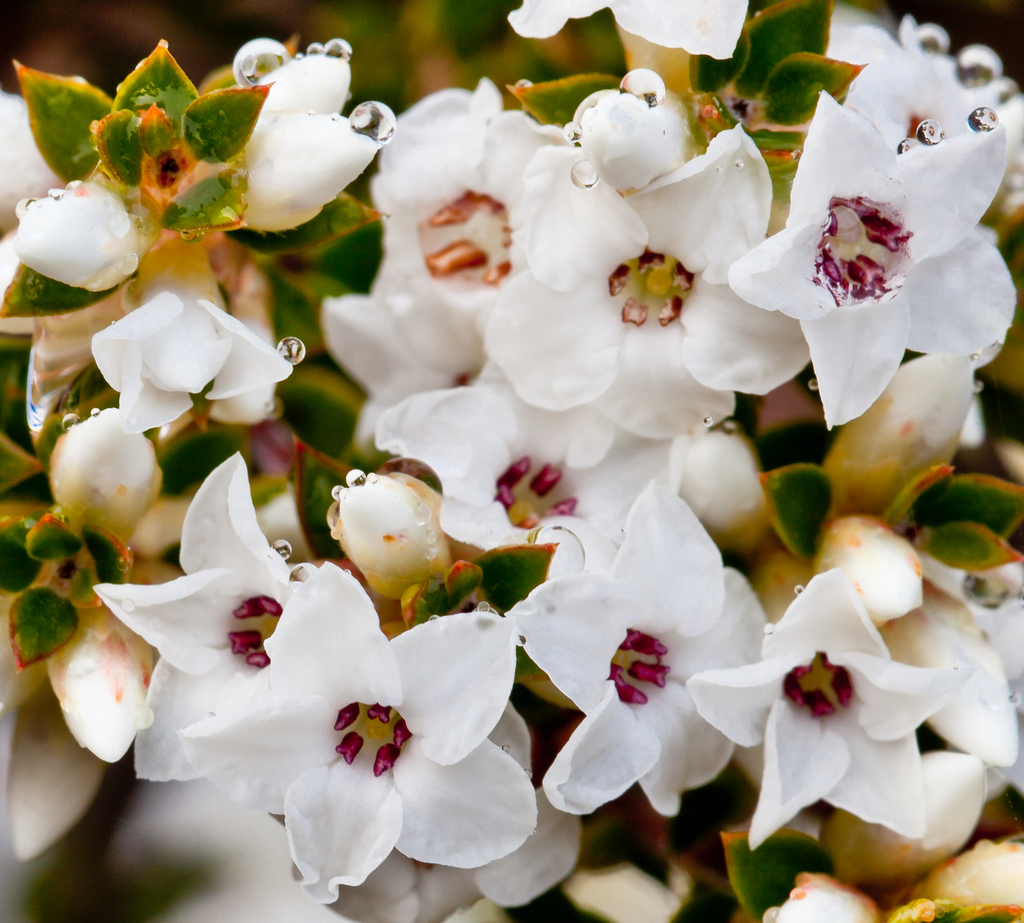
alpine heath
Epacris serpyllifolia
Epacris serpyllifolia, also known as alpine heath, is a plant of the heath family, Ericaceae, that is native to southeast Australia: the states of Tasmania, Victoria and New South Wales. Growing in heathland, sup-alpine and/or mountainous areas, it is generally a small shrub around 0.3 metres to 1.2 metres in height, with small stiff leaves. White tube-like flowers appear from spring to early summer. It regenerates after bushfire by seed or by resprouting.
From the article Epacris serpyllifolia on Wikipedia (CC BY-SA), quoted section by section
Description
Epacris serpyllifolia is a prostrate, low-lying or weakly erect, sometimes bushy shrub that typically grows to a height of up to 30 cm (12 in). Its leaves are egg-shaped, 2–6 mm (0.079–0.236 in) long, sometimes with a short point on the end. The flowers are borne in leaf axils near the ends of branches with often coloured sepals about 3 mm (0.12 in) long. The petal tube is slightly longer than the sepals and the petal lobes are shorter than the petal tube, and the anthers sometimes slightly longer than the petal tube.
Range & habitat
This epacris is endemic to Tasmania where it is widespread and abundant in alpine and subalpine areas.
== References ==
Wikipedia: “Distribution”
Where it lives
Recorded sightings
—
geo-referenced records in GBIF, from museums, herbaria and field observers.
Drag the globe to turn it. Dots are where records exist, not a range map; darker means more records.
In the stacks
Searching the stacks…
Every page naming Epacris serpyllifolia in the Biodiversity Heritage Library →
This page is assembled live from iNaturalist, GBIF, Wikipedia, the Source Library and the Internet Archive. It is not yet part of the hand-edited codex. iNaturalist taxon 323210.