- Plants
- ›Vascular Plants
- ›flowering plants
- ›Dicots
- ›Legumes, Milkworts, and Allies
- ›milkworts
- ›Polygaleae
- ›Comesperma
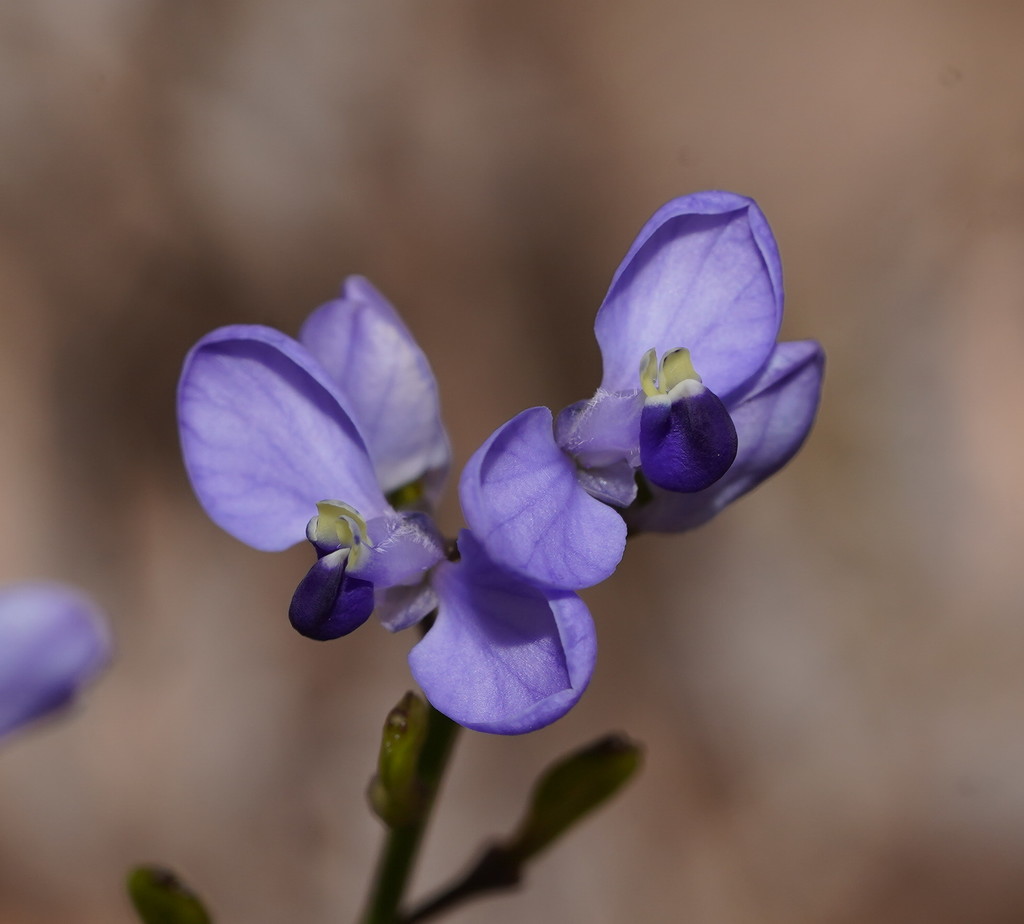
Love Creeper
Comesperma volubile
Comesperma volubile, commonly known as love creeper, is a slender climber in the family Polygalaceae. It grows to between 1 and 2 metres high. The leaves are 10 to 50 mm long and 1 to 5 mm wide. Blue or pale purple flowers are produced in sprays from July to December in the species native range. It occurs in heathland and forest in the states of Western Australia, South Australia, Tasmania, Victoria, New South Wales and Queensland in...
From the article Comesperma volubile on Wikipedia (CC BY-SA), quoted section by section
Description
Comesperma voluble is a twining creeper to about 3 m (9.8 ft) high on rare occasion a small shrublet with smooth, angled stems. There are few leaves, linear to oval-shaped, 10–45 mm (0.39–1.77 in) long, 1.5–9 mm (0.059–0.354 in) wide, lower surface pale, margins curved or rolled under. The flowers are in lateral racemes 3–25 cm (1.2–9.8 in) long, the sepals are separated, outer three broadly oval-shaped, about 2 mm (0.079 in) long, wings oval-shaped to nearly orb-shaped, 4–7 mm (0.16–0.28 in) long, keel darker, 3.5–5 mm (0.14–0.20 in) long, upper petals egg-shaped to oblong. Flowering occurs mainly August to November and the fruit is a narrow wedge-shaped capsule, 12–20 mm (0.47–0.79 in) long.
Range & habitat
Love creeper occurs in heathland and forest in the states of Western Australia, South Australia, Tasmania, Victoria, New South Wales and Queensland, in Australia.
== References ==
Wikipedia: “Distribution and habitat”
Where it lives
Recorded sightings
—
geo-referenced records in GBIF, from museums, herbaria and field observers.
Drag the globe to turn it. Dots are where records exist, not a range map; darker means more records.
In the stacks
Searching the stacks…
Every page naming Comesperma volubile in the Biodiversity Heritage Library →
This page is assembled live from iNaturalist, GBIF, Wikipedia, the Source Library and the Internet Archive. It is not yet part of the hand-edited codex. iNaturalist taxon 321125.