- Plants
- ›Vascular Plants
- ›flowering plants
- ›monocots
- ›Agaves, Orchids, Irises, and Allies
- ›Orchids
- ›Orchidoid Orchids
- ›Diurideae
- ›Cryptostylidinae
- ›Cryptostylis
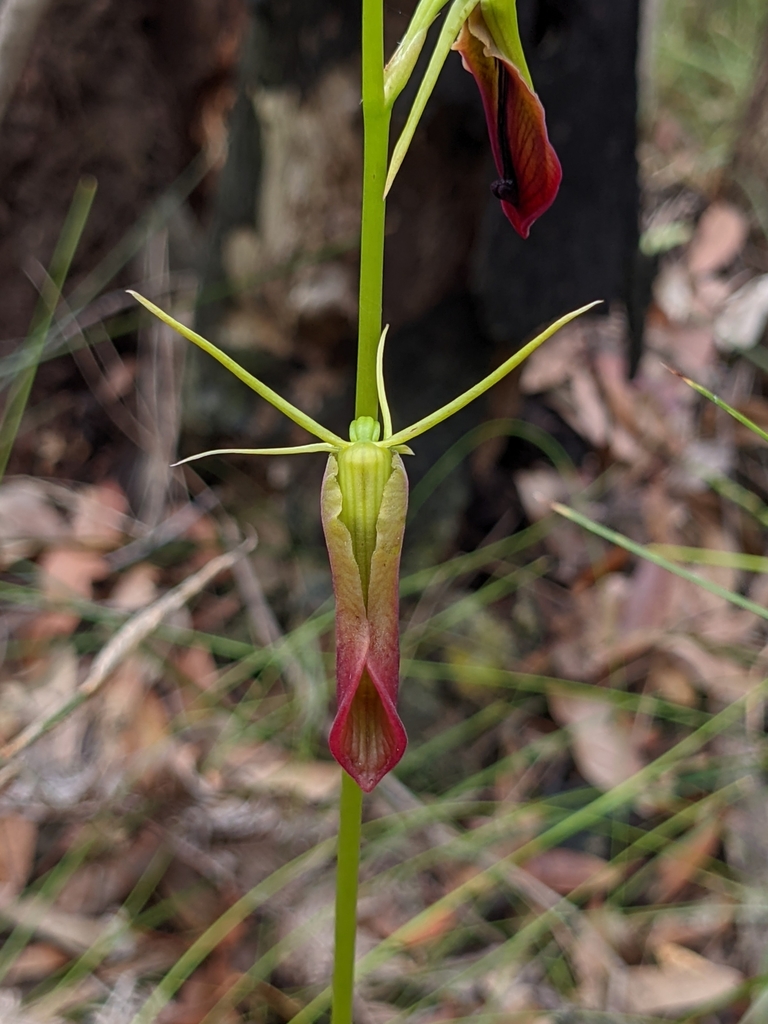
Large Tongue Orchid
Cryptostylis subulata
Cryptostylis subulata, known as the large tongue orchid grows in south eastern Australia. It was given its current name by H.G. Reichenbach in 1871, originally described by Labillardiere as Malaxis subulata in 1806 from Tasmania. The specific epithet subulata refers to the duck like shape of the flower's labellum. Sometimes this plant is known as the duck orchid, but this may cause confusion with the flying duck orchid.
From the article Cryptostylis subulata on Wikipedia (CC BY-SA), quoted section by section
Description
Cryptostylis subulata is a terrestrial, perennial, deciduous, herb with leathery, dark green to yellowish-green leaves which sit on petioles that are anywhere from 1 to 15 cm (0.5 to 6 in) long. The leaves are lance-shaped and measure 5–20 cm (2–8 in) long and 1–3 cm (0.5–1 in) across. The inflorescences (flower spikes) appear from August to April and bear two to twenty individual flowers on a flowering stem which is 50–80 cm (19.5–31.5 in) tall. Each flower has three green sepals which are 1.8 to 3 cm (0.71 to 1.18 in) long, and two petals which are 1.0 to 1.3 cm (0.39 to 0.51 in) long and narrower than the sepals. The labellum is a rolled reddish brown, purplish or yellowish tube-like structure measuring 1.5–3.5 cm (0.59–1.38 in) long by 0.5–1 cm (0.20–0.39 in) across. There is a dark purple callus ending in two knobs on the lower side of the labellum.
Range & habitat
It is tolerant of a range of soils, from well-drained sandy heathland to swampy depressed areas, as well as dry eucalypt forest. It occurs mostly in coastal districts of Queensland, New South Wales, Victoria and Tasmania, although it is also found in the Blue Mountains. In New Zealand it is only known from swamps north of Kaitaia and Taipa-Mangonui.
Wikipedia: “Distribution and habitat”
What it does
Like other Australian members of its genus, it is pollinated by the ichneumon wasp known as the orchid dupe wasp (Lissopimpla excelsa), the males of which mistake the flower parts for female wasps and copulate with it.
Wikipedia: “Ecology”
How it is grown
Cryptostylis subulata has been successfully grown by orchid enthusiasts, but is slow growing. The rhizomes are delicate and resent disturbance, and need to be moist at all times.
== References ==
Wikipedia: “Use in horticulture”
Where it lives
Recorded sightings
—
geo-referenced records in GBIF, from museums, herbaria and field observers.
Drag the globe to turn it. Dots are where records exist, not a range map; darker means more records.
In the stacks
Searching the stacks…
Every page naming Cryptostylis subulata in the Biodiversity Heritage Library →
This page is assembled live from iNaturalist, GBIF, Wikipedia, the Source Library and the Internet Archive. It is not yet part of the hand-edited codex. iNaturalist taxon 321092.