- Plants
- ›Vascular Plants
- ›flowering plants
- ›Dicots
- ›myrtles, evening primroses, and allies
- ›myrtle family
- ›Myrtoideae
- ›gum trees
- ›Angophora
Dwarf apple
Angophora hispida
Angophora hispida grows as a mallee, or as a tree to about 7 m (23 ft) in height.
Its small size, especially when compared to its Angophora and Eucalyptus relatives, leads to it being known by the common name dwarf apple. It is native to a relatively small patch of central New South Wales – from just south of Sydney up to the Gosford area. The plant's leaves are sessile (stalk-less) and hug the stem with heart-shaped bases. Its previous name – A. cordifolia – referred to these cordate leaves. Another distinctive feature is the red bristly hairs that cover the branchlets, flower bases and new growth. This leads to the specific epithet hispida (meaning 'bristly').
From the article Angophora hispida on Wikipedia (CC BY-SA), quoted section by section
Description
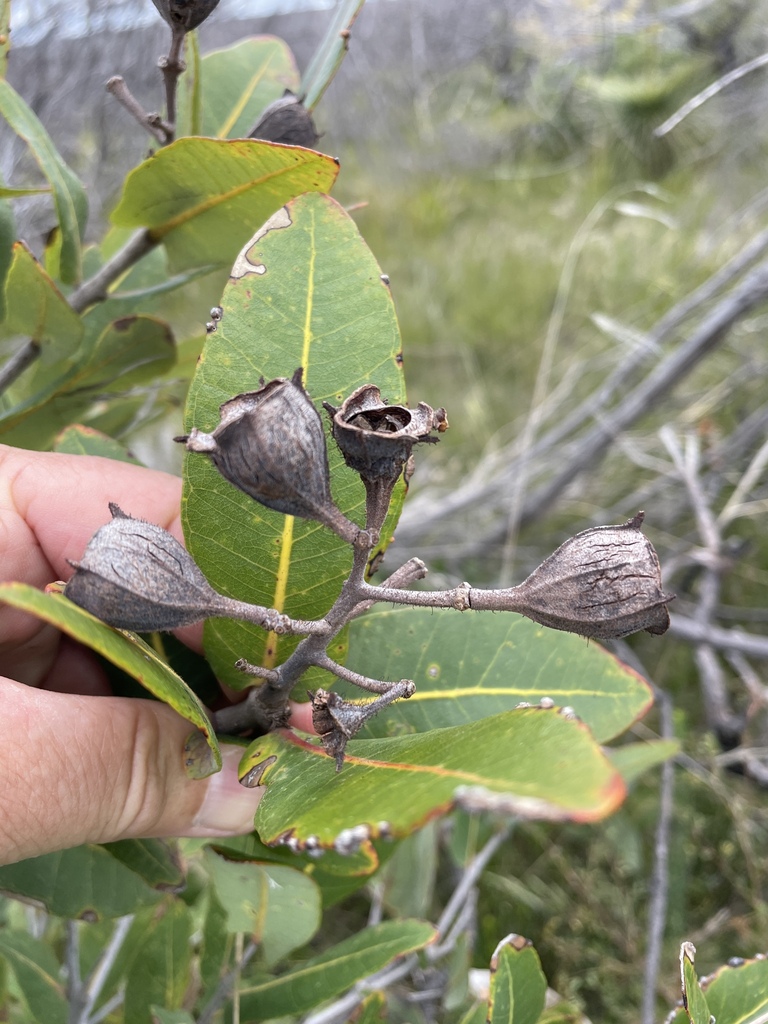
Dwarf apple grows as a small tree or mallee to 7 m (23 ft) high. It has greyish flaky bark. Like other members of the genus Angophora and unlike other eucalypts, the leaves are arranged oppositely along the stem. Sitting on petiole 0–4 mm long, the leaves are ovate to elliptic in shape, and measure 5–10 cm (2.0–3.9 in) in length and 3–4.5 cm (1.2–1.8 in) across, with a blunt rounded apex, and a cordate (heart-shaped) base. They are pale yellow-green above and greyish on their undersurface. New growth is covered in reddish hairs. Flowering takes place from November to January. The showy creamy-white flower heads are terminal and umbellate, each composed of three to seven flowers on 0.8–3.2 cm (0.31–1.26 in) long pedicels, which in turn branch off from a 1.5–7 cm (0.59–2.76 in) long peduncle. Like the new leaves and stems, developing buds are covered in reddish hair. Globular in shape with longitudinal ribbing, they grow to a diameter of 0.9–1.3 cm (0.35–0.51 in). The flowers fall leaving the cup-shaped woody seed pods or fruit, which measure 1.5–2.6 cm (0.59–1.02 in) long and 1.3–2 cm (0.51–0.79 in) in diameter. These shed the mature seed in February and March. The oval-shaped seeds are brown and flat, measuring 0.8–1 cm (0.31–0.39 in) long.
Range & habitat
Dwarf apple is found only in the Sydney Basin, as far south as O’Hares Creek off the Georges River, on dry sandstone soils low in nutrients. The associated plant communities are heath, scrubland or open woodland, with such species as scribbly gums (Eucalyptus racemosa and E. haemastoma), red bloodwood (Corymbia gummifera), narrow-leaved apple (Angophora bakeri), heath banksia (Banksia ericifolia), rusty banksia (B. oblongifolia), silver banksia (B. marginata), conesticks (Petrophile pulchella), scrub sheoak (Allocasuarina distyla), wax flower (Eriostemon australasius) and parrot pea (Dillwynia floribunda). It grows from sea level to an altitude of 300 m (980 ft) and with an annual rainfall of 800 to 1,600 mm (31 to 63 in).
Wikipedia: “Distribution and habitat”
What it does
Dwarf apple regenerates from bushfire by resprouting from its woody base, known as a lignotuber, or epicormic shoots. It can flower within a year of being burnt and plays an important role as a food source for nectar-eating insects after bushfire. The flowers attract birds, such as the noisy miner and wattlebirds, and a wide variety of insects, including honeybees, native bees, flies, moths and butterflies, and a wide array of beetles, including the rose chafer (Eupoecila australasiae), green-velvet flower chafer (Glycyphana brunnipes), the variable jewel beetle (Temognatha variabilis), the cowboy beetle (Chondropyga dorsalis), and a scarab beetle Bisallardiana gymnopleura, as well as members of the scarab genus Phyllotocus and soldier beetle genus Telephorus. The dwarf apple is a host for larvae of froghoppers, known as spittlebugs. Angophora hispida has been recorded as a host for the mistletoe species Muellerina eucalyptoides.
Wikipedia: “Ecology”
How it is grown
This is a small tree suitable for larger gardens, its red new growth and profuse white flowers are attractive horticultural features. Flowering in summer, the flowers attract brightly coloured beetles. It requires a sunny aspect and good drainage to grow well.
Wikipedia: “Use in horticulture”
Where it lives
Recorded sightings
—
geo-referenced records in GBIF, from museums, herbaria and field observers.
Drag the globe to turn it. Dots are where records exist, not a range map; darker means more records.
In the stacks
Searching the stacks…
Every page naming Angophora hispida in the Biodiversity Heritage Library →
This page is assembled live from iNaturalist, GBIF, Wikipedia, the Source Library and the Internet Archive. It is not yet part of the hand-edited codex. iNaturalist taxon 321070.