- Plants
- ›Vascular Plants
- ›flowering plants
- ›Dicots
- ›proteas, lotuses, planes, and allies
- ›Protea family
- ›Primitive Proteas
- ›Persoonieae
- ›Persoonia
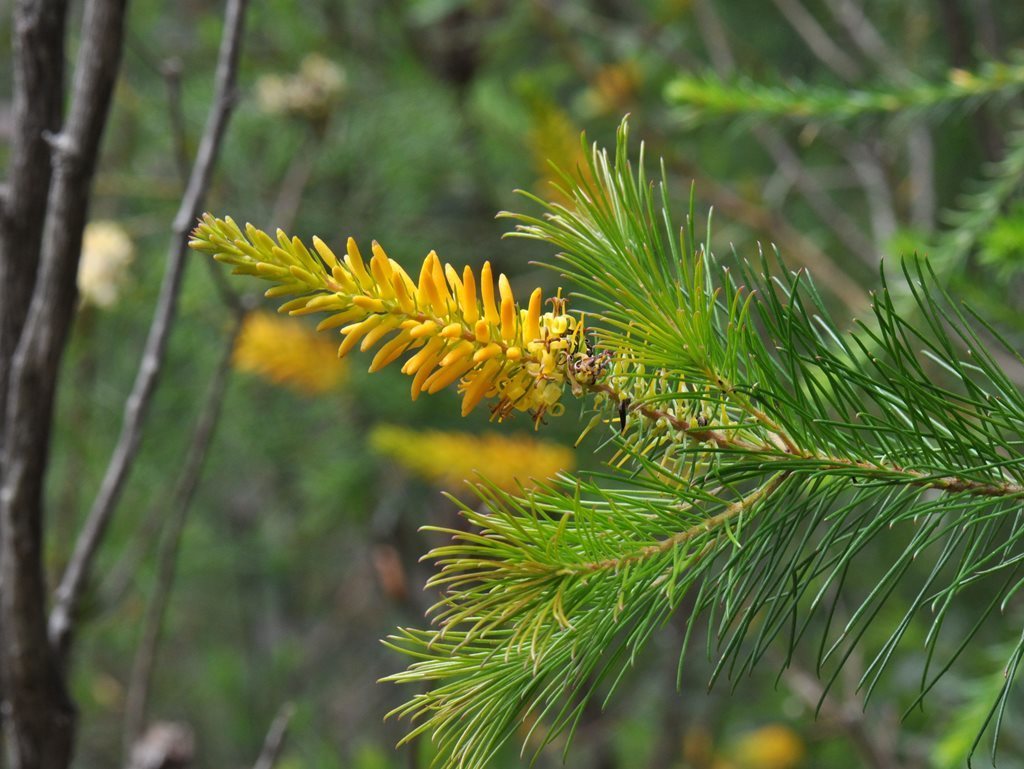
Pine-leaf Geebung
Persoonia pinifolia
Persoonia pinifolia, or pine-leaved geebung, is a large shrub which is native to the Sydney region in New South Wales, Australia. It can reach up to 3 metres in both height and width. It has narrow linear leaves to 70 mm long and terminal flower racemes late winter to spring. These are followed by fleshy green fruits (drupes) that have the appearance of a bunch of grapes.
From the article Persoonia pinifolia on Wikipedia (CC BY-SA), quoted section by section
Description
Persoonia pinifolia grows as an upright woody shrub up to 3 m (10 ft) high and wide. Its young branches are moderately hairy. The leaves are soft and thread-like, 30–70 mm (1–3 in) long, about 0.5 mm (0.02 in) wide, moderately hairy when young, but become glabrous as they age. The ends of the leaves are often curved. The flowers are arranged in long, terminal racemes making them much more conspicuous than those of most other persoonias. The flowers each have a moderately hairy pedicel 1–4 mm (0.04–0.2 in) long and there is a small leaf at the base of each flower. The flower is composed of four tepals 8–9 mm (0.3–0.4 in) long, which are fused at the base but with the tips rolled back. The central style is surrounded by four yellow anthers which are also joined at the base with the tips rolled back, so that it resembles a cross when viewed end-on. Flowering occurs mainly from late winter to summer, sometimes in other months. Flowering is followed by fruit which are fleshy green drupes giving the appearance of a bunch of grapes.
What it does
The fruits of P. pinifolia are taken by birds, including pied currawong, satin and regent bowerbirds, olive-backed oriole and Lewin's honeyeater but how this affects seed dispersal is not known. Unlike most Proteaceae, Persoonia pinifolia does not have proteoid roots.
Wikipedia: “Ecology”
How it is grown
Pine-leaved geebung is an attractive plant in the garden, but it is difficult to propagate from seed or cuttings. Success has been achieved by clipping the seed coating followed by treatment with gibberellic acid solution. Some clones seem to produce seed that germinates more readily. The species is reliable in gardens in an open sunny spot with good drainage, and requires little maintenance. The flowers, although small, are well displayed and the plant tolerates reasonably heavy frosts. It is a good hedge or screen plant and often flowers from January to August, followed by interesting olive-like fruit. Tissue culture has been shown to be successful with P. pinifolia and some other species of persoonia.
== References ==
Wikipedia: “Use in horticulture”
Where it lives
Recorded sightings
—
geo-referenced records in GBIF, from museums, herbaria and field observers.
Drag the globe to turn it. Dots are where records exist, not a range map; darker means more records.
In the stacks
Searching the stacks…
Every page naming Persoonia pinifolia in the Biodiversity Heritage Library →
This page is assembled live from iNaturalist, GBIF, Wikipedia, the Source Library and the Internet Archive. It is not yet part of the hand-edited codex. iNaturalist taxon 320841.