- Plants
- ›Vascular Plants
- ›flowering plants
- ›Dicots
- ›sandalwoods, mistletoes, and allies
- ›schoepfia family
- ›Schoepfia
arana
Schoepfia arenaria
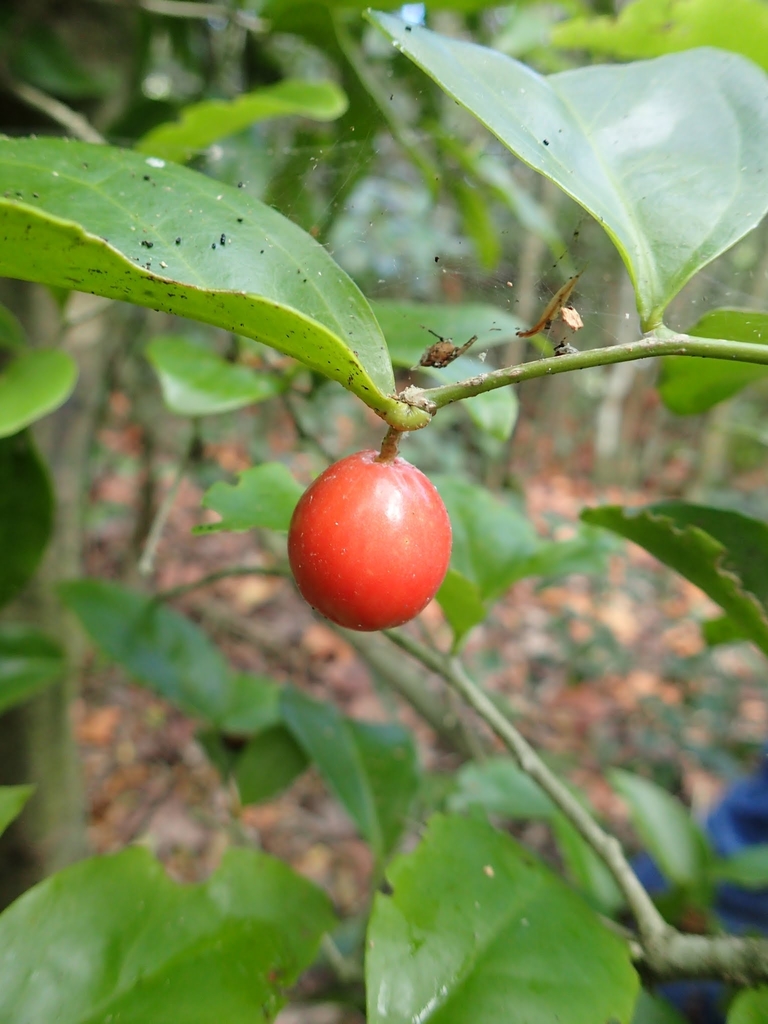
Schoepfia arenaria is an extremely rare species of hemiparasitic flowering plant in the Schoepfiaceae family. It grows as a small, multi-trunked tree. It is endemic to Puerto Rico, where it is found growing along the northern coast. A local Spanish vernacular name recorded for this tree is araña ('spider'). It has no common name in English.
From the article Schoepfia arenaria on Wikipedia (CC BY-SA), quoted section by section
Description
Schoepfia arenaria is a small evergreen tree growing to 6m in height. It generally grows as a cluster of trunks from the base at ground-level, up to 10cm in diameter. The wood is light brown and hard. The trunks are covered in very thick, furrowed, grey-coloured bark. These bear thin twigs devoid of hairs, but striated with streaks of whitish cork from a young age. The bark is coloured grey, the outer bark becoming chocolate brown on the inside and the inner bark is pink. The leaves are simple, alternate, and lack stipules. The ovate leaves are 4.5-8.5(-11)cm long by 3–4.5(-6)cm in width, and gradually become narrower towards their end, tapering to an obtuse or subacute (not really sharp) tip. The base is rounded or broadly becomes wider, slightly inequilateral. The texture is firm, almost leathery or like thick paper, and usually sparely tuberculate on both sides. The colour of the leaves is glaucous, pale green to olive; the leaves have a dull sheen when not wet. There is a flat or slightly raised midrib from which 4 or 5 pairs of lateral veins curve towards the apex (never looping back to the midrib), of which the first pair appears at the very base of the leaf. These veins are also flat or slightly raised on both sides. …
Range & habitat
It is endemic to the US island of Puerto Rico in the Caribbean. It occurs in the northern coastal part of the island. It was originally collected along a beach near the town of Santurce, now a suburb of the capital city of Puerto Rico, San Juan. The species was collected here again in 1939, but it is most certainly eliminated from the area at present. In 1991 there are only about 200 individuals known to exist in the wild, and they were divided amongst five locations. The World Conservation Monitoring Centre stated in their 1998 IUCN Red List assessment that there were only about 120 individuals known to exist after Hurricane Hugo had destroyed a number of the plants, but that the hurricane had caused a large crop of seeds to grow. Hurricane Hugo hit Puerto Rico in 1989, so the assessment may have been written a considerable time before it was accepted into the Red List and rather outdated. The four originally known localities are at Isabela, Fajardo, Piñones Commonwealth Forest and Río Abajo Commonwealth Forest. The largest population, some 100 individuals of all ages, is found at Isabela, on private land. These plants are found growing on the wooded upper slopes of the hills to the west of the mouth of the Guajataca Gorge. The hills are only a remnant of the original land, most other hills in this area were destroyed during construction of Highway 2. …
Wikipedia: “Distribution”
What it does
It is thought to be hemiparasitic. The flowers of S. arenaria appear mainly in the spring and fall, and the fruit in the summer and winter.
It is known from elevations of 0-30m. It was originally collected amongst other shrubs atop the higher sand dunes along a beach in what is now a suburb of the capital city of Puerto Rico. Millspaugh noted in 1900 that the flora of the sandy beaches around San Juan was unique in the Antilles, differing from the usual coastal species of the Caribbean. The most common plants found here were Wedelia trilobata, Bidens leucantha, Coccoloba uvifera and Ipomoea pes-caprae. The habitat in which modern populations are mostly found is small limestone hills in coastal, evergreen and semi-evergreen, subtropical, moist thickets or forests.
Wikipedia: “Ecology”
Where it lives
Recorded sightings
—
geo-referenced records in GBIF, from museums, herbaria and field observers.
Drag the globe to turn it. Dots are where records exist, not a range map; darker means more records.
In the old herbals & bestiaries


In the stacks
Searching the stacks…
Every page naming Schoepfia arenaria in the Biodiversity Heritage Library →
This page is assembled live from iNaturalist, GBIF, Wikipedia, the Source Library and the Internet Archive. It is not yet part of the hand-edited codex. iNaturalist taxon 320162.