- Plants
- ›Vascular Plants
- ›flowering plants
- ›Dicots
- ›saxifrages, stonecrops, and allies
- ›stonecrop family
- ›Pig's Ears, Flaming Katies, Butterbushes, and Allies
- ›Kalanchoe
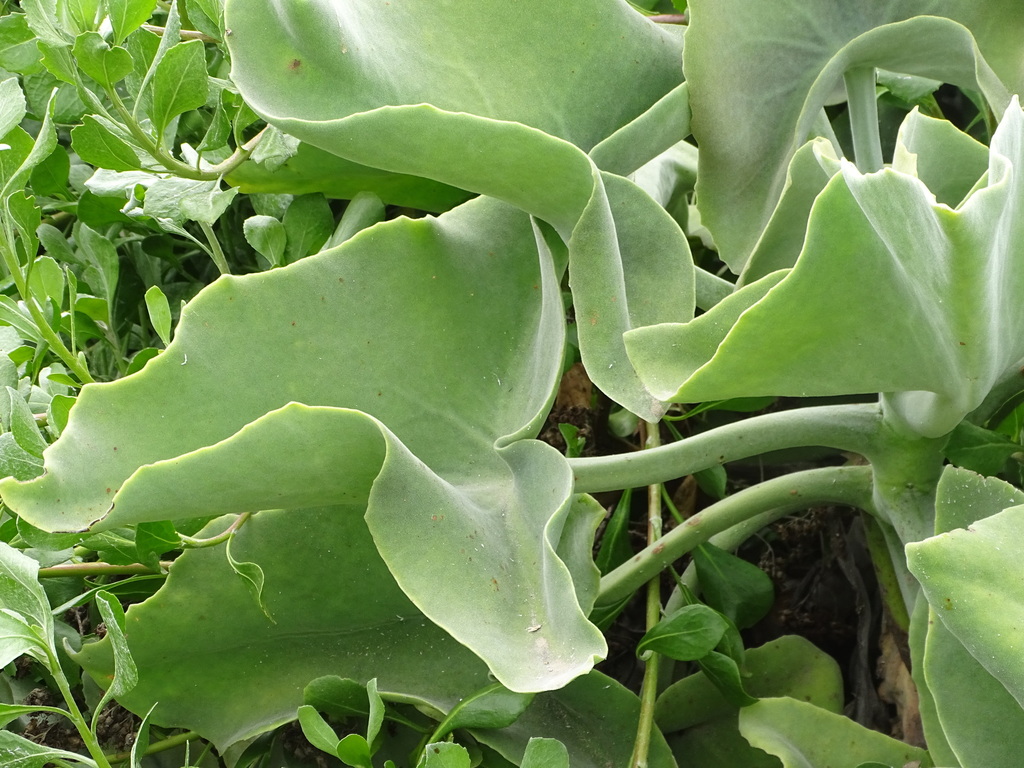
Velvet-leaf
Kalanchoe beharensis
Kalanchoe beharensis (commonly known as elephant's ear kalanchoe, felt bush, or feltbush) is a plant species in the succulent genus Kalanchoe, and the family Crassulaceae. Kalanchoe beharensis is native to Madagascar known by local names mongy, rongy and tavitavy.
From the article Kalanchoe beharensis on Wikipedia (CC BY-SA), quoted section by section
Description
Kalanchoe beharensis is an evergreen shrub, 3–5 ft (1–2 m) tall. The stem is about 1.5 m (4.9 ft) long, slender and knotted. Leaves are olive green, triangular-lanceolate shaped, decussately arranged (pairs at right-angles to each other) with leaf margins that are doubly crenate (crinkled). Each leaf is about 10 cm (4 in) long and 5–10 cm (2–4 in) wide. The bottoms of the leaves are glabrous (smooth and glossy), and covered with a woolly hair towards the apex. The leaf hairs are brown, and the tips of the teeth are darker. The hairs on the stem, younger leaves, and petioles (leaf stalks) are white. A sign of older leaves is concavity on the upper surface. The types of trichome present on the leaves of Kalanchoe vary among the different species. The different types of trichomes are an indicator of adaptation to a particular environment. On the leaf blade of K. beharensis there are trichomes of the non-glandular, bushy three-branched type. This type of trichome is dead, with evidence of tannin. K. beharensis trichomes are also characterized by striped cuticular ornamentation on their surface. Glandular trichomes are also present on the leaves, with more on petioles than on leaf blades, and more on the top of the leaf as opposed to the bottom.
Inflorescences. Inflorescences are 50–60 cm (20–24 in) high, forming a branched corymb. Flowers are on short pedicels (stalks). …
What it does
The genus Kalanchoe may reproduce asexually by producing plantlets on leaf margins, which when distributed on a suitable substrate will form new plants. Plantlet-forming species fall under two categories. The first category is induced plantlet-forming species that produce plantlets under stress. The second plantlet-forming species is constitutive plantlet-forming species that spontaneously forms plantlets. Induced plantlet-forming species have the LEC1 gene that allows them to produce seeds, whereas the constitutive plantlet-forming species have a defective LEC1 gene and cannot produce seeds. K. beharensis produces seeds as well as plantlets.
Wikipedia: “Reproduction”
How it is grown
It may be grown as a houseplant in a bright, sunny windows with sufficient aeration to prevent the proliferation of insect pests. They may live outdoors in mostly frost-free landscapes. It is naturally toxic to humans and cats, and may irritate and itch expose skin; the species is (reportedly) not toxic to dogs, provided the plant has not been treated with any chemicals (according to the National Animal Poison Information network). This plant needs full to partial sun, with intermediate to warm temperatures above 5 °C (41 °F). It will survive random bouts of frost on a scale from light to moderate, preferring to avoid it altogether. For growth in a greenhouse, K. beharensis will grow in a mixture of equal parts loam and sand, and one part extra perlite, pumice or other inert material for aeration and drainage. The plant should be dry before watering again, as too much water will kill it. Watering should occur every 10–14 days during the growing season. In the winter months it should be watered sparingly, possibly only once every thirty days. The species is highly resilient and will survive times of neglect if generally protected from harsh sun for prolonged periods. Propagation is by seed, though most frequently and effectively is achieved via cuttings. …
Wikipedia: “Cultivation”
Where it lives
Recorded sightings
—
geo-referenced records in GBIF, from museums, herbaria and field observers.
Drag the globe to turn it. Dots are where records exist, not a range map; darker means more records.
In the stacks
Searching the stacks…
Every page naming Kalanchoe beharensis in the Biodiversity Heritage Library →
This page is assembled live from iNaturalist, GBIF, Wikipedia, the Source Library and the Internet Archive. It is not yet part of the hand-edited codex. iNaturalist taxon 320048.