- Plants
- ›Vascular Plants
- ›flowering plants
- ›Dicots
- ›Mustards, Capers, and Allies
- ›mustard family
- ›Brassicoideae
- ›Camelinodae
- ›Cardamineae
- ›Cardamine
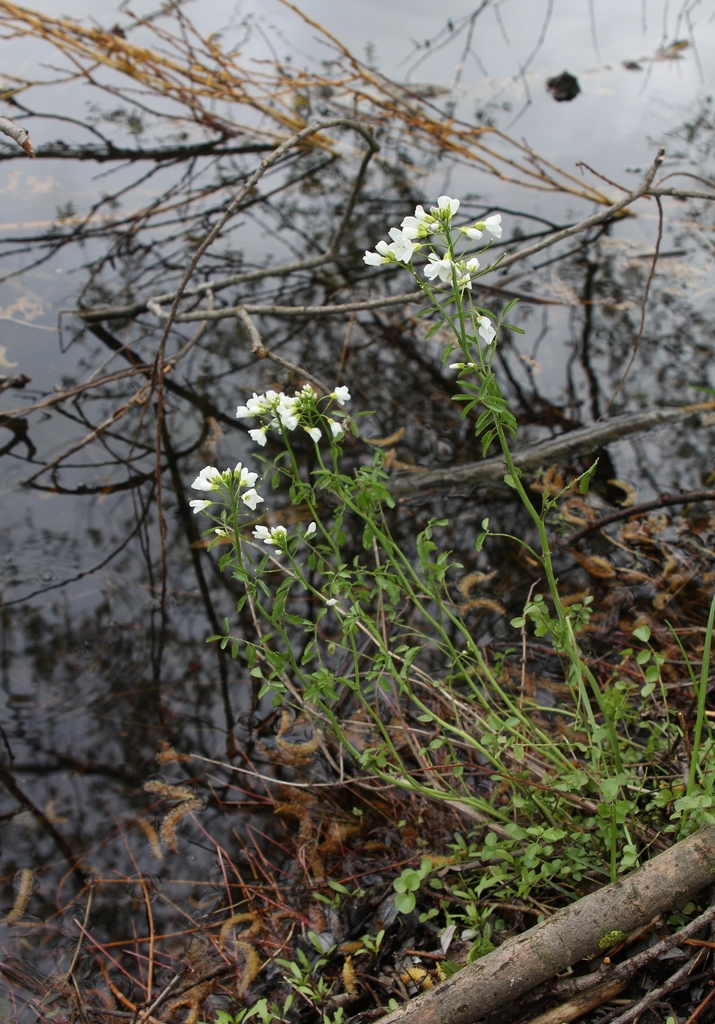
white cuckoo bitter-cress
Cardamine dentata
Cardamine pratensis, the cuckoo flower, lady's smock, mayflower, or milkmaids, is a flowering plant in the family Brassicaceae. It is a perennial herb native throughout most of Europe and western Asia. The specific name pratensis is Latin for "from/of the meadow".
From the article Cardamine pratensis on Wikipedia (CC BY-SA), quoted section by section
Description
Cardamine pratensis is a herbaceous, hairless, perennial plant growing to 60 centimetres (24 in) tall, with pinnate leaves 5–12 cm (2–4+3⁄4 in) long with 3–15 leaflets, each leaflet about 1 cm long. The flowers are produced on a spike 10–30 cm (4–12 in) long, each flower 1–2 cm in diameter with four very pale violet-pink (rarely white) petals. and 6 stamens. The fruit is a seed pod up to 5 cm (2 in). It grows best close to water.
Range & habitat
The species is widespread in Europe and commonly found throughout the British Isles. Recorded in Ireland from all 40 of the "vice-counties" (a system adopted by Robert Lloyd Praeger in 1901).
Wikipedia: “Distribution”
How it is grown
It is grown as an ornamental plant in gardens, and has become naturalised in North America as a result of cultivation. In some European countries, including parts of Germany, the plant is now under threat. It is a food plant for Anthocharis cardamines (the orange-tip butterfly).
Wikipedia: “Cultivation”
In human culture
The specific name pratensis is Latin for "from/of the meadow". Its common name cuckoo flower derives from the formation of the plant's flowers at around the same time as the arrival each spring of the first cuckoos in the British Isles. An alternative 16th century dated tale refers to 'cuckoo spit', which the plant is sometimes covered in, due to a bug called the froghopper and not the cuckoo.
Wikipedia: “Etymology”
Where it lives
Recorded sightings
—
geo-referenced records in GBIF, from museums, herbaria and field observers.
Drag the globe to turn it. Dots are where records exist, not a range map; darker means more records.
In the stacks
Searching the stacks…
Every page naming Cardamine dentata in the Biodiversity Heritage Library →
This page is assembled live from iNaturalist, GBIF, Wikipedia, the Source Library and the Internet Archive. It is not yet part of the hand-edited codex. iNaturalist taxon 318463.