- Plants
- ›Vascular Plants
- ›flowering plants
- ›Dicots
- ›nightshades, bindweeds, gooseweeds, and allies
- ›nightshade family
- ›nightshades and allies
- ›nightshades and jaltomatas
- ›Solanum
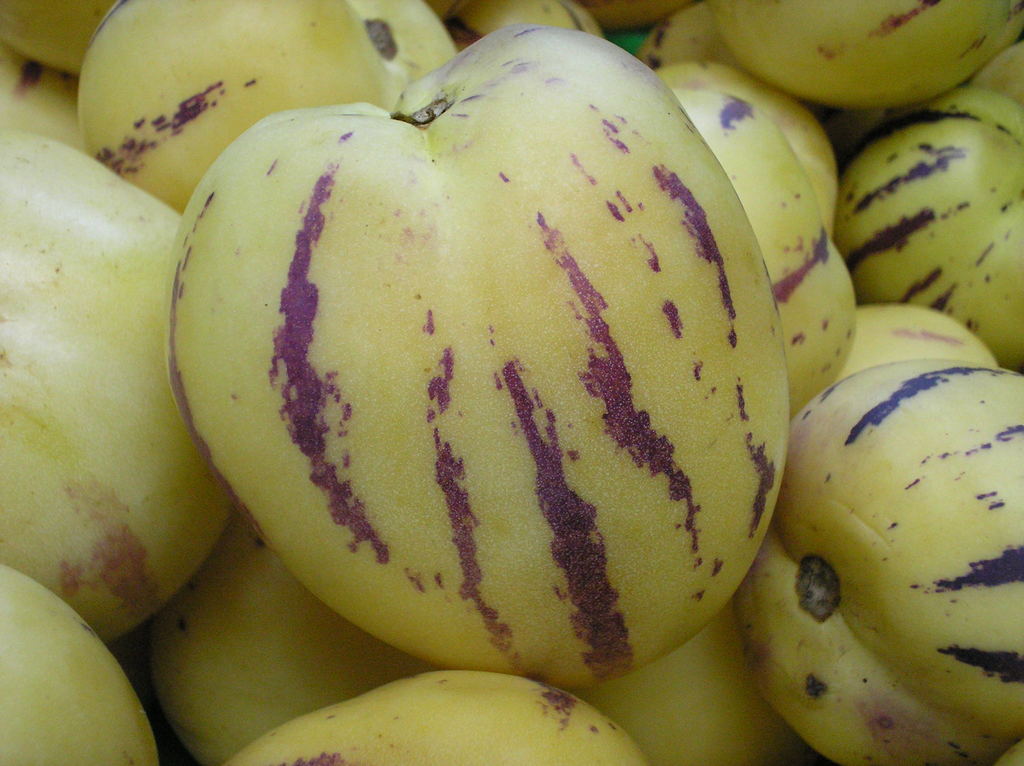
pepino
Solanum muricatum
Solanum muricatum is a South American species of evergreen shrub grown for its sweet edible fruit.
It is known by the Spanish common names of pepino or pepino dulce ('sweet cucumber', differentiating it from cucumber, which is also called pepino). It is also sometimes called pepino melon or melon pear due to its flavor. Another common name, tree melon, is more often used for the papaya.
From the article Solanum muricatum on Wikipedia (CC BY-SA), quoted section by section
Description
The fruit resembles a melon (Cucumis melo) in color, and its flavor recalls a succulent mixture of honeydew and cucumber. The species is a close relative of other nightshades cultivated for their fruit, including the tomato (S. lycopersicum) and the eggplant/aubergine (S. melongena), which its own fruit closely resembles.
Range & habitat
The pepino dulce is presumed to be native to the temperate Andean regions of Colombia, Peru, and Chile, though it is not known in the wild and the details of its domestication are unknown.
Wikipedia: “Distribution and habitat”
At the table
Delicate and mild-flavored, pepinos are often eaten as a fresh snack fruit. They combine very well with a number of other fruits as well.
Wikipedia: “Uses”
How it is grown
Pepinos were described by early Spanish colonizers as being cultivated on the coast; the Moche Valley in Peru was particularly famous for them. They are not, however, often found archaeologically as they are soft and pulpy and not easy to preserve, while their tough seeds are small and easily lost among debris. In the United States, the fruit is known to have been grown in San Diego before 1889 and in Santa Barbara by 1897. More commercially viable cultivars were introduced from New Zealand and elsewhere towards the end of the 20th century, leading to its introduction into upscale markets in Japan, Europe and North America. The plant is relatively hardy. In its native range it grows at altitudes ranging from close to sea level up to 3,000 metres (9,800 feet). It performs best in a warm, relatively frost-free climate. The plant can survive a low temperature of −2.5 °C (27.5 °F) if the freeze is not prolonged, but it may drop many of its leaves. The species is perennial, but its sensitivity to chilling, pests, and diseases force the growers to replant the crop every year. The crop also adapts well to greenhouse cultivation, training the plants up to 2 m (6+1⁄2 ft) tall, and obtaining yields that are 2–3 times larger than those obtained outdoors. They are propagated by cuttings since they are established easily without rooting hormones. …
Wikipedia: “Cultivation”
Where it lives
Recorded sightings
—
geo-referenced records in GBIF, from museums, herbaria and field observers.
Drag the globe to turn it. Dots are where records exist, not a range map; darker means more records.
In the stacks
Searching the stacks…
Every page naming Solanum muricatum in the Biodiversity Heritage Library →
This page is assembled live from iNaturalist, GBIF, Wikipedia, the Source Library and the Internet Archive. It is not yet part of the hand-edited codex. iNaturalist taxon 290744.