- Plants
- ›Vascular Plants
- ›flowering plants
- ›Dicots
- ›Mints, Plantains, Olives, and Allies
- ›bignonia family
- ›Jacarandeae
- ›Jacaranda
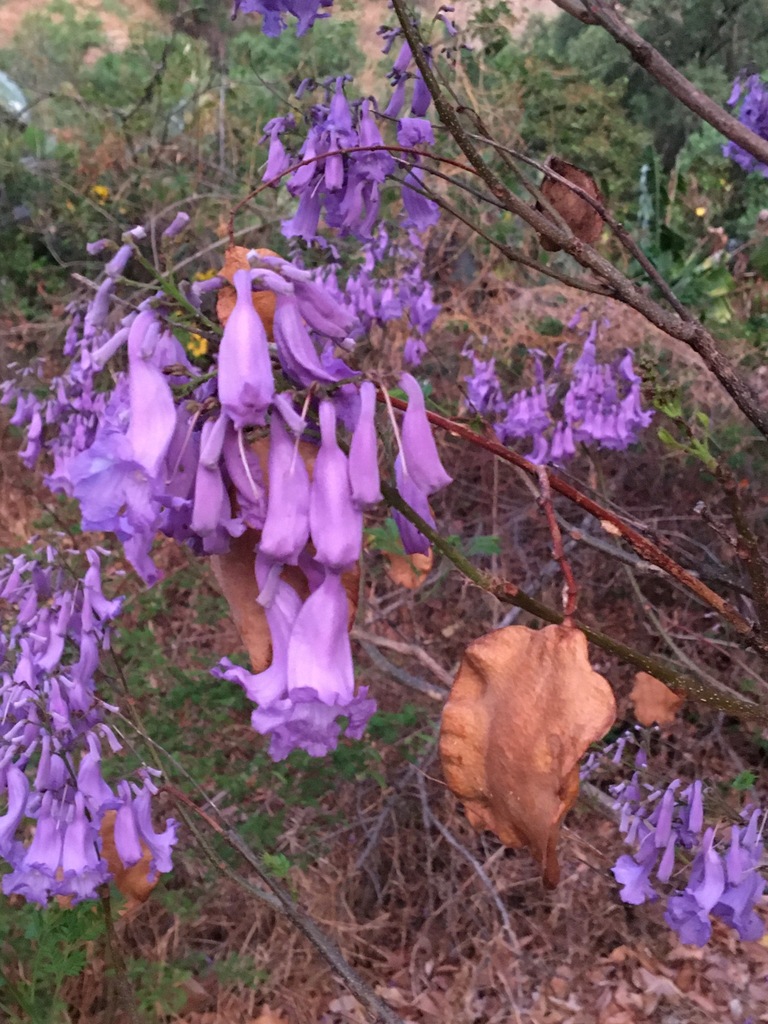
Jacaranda acutifolia
Jacaranda mimosifolia is a sub-tropical tree native to south-central South America that has been widely planted elsewhere because of its attractive and long-lasting violet-colored flowers. It is also known as the jacaranda, blue jacaranda, Nupur or black poui. Older sources call it J. acutifolia, but modern authorities usually classify it as J. mimosifolia. In scientific usage, the name "jacaranda" refers to the genus Jacaranda, which has many other members, but in horticultural and everyday usage, it nearly always means the blue jacaranda.
In its native range in the wild, J. mimosifolia is listed as Vulnerable by the IUCN.
From the article Jacaranda mimosifolia on Wikipedia (CC BY-SA), quoted section by section
Description
The tree grows to a height of up to 20 m (66 ft). Its bark is thin and grey-brown, smooth when the tree is young but eventually becoming finely scaly. The twigs are slender and slightly zigzag; they are a light reddish-brown. The flowers are up to 5 cm (2 in) long, and are grouped in 30 cm (12 in) panicles. They appear in spring and early summer, and last for up to two months. They are followed by woody seed pods, about 5 cm (2 in) in diameter, which contain numerous flat, winged seeds. The blue jacaranda is cultivated for the sake of its large compound leaves, even in areas where it rarely blooms. The leaves are up to 45 cm (18 in) long and bi-pinnately compound, with leaflets little more than 1 cm (0.4 in) long. There is a white form available from nurseries.
The unusually shaped, tough pods, which are 5 to 8 cm (2 to 3 in) across, are often gathered, cleaned, and used to decorate Christmas trees and dried arrangements.
Range & habitat
Jacaranda mimosifolia is native to southern Brazil, Uruguay, Paraguay, northern Argentina (Salta, Jujuy, Catamarca, and Misiones provinces), and southern Bolivia. It is found in the Dry Chaco and flooded savannas, and in the Southern Andean Yungas of the eastern Andean piedmont and inter-Andean valleys, up to 2600 meters elevation. In its native range, the tree is threatened by uncontrolled logging and clearing of land for agriculture, and is assessed as Vulnerable in the IUCN Red List. The jacaranda is regarded as an invasive species in parts of South Africa, Namibia, and Queensland, Australia, where it can out-compete native species.
Wikipedia: “Habitat and range”
How it is grown
Jacaranda trees were introduced to South Africa by Baron von Ludwig during the start of the botanical garden in Cape Town around 1829. Pretoria, the administrative capital of South Africa, is popularly known as Jacaranda City because of the large number of trees; It is estimated that Pretoria and surroundings are home to more than 65,000 of them. Jacaranda trees turn the city blue and purple when they flower in spring. The jacaranda trees, far from their native South Central South America (southern Brazil, Paraguay, northern Argentina, and southern Bolivia), bloom every October. Water scarcity has South Africa trying to eradicate foreign species of plants and trees, including the jacaranda. Acknowledging the tree's popularity with locals, the government announced in the early 2000s that it would not remove the trees, but banned the planting of new ones. By 2016, this decision was reversed, and jacarandas were again allowed to be planted in urban environments in some provinces.
The first jacaranda bloomed in Sydney, Australia, in about 1850. An 1865 report mentioned that Sydneysiders were visiting the Botanic Garden to see the tree's "luxuriant blossom". This tree was over 175 years old as of 2023, and protected by ropes to prevent it from falling apart. In the early 20th Century, Margaret Fell, wife of John Fell, was significant in boosting the popularity of jacarandas. …
Wikipedia: “Cultivation”
In human culture
Jacaranda FM, a South African radio station in Midrand, is named after the Jacaranda tree. The Australian Christmas song "Christmas Where the Gum Trees Grow" refers to jacaranda trees, as the blooms are only seen in summer time—as the song explains, "When the bloom of the jacaranda tree is here, Christmas time is near". The movie musical Encanto, set in Colombia, references the plant in the song "What Else Can I Do". Isabela Madrigal explores her plant-summoning powers, she creates, and mentions by line, "a hurricane of jacarandas". References to the jacaranda plant recur in the musical work of Trevor Rabin, providing the title of his 2012 solo album and also appearing in the lyrics of "I'm Running", a song which he co-wrote and performed as part of Yes and which appeared on their 1987 album Big Generator. The plant has also lent its name to his home studio, The Jacaranda Room. In Argentina, María Elena Walsh dedicated her song "Canción del Jacarandá" to the tree. Writer Alejandro Dolina, in his book Crónicas del Ángel Gris (Chronicles of the Gray Angel), tells the legend of a massive jacarandá tree, planted in Plaza Flores in Buenos Aires, that was able to whistle tango songs on demand. …
Wikipedia: “In popular culture”
Where it lives
Recorded sightings
—
geo-referenced records in GBIF, from museums, herbaria and field observers.
Drag the globe to turn it. Dots are where records exist, not a range map; darker means more records.
In the stacks
Searching the stacks…
Every page naming Jacaranda acutifolia in the Biodiversity Heritage Library →
This page is assembled live from iNaturalist, GBIF, Wikipedia, the Source Library and the Internet Archive. It is not yet part of the hand-edited codex. iNaturalist taxon 287634.