- Plants
- ›Vascular Plants
- ›flowering plants
- ›Dicots
- ›Soapberries, Cashews, Mahoganies, and Allies
- ›Cashew Family
- ›cashews, sumacs, and allies
- ›Pseudosmodingium
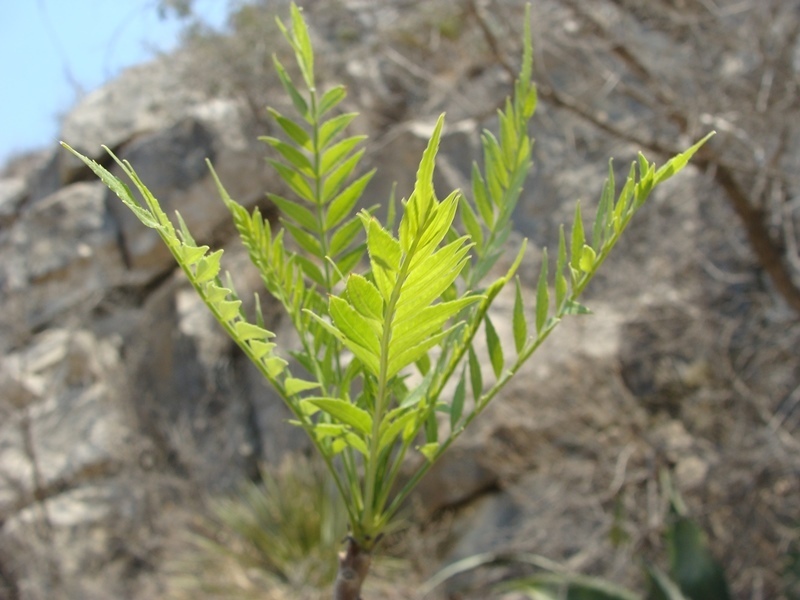
Pseudosmodingium andrieuxii
Pseudosmodingium andrieuxii is a flowering plant belonging to the Cashew or Sumac Family, the Anacardiaceae.
From the article Pseudosmodingium andrieuxii on Wikipedia (CC BY-SA), quoted section by section
Description
Pseudosmodingium andrieuxii, with no English name, is a bush or small tree up to 6m tall (~20 feet). It is hairless, or essentially so. Within the family Anacardiaceae and in common with other surviving species of Pseudosmodingium, P. andrieuxii is characterized by this combination of features:
Leaves are divided into leaflets, with the rachis tipped with a leaflet (imparipinate) Flowers are arranged in panicles. Plants bear either all male or all female flowers, thus the plants are dioecious, or else they produce mostly flowers of only one sex along with a few flowers of the other sex, and possibly with some flowers developing both male and female parts, in which case the plants are said to be "polygamodioecious". Fruits are drupe-type and develop two papery wings. Within the genus Pseudosmodingium, P. andrieuxii is distinguished by these features:
Leaves are divided into 13 or more leaflets. Panicles are only up to about 10cm long (~4 inches) Flowers are yellow at the bases of their corollas. Drupes are pale. Other noteworthy general features include that each flower, with petals up 3 mm (0.12 in) long, stands atop a slender petiole up to 7 mm (0.28 in) long. The drupes are a little flattened but almost orbicular, usually straw-colored, hairless, shiny, and up to 8 mm (0.31 in) long and about 10 mm (0.39 in) wide. …
Range & habitat
On the iNaturalist page for Pseudosmodingium andrieuxii, the map showing locations of observations of the species by citizen scientists documents that it is endemic just to Mexico's central and southern regions.
Wikipedia: “Distribution”
In human culture
The genus name Pseudosmodingium, beginning with the Late Latin prefix pseudo-, meaning "false", indicates that the taxon is a "false Smodingium," which is an African shrub or small tree bearing leaves a little like our taxon, and produces sap which is toxic to the skin; sometimes it is called African Poison Ivy. The name Smodingium is said to derive from the Greek, meaning "an indurated mark", referring to the hard fruit. In the original 1874 description of Pseudosmodingium andrieuxii, treated there as Smodingium andrieuxii, it appears that the species name andrieuxii was chosen to honor a plant collector, a certain Andrieux, who during a visit to Mexico in 1834 collected the plant that became the type specimen. The author, Henri Ernest Baillon, wrote in Latin: "Species in herbarüs valde manca, in ditione mexicana, ano 1834, ab Andrieus (exs., n.184) lecta fuit (Herb. Mus. par.)." It is known that a G. Andrieux, who sent his collected specimens to de Candolle, Delessert and others, was active in southern Mexico in 1834.
Wikipedia: “Etymology”
Where it lives
Recorded sightings
—
geo-referenced records in GBIF, from museums, herbaria and field observers.
Drag the globe to turn it. Dots are where records exist, not a range map; darker means more records.
In the stacks
Searching the stacks…
Every page naming Pseudosmodingium andrieuxii in the Biodiversity Heritage Library →
This page is assembled live from iNaturalist, GBIF, Wikipedia, the Source Library and the Internet Archive. It is not yet part of the hand-edited codex. iNaturalist taxon 287428.