- Plants
- ›Vascular Plants
- ›flowering plants
- ›Dicots
- ›sandalwoods, mistletoes, and allies
- ›showy mistletoes
- ›Psittacantheae
- ›Psittacanthinae
- ›Psittacanthus
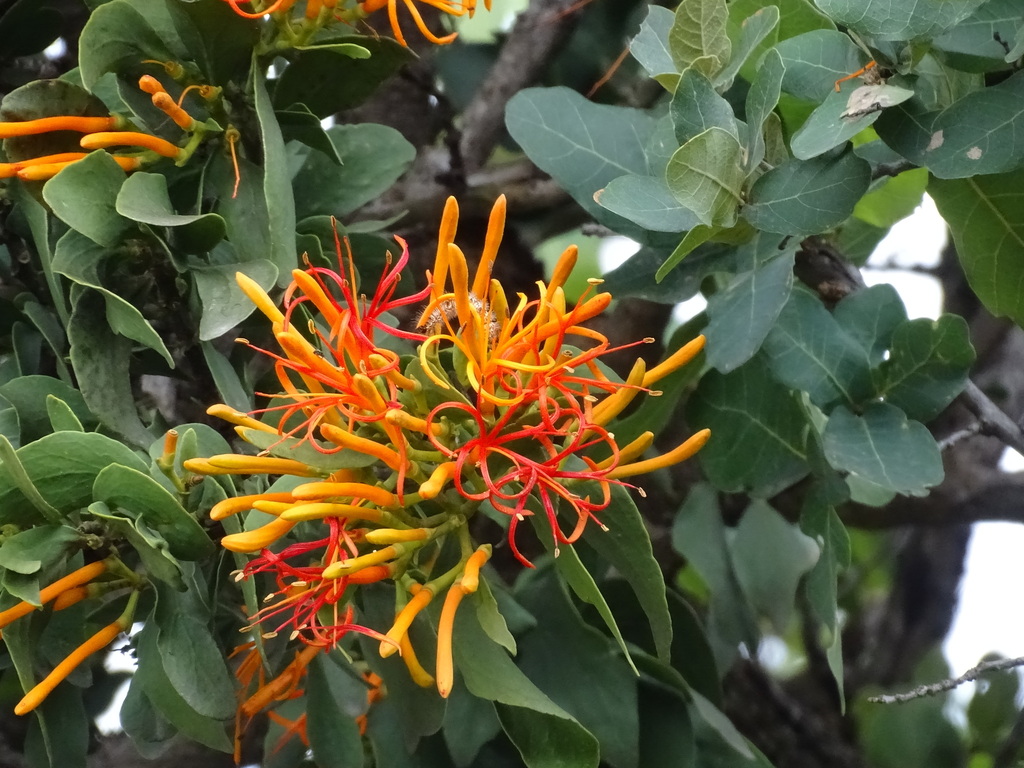
Psittacanthus schiedeanus
Psittacanthus schiedeanus (Schltdl. & Cham.) G.Don is a species of neotropical mistletoe in the Loranthaceae family, which is native to Panamá, Costa Rica, Honduras and Mexico.
From the article Psittacanthus schiedeanus on Wikipedia (CC BY-SA), quoted section by section
Description
Psittacanthus schiedeanus is a hemiparasite growing to 1–2 metres (3–7 ft) with quadrangular stems which are flattened at the nodes. The haustorium is large. The bluish-green leaves are asymmetric and about 20 centimetres (8 in) long and 8 centimetres (3 in) wide, with stout petioles and pinnate venation. The inflorescence is terminal. The fruit is a berry. Its most remarkable feature is its seeds, which have up to twelve cotyledons (the most of any dicot, almost all of which have two; the source of the class name).
What it does
Birds are important in the plant's life-cycle. They pollinate it while feeding on the nectar, and when they feed on the fruit they disperse the seeds.
Wikipedia: “Ecology”
In human culture
Psittacanthus comes from the Greek psittakos (parrot), and the Greek anthos (flower), possibly chosen, according to Don, because of the bright colours. The epithet schiedeanus honours the collector Christian Julius Wilhelm Schiede, botanist and plant collector in Mexico.
Wikipedia: “Etymology”
Where it lives
Recorded sightings
—
geo-referenced records in GBIF, from museums, herbaria and field observers.
Drag the globe to turn it. Dots are where records exist, not a range map; darker means more records.
In the stacks
Searching the stacks…
Every page naming Psittacanthus schiedeanus in the Biodiversity Heritage Library →
This page is assembled live from iNaturalist, GBIF, Wikipedia, the Source Library and the Internet Archive. It is not yet part of the hand-edited codex. iNaturalist taxon 287045.