- Plants
- ›Vascular Plants
- ›flowering plants
- ›Dicots
- ›Soapberries, Cashews, Mahoganies, and Allies
- ›Quassia Family
- ›Quassia
Quassia
Quassia amara
Quassia amara, also known as amargo, bitter-ash, bitterwood, or hombre grande (spanish for "big man") is a species in the genus Quassia, with some botanists treating it as the sole species in the genus. The genus was named by Carl Linnaeus who named it after the first botanist to describe it: the Surinamese freedman Graman Quassi.
Q. amara is used as insecticide, in traditional medicine and as additive in the food industry.
From the article Quassia amara on Wikipedia (CC BY-SA), quoted section by section
Description
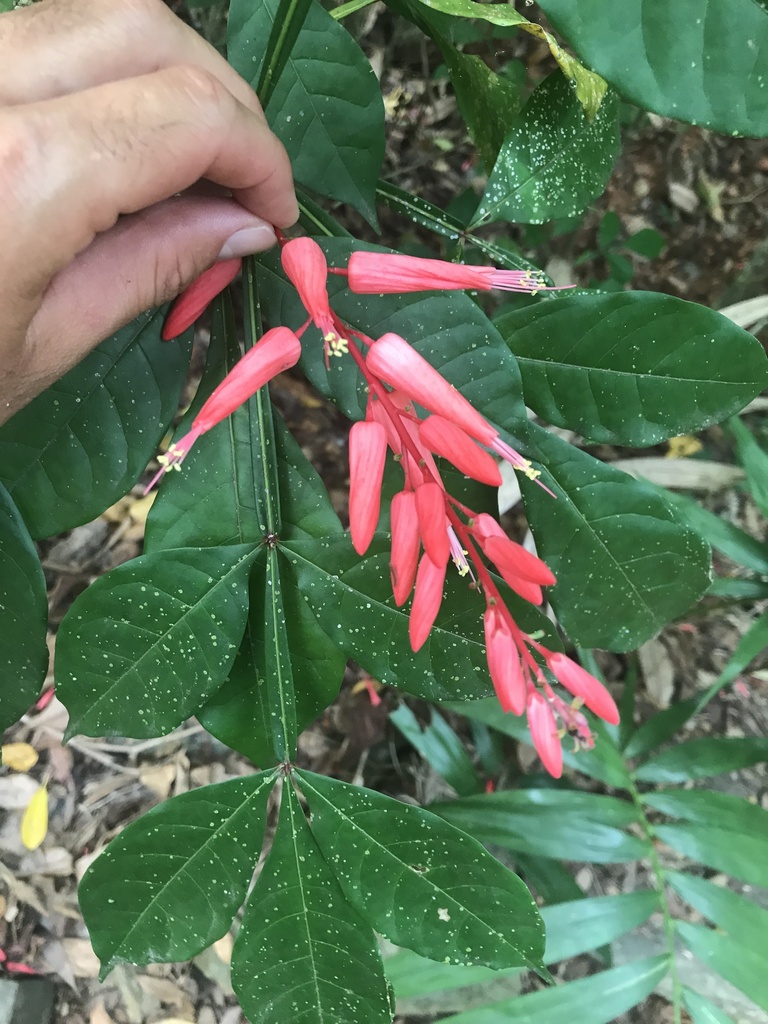
A small, multi-stemmed and slow growing tree with a disorderly growth twiggy limbs. It is a shrub or rarely a small tree, reaching a height up to 6 metres. The pinnate with 3-5 leaflets, deeply veined, polished alternated dark green leaves are 15–25 cm long and distinctive for their broadly winged axis and reddish veins. Leaf rachis are winged. Terminal red-branched racemes of panicles, 10–30 cm long, produces narrow, vivid crimson flowers, 2.5-3.5 cm long, that decorate the tips of each little limb. The flower comprises 5 lanceolate petals, which remain mostly closed together forming a sharpening cylinder. The flowers are produced in a panicle 15–25 cm long, each flower 2.5-3.5 cm long, bright red on the outside, and white inside. They are generally open for two days during the flowering period and each inflorescence presents on to four open flowers at once. The flowers are fragile and sometimes fall from the rachis at the slightest touch. The fruits, five small elliptic, fleshy, purple black drupes, 0.8-1.5 cm long, replace the flower and turn red as they mature. Every fruit contains one small seedling. All parts of Q. amara contain the bitter Quassimarin (plant compound).
The tree is predominately pollinated by hummingbirds but also self-compatible. Besides hummingbirds, other birds and Trigona species from the Apidea family do pollination.
Range & habitat
Quassia amara is an understorey plant in neotropic rainforests and humid sites and mostly abundant in young forests. Therefore Q. amara is native in the tropics of Southern America. More exactly in the Caribbean (Trinidad and Tobago), Central America (Costa Rica, Nicaragua, Panama), Northern South America (French Guiana, Guyana, Suriname, Venezuela, Brazil, Peru) and in Western South America (Colombia, Argentina). It is found in the Amazon Rainforest at altitudes ranging from sea level up to 900 m (3,000 ft). Q. amara is traditionally harvested in natural forests. There are reports of cultivation in other countries of Central and South America. It inhabits zones of high precipitation (1500–4500 mm per year), and may appear in dry lands or in riparian lands where there is a high humidity permanent. Q. amara is widely planted outside its native range.
Wikipedia: “Distribution”
What it does
In Costa Rica the flowering period of Q.amara arises between October and April, whereas in central Panama the flowering period occurs from October to January. The fruits ripen after two months. In February and early March, there is a peak of fruit ripening. The drupes show different colors during the ripening process. They turn from reddish to green until the reach a black color. The best germination results were obtained with seeds from drupes that are just before becoming totally black. Not only the color but also the size of the fruits are indicators for the viability of a seed. Fruits with a size between 1 and 1.5 cm are suitable for reproduction and they can be easily detached from the receptacle. The treelet can be propagated sexual by seeds or asexual by vegetative cuttings of half-ripe wood. The trees can be cultivated in tree nurseries. Therefore seeds can be sowed of substrat such as sawdust, sand or soil. The seedlings are grown up for eight months until they reach a height around 40 cm. The germination occurs within 10 weeks. During the germination period daily watering is important. A distance of 10 x 15 cm at a density of 35 plants per m is recommended in tree nurseries.
Wikipedia: “Reproduction”
At the table
The bitter principle found in the bark and wood is used as the basis of Angostura Bitters, which is used as a flavouring in longdrinks, soft drinks, digestive tonics and also in gin-based drinks. It can be used as a substitute for hops in beer manufacturing or can be added to baked goods.
Wikipedia: “Additive in food industry”
In medicine
Traditionally, Q. amara is used as a digestive, to treat fever, and against hair parasites (lice, fleas) and mosquito larvae in ponds (which has not proven harmful to fish populations). The component Simalikalactone D was identified as an antimalarial. The preparation of a tea out of young leaves is used traditionally in French Guiana. Experiments showed a high inhibition of Plasmodium yoelii yoelii and Plasmodium falciparum. A 2012 study found a topical gel with 4% Quassia extract to be a safe and effective treatment for rosacea. Quassia amara is part of the family of the Simaroubaceae, which contains quassinoids. Those are secondary metabolites that have a large range of biological activities. The plant is known for the active principles that can be found in its bark. They have several different effects like increasing appetite, tonic, diuretic, febrifugal, anthelmintic and anti-leukemic. It also leads to more activity from the gall bladder and has an effect against liver congestion. At external use, they act efficacy against parasites like pinworms. It is also a tribal remedy used in South America against debility, liver problems, malaria, snakebite, and back spasms. The Quassia amara is sold in the form of ground-up chips that are used to produce tonic or tinctures. Those are made by soaking the bark in the water for a long time.
Diabetes. …
Wikipedia: “Medicine”
How it is grown
Q. amara is suitable for medium (loamy) and heavy (clay) soils. It prefers rich soils, that are water retentive. The tree can adapt to different pH-values in soils. It is a frost sensitive plant. Its salt toleration and dry toleration is low. It is classified as a semi-sciophyte with high tolerance to shade conditions but with a requirement of direct exposure to sunlight in order to complete its life cycle, in particular due to its effect on flower and fruit production. An increase in the light conditions increases flower and fruit production although it does not influence seed fertility. Therefore, its natural regeneration appears to be limited by light and interspecific competition with upperstorey forest species.
Wikipedia: “Cultivation”
Where it lives
Recorded sightings
—
geo-referenced records in GBIF, from museums, herbaria and field observers.
Drag the globe to turn it. Dots are where records exist, not a range map; darker means more records.
In the stacks
Searching the stacks…
Every page naming Quassia amara in the Biodiversity Heritage Library →
This page is assembled live from iNaturalist, GBIF, Wikipedia, the Source Library and the Internet Archive. It is not yet part of the hand-edited codex. iNaturalist taxon 286387.