- Plants
- ›Vascular Plants
- ›flowering plants
- ›monocots
- ›Aroids, Water Plantains, Seagrass, and allies
- ›pondweed family
- ›Potamogeton
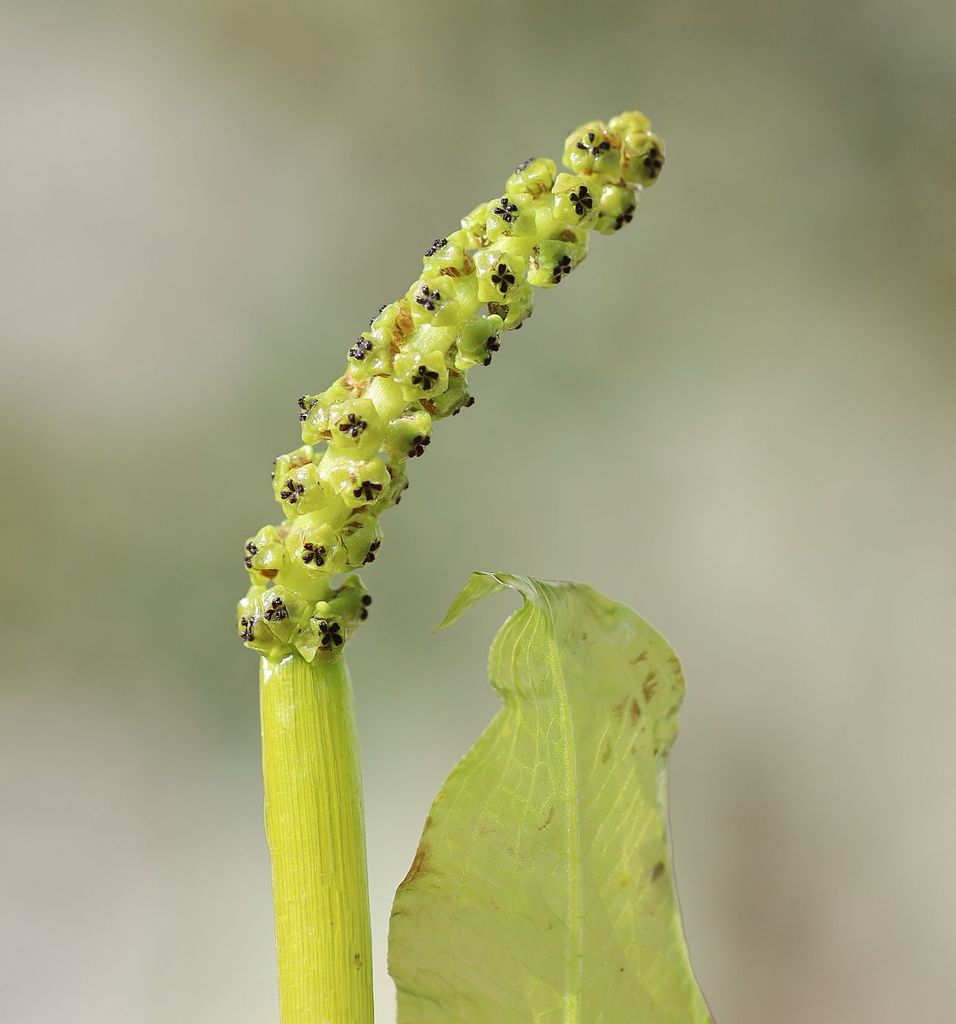
Shining Pondweed
Potamogeton lucens
Potamogeton lucens, or shining pondweed, is an aquatic perennial plant native to Eurasia and North Africa. It grows in relatively deep, still or slow-flowing, calcareous freshwater habitats.
From the article Potamogeton lucens on Wikipedia (CC BY-SA), quoted section by section
Description
Shining pondweed is a large plant with robust creeping rhizomes and long, terete, branching stems, typically up to 2.5 m but exceptionally to 6 m. The leaves are large, 75–200 mm (exceptionally more) long and 25–65 mm wide, 2–6 times as long as broad; as with the smaller P. gramineus, the leaves on the branches are smaller than those on the main stem. The leaves are pale green or yellowish, translucent, shiny with distinctive netted veining, minutely denticulate margins, and a short petiole of 1–12 mm. Floating leaves are absent. Flowers appear between June and September. The fruits are 3 mm across. Like most other broad-leaved pondweeds, Potamogeton lucens is tetraploid, with 2n=52. Over much of its range, shining pondweed is not likely to be confused with any other species. However, in southern Europe the related and quite similar P. schweinfurthii has recently been discovered. P. lucens can usually be distinguished by its relatively broader leaves, 2–6 times as long as they are broad, and most or all of which are petiolate, but some forms are very difficult to distinguish without a detailed comparison of multiple characters. However, there are hybrids with various other pondweed species including P. gramineus (P. × angustifolius J.Presl.), P. perfoliatus (P. × salicifolius Wolfg.), P. alpinus (P. × nerviger Wolfg.), P. nodosus (P. × subrufus Hagstr.) P. sarmaticus (P. …
Range & habitat
Potamogeton lucens is native to Europe (including Britain, continental Europe, Scandinavia), Asia (Afghanistan, India, Kazakhstan, Kyrgyzstan, Myanmar, Nepal, Pakistan, Philippines, Russia, Tajikistan, Turkmenistan, Uzbekistan), the Middle East and North Africa. In North America it is replaced by the rather similar P. illinoensis.
Wikipedia: “Distribution”
What it does
Potamogeton lucens is strictly a lowland plant of standing or slow-flowing calcareous water, especially favouring peatland areas with a calcareous water supply such as the Cambridgeshire Fens. Although having a preference for deep water (0.5–2.0 m), it can persist in shallow areas, and may also grow in open reedbeds, which may provide a refuge in eutrophic waters. Shining pondweed is more prevalent in older, poorly connected floodplain lakes and is a poor colonizer, slow to regenerate following floods and intolerant of drawdown. In Britain shining pondweed is mainly restricted to southern England with scattered outposts in Scotland and Wales, but is more widespread in Ireland. It is tolerant of eutrophication to some extent and in marl lakes it may replace Chara spp. as nutrient levels increase, before itself being ousted by fine-leaved pondweeds and eventually phytoplankton at higher nutrient levels. In a study of nutrient-rich river backwaters in the R. Tisza (Hungary), shining pondweed was tolerant of very high phosphate concentrations, so long as chemical oxygen demand and chlorophyll-a concentrations in the water were not too high. In the Netherlands, the invasive Elodea nuttallii may compete with it for habitat. Globally and on the majority of national Red Lists, shining pondweed is not considered threatened. P. …
Wikipedia: “Ecology and conservation”
How it is grown
Shining pondweed is rarely cultivated, even though it is both easy to grow and an attractive plant. Its distinctive, large, transparent netted leaves are unlike any other commonly cultivated pond plant. In common with other pondweeds of this group it roots poorly from stem cuttings and is best propagated by division of the rhizomes. It is easy to grow in a garden pond or even in a barrel, but unlike some other submerged plants needs to be able to root in a suitable substrate such as sand or aquatic compost. Plants being established should be weighted down initially to allow them to root. Where waterfowl grazing is likely, protection will be necessary, especially in the early summer growth period.
== References ==
Wikipedia: “Cultivation”
Where it lives
Recorded sightings
—
geo-referenced records in GBIF, from museums, herbaria and field observers.
Drag the globe to turn it. Dots are where records exist, not a range map; darker means more records.
In the stacks
Searching the stacks…
Every page naming Potamogeton lucens in the Biodiversity Heritage Library →
This page is assembled live from iNaturalist, GBIF, Wikipedia, the Source Library and the Internet Archive. It is not yet part of the hand-edited codex. iNaturalist taxon 283890.