pampano
Calathea lutea
Calathea lutea, called the bijao, cigar calathea, Cuban cigar, Mexican cigar plant, Habana cigar, and pampano, is a species of flowering plant from the genus Calathea in the family Marantaceae. It is native to Belize, Bolivia, Brazil North, Colombia, Costa Rica, Ecuador, El Salvador, French Guiana, Guatemala, Guyana, Honduras, Jamaica, Leeward Is., Mexico, Nicaragua, Panamá, Peru, Puerto Rico, Suriname, Trinidad-Tobago, Venezuela, Venezuelan Antilles and Windward Is.
From the article Calathea lutea on Wikipedia (CC BY-SA), quoted section by section
Description
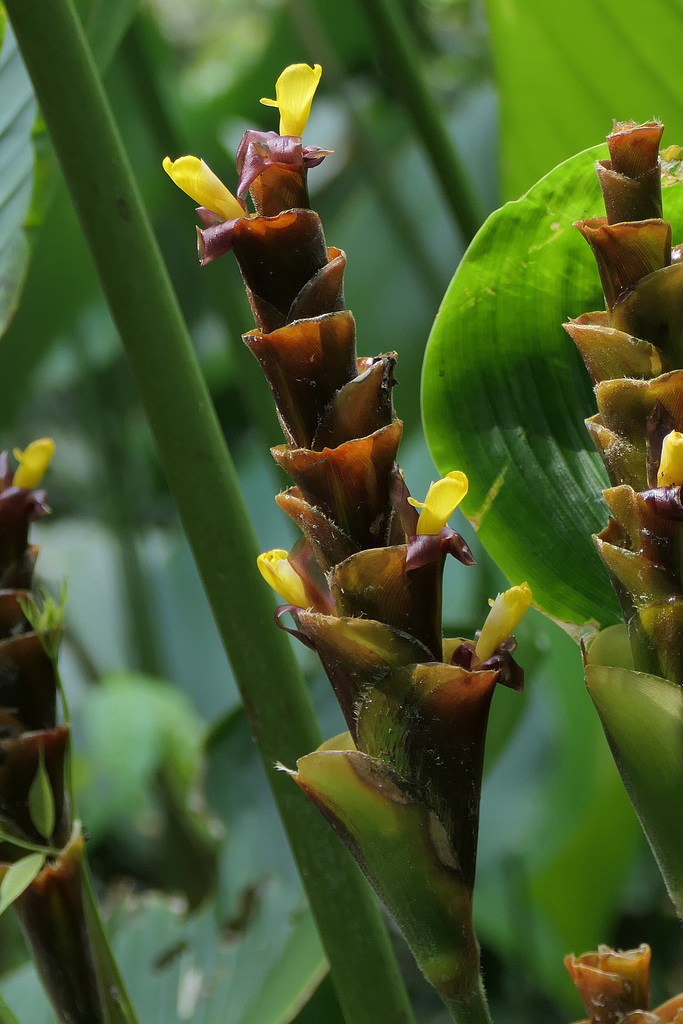
Calathea lutea is a tall plant (around 2 to 4 meters when mature) with huge, ovale, green leaves, with thick, long, yellowish green petioles and a long pulvinus. The inflorescence of this species is made of multiple distachious bracts set on a long, green peduncle. The bracts are brownish red and sometimes green with orange tips. The flowers are small with purple petals and yellow staminodes. The plant is often used as an ornemental plant.
At the table
In the Brazilian Amazon, local artisans use the flower stalks to make woven handicrafts such as sieves, baskets, and board games. The leaves of Calathea lutea are often used as a wrapping material to cook food in Amazonian countries.
== References ==
Wikipedia: “Uses”
Where it lives
Recorded sightings
—
geo-referenced records in GBIF, from museums, herbaria and field observers.
Drag the globe to turn it. Dots are where records exist, not a range map; darker means more records.
In the stacks
Searching the stacks…
Every page naming Calathea lutea in the Biodiversity Heritage Library →
This page is assembled live from iNaturalist, GBIF, Wikipedia, the Source Library and the Internet Archive. It is not yet part of the hand-edited codex. iNaturalist taxon 283380.