- Plants
- ›Vascular Plants
- ›flowering plants
- ›Dicots
- ›saxifrages, stonecrops, and allies
- ›stonecrop family
- ›Sempervivoideae
- ›Sedeae
- ›Dudleya
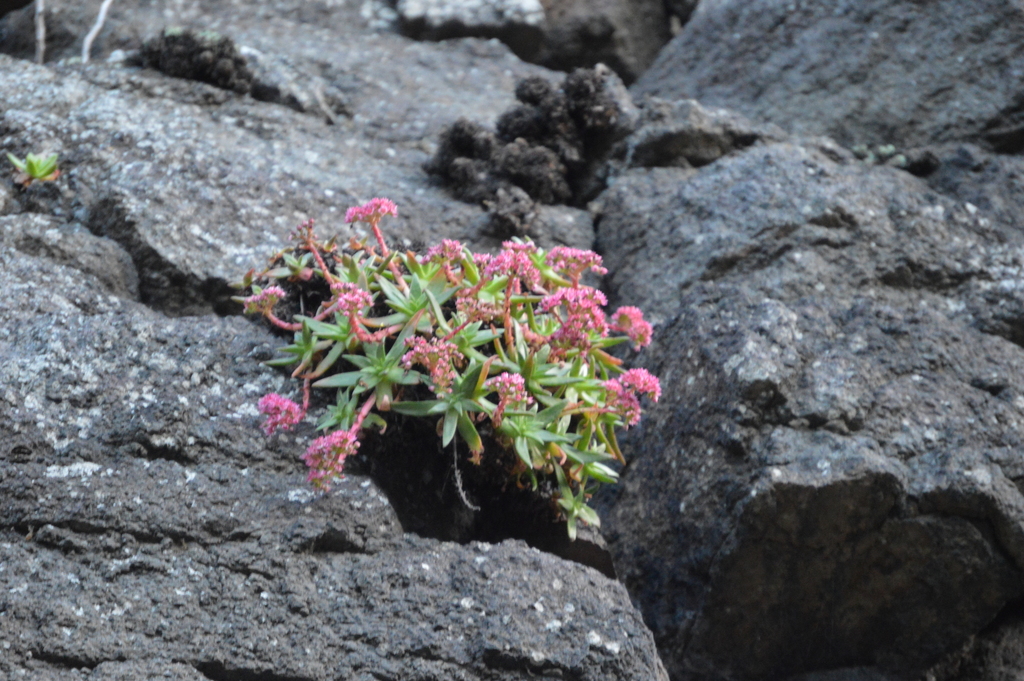
La Mision Liveforever
Dudleya formosa
Dudleya formosa, known by the common name La Misión liveforever, is a species of perennial succulent plant endemic to the Guadalupe Valley in Baja California. It is characterized by bright green leaves, red floral stems, and pink flowers.
From the article Dudleya formosa on Wikipedia (CC BY-SA), quoted section by section
Description
Dudleya formosa has a trailing caudex, 0.5 to 2.5 cm thick, becoming over 5 decimeters (dm) long, branching to form a loose, prostrate mound that can reach up to several hundred rosettes. Rosettes are flattish, 4 to 13 cm in diameter with around 10 to 20 leaves. Leaves are oblong to oblong-obovate, acute to obtuse with a sharp tip 0.5 mm long. Foliage is a bright green, and like other Dudleya the leaves are tinged with a red hue at the tips and margins. Leaves are not glaucous. Measurements of the leaves put them at 2 to 8 cm long, 1 to 3 cm wide, and 3 to 6 mm thick. Delving further into D. formosa's leaf morphology, leaves are convex below (ventrally), and flat above (dorsally). Leaf margins are subacute. The base is 10 to 20 mm wide, and 1 to 4 mm high, but rarely, on rapidly growing stems, it is decurrent and up to 10 mm high. The peduncle is red, 4 to 15 cm high, and 3 to 6 mm thick, with foliage covering 2 to 5 cm. of the base. There are 10 to 17 bracts, which are close-set, horizontal, ovate to triangular lanceolate, cordate, and acute, with the lowermost being 8 to 21 mm long, and 4 to 12 mm wide. The inflorescence has a more pink hue, and is rather dense, being shaped somewhat flat-topped to hemispherical. It is 2 to 6 cm in diameter, with usually 3 to 7 close set branches that rebranch once or twice. …
Wikipedia: “Morphology”
Range & habitat
Dudleya formosa occurs in the Guadalupe Valley in far northwestern Baja California. It is particularly located around the vicinity of the town of La Misión. It occurs on north-facing cliffs on basaltic rock.
Wikipedia: “Distribution and habitat”
In human culture
Dudleya formosa was discovered in July 1945 by a Mr. Fred Wylie, who sent the specimen to the San Diego Natural History Museum. After the specimen was rediscovered by Mrs. Ethel B. Higgins, D. formosa was described by Reid Moran in the year 1950. Dr. Charles H. Uhl of Cornell University reports a haploid number of 17 chromosomes. D. formosa was initially placed under the subgenus Stylophyllum due to the spreading petals and carpels. Since recent phylogenetic analysis has disregarded the existence of the subgenus Stylophyllum, D. formosa instead finds itself placed in a proposed clade Formosa, along with D. edulis and some members of D. attenuata.
Wikipedia: “Taxonomic history and phylogeny”
Where it lives
Recorded sightings
—
geo-referenced records in GBIF, from museums, herbaria and field observers.
Drag the globe to turn it. Dots are where records exist, not a range map; darker means more records.
In the stacks
Searching the stacks…
Every page naming Dudleya formosa in the Biodiversity Heritage Library →
This page is assembled live from iNaturalist, GBIF, Wikipedia, the Source Library and the Internet Archive. It is not yet part of the hand-edited codex. iNaturalist taxon 282733.