- Plants
- ›Vascular Plants
- ›flowering plants
- ›Dicots
- ›saxifrages, stonecrops, and allies
- ›stonecrop family
- ›Sempervivoideae
- ›Sedeae
- ›Dudleya
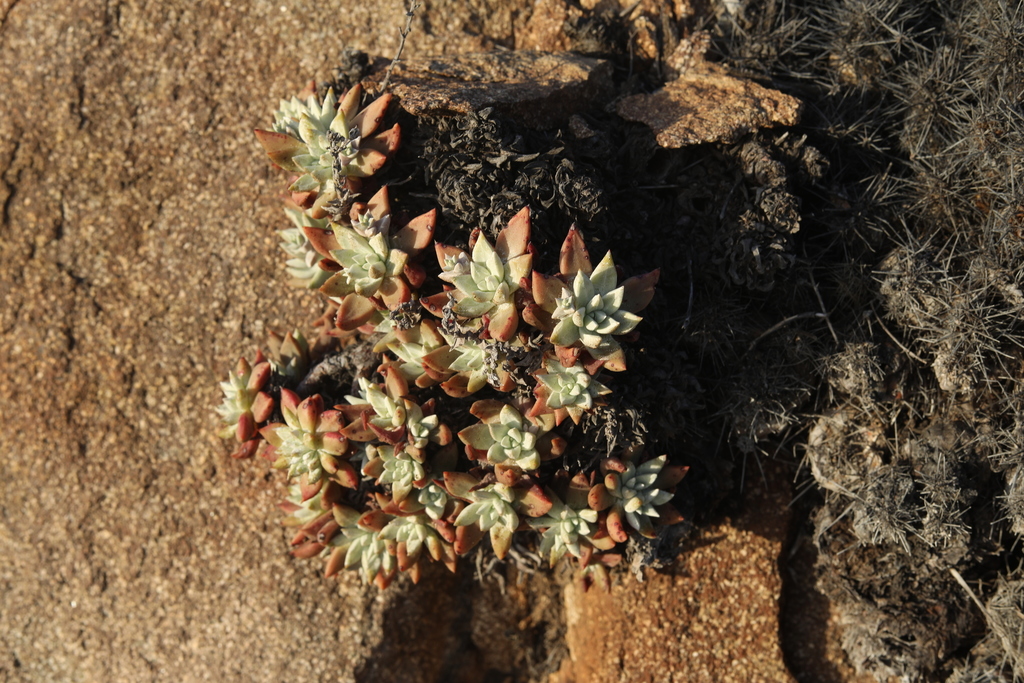
Punta Banda liveforever
Dudleya campanulata
Dudleya campanulata is a species of perennial succulent plant known by the common name as the Punta Banda liveforever, native to Baja California and endemic to the Punta Banda peninsula, a promontory south of Ensenada that encloses the southern limit of the Bahía de Todos Santos, a deepwater bay. One of many species of Dudleya native to the peninsula and surrounding islands, it is distinguished by its campanulate flowers and its occupation of a narrow habitat that consists of ocean bluffs on the southern end of the Punta Banda, near the well-known blowhole La Bufadora.
From the article Dudleya campanulata on Wikipedia (CC BY-SA), quoted section by section
Description
The caudex of Dudleya campanulata is 7 to 18 mm thick, clothed with dried foliage, and branched into mound-like clumps of up to 150 rosettes, which are each 3 to 8 cm wide. The rosettes contain 12 to 30 upcurved or erect leaves, with the young leaves being farinose, whilst older leaves are glaucous and tinged with a purple or dull green hue. Leaves are oblong-lanceolate, acute, apiculate, or semiterete, 2 to 4 cm long, 6 to 13 mm wide in the middle, flattish ventrally and rounded dorsally. Floral stems, to their terminal flower, are 8 to 25 cm tall, 3 to 6 mm thick, reddish and glaucous, and bare in the lower 2 to 5 cm of the stem. Above the bare base of the floral stem, 10 to 25 bracts grow, triangular-ovate, acute, subclasping at base and turgid. Bracts are 6 to 20 mm long, 6 to 9 mm wide, and 2 to 4 mm thick. The inflorescence is typically obpyramidal 4 to 12 cm wide, composed of 2 to 5 simple or bifurcate ascending branches, with the ultimate uniparous branches 1 to 7 cm long, with 2 to 11 buds or flowers. On the flowers, the calyx is 3 to 4 mm high, rounded below, with the segments deltoid, acute, and 1.5 to 2 mm long, 2 to 3 mm wide, and united about 0.5 mm. When in bud, the corollas are ovoid, broadly acute, in anthesis narrowly to broadly campanulate. The corolla is 8 to 10 mm long, 3.5 to 5 mm wide at the base, and 10 - 16 mm wide above. …
Range & habitat
Dudleya campanulata is endemic to the Cape Punta Banda, a promontory that shelters the southern limit of the Todos Santos Bay, a deepwater bay with the city of Ensenada along its coast. D. campanulata occupies a very local area, restricted to the igneous ocean cliffs facing the west to the Pacific Ocean and sea stacks on the southern side of the cape. Other species of Dudleya occur on the Punta Banda and the surrounding vicinity, some of which freely hybridize with each other. Dudleya anomala is one of these very niche Dudleyas occurring in the vicinity, albeit it represents a rare mainland occurrence of an insular species from Todos Santos Island.
Wikipedia: “Distribution and habitat”
Where it lives
Recorded sightings
—
geo-referenced records in GBIF, from museums, herbaria and field observers.
Drag the globe to turn it. Dots are where records exist, not a range map; darker means more records.
In the stacks
Searching the stacks…
Every page naming Dudleya campanulata in the Biodiversity Heritage Library →
This page is assembled live from iNaturalist, GBIF, Wikipedia, the Source Library and the Internet Archive. It is not yet part of the hand-edited codex. iNaturalist taxon 282730.